


Your grip strength should never be the bottleneck that dictates the size of your back. It is frustrating when your lats have several reps left in the tank, but your fingers start to slip off the bar during a heavy set of deadlifts. You want to build a powerful physique, and you've likely heard the common myth that using equipment too early makes your hands weak. However, the reality of high-volume training is that your smaller muscle groups will often fatigue before your primary movers. Knowing exactly when do you need to use weight lifting straps is the difference between a stalled plateau and consistent hypertrophy.
We believe in a grounded, results-oriented approach to training where equipment serves as a tactical tool for progress. This guide will provide a clear rule for when to transition from a raw grip to lifting straps to maximize your strength gains without compromising forearm development. You'll learn the functional differences between Lasso and Figure 8 straps; this ensures you choose the right gear for your specific goals. We'll show you how to leverage these tools to increase your volume on pull days and maintain the operational excellence your training demands.
Key Takeaways
- Identify the specific point in your set where grip fatigue hinders muscle growth and how to use straps as a tactical solution for continued progress.
- Apply the "80% Rule" to understand exactly when do you need to use weight lifting straps to maximize load without sacrificing natural grip strength.
- Improve your positioning and symmetry during heavy deadlifts and rows by removing forearm tension and focusing on primary movers.
- Compare the utility of versatile Lasso straps against heavy-duty Figure 8 Lifting Straps to select the right tool for your specific lifting discipline.
- Increase your total training volume on pull days by strategically integrating straps once your manual grip reaches its operational limit.
Understanding Weight Lifting Straps: Purpose and Mechanism
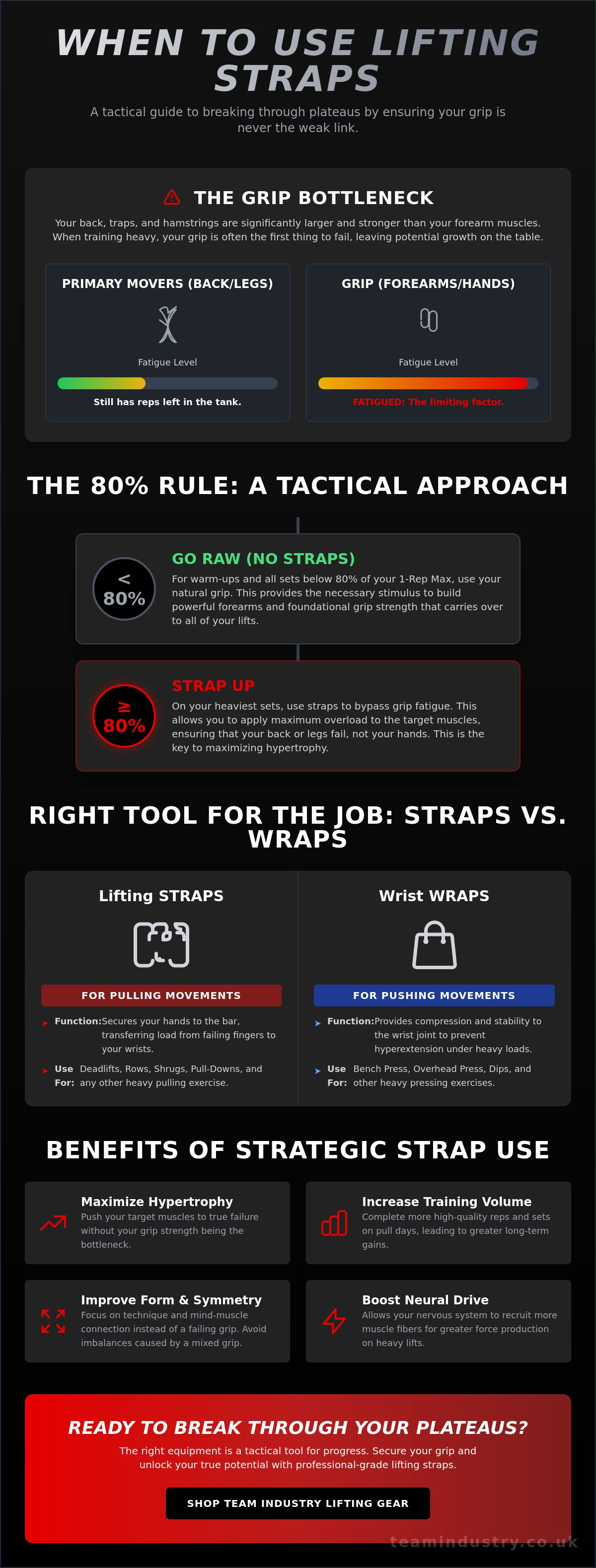
Weight lifting straps function as a mechanical bridge between your hands and the equipment. They are designed to secure your grip to a barbell, dumbbell, or pull-down attachment, ensuring the weight stays in your palm even when your fingers begin to fail. By using lifting straps, you shift the burden of the load from the small muscles in your forearms to the larger, more powerful structures of your back and legs. This is essential for maintaining high training intensity during complex pulling movements where the target muscle hasn't yet reached failure.
The physics behind this tool involves a fundamental transfer of torque. Instead of relying solely on the friction of your skin and the strength of your finger flexors, the strap wraps around the bar and anchors to your wrist. This setup transfers the weight's downward force directly to the wrist joint, which is supported by the larger radius and ulna bones. Many lifters ask, when do you need to use weight lifting straps? The answer lies in the moment your grip strength becomes the limiting factor for the muscle you are actually trying to train.
To better understand the mechanics and application of this equipment, watch this guide from Noel Deyzel:
It's vital to distinguish these from Wrist Wraps. While they look similar, they serve opposite functions. Wraps provide compression and stability for the wrist joint during pushing movements like the bench press or overhead press. Straps are purely for pulling. Using the right tool for the job ensures operational safety and prevents unnecessary strain on the joint during heavy sets.
The Anatomy of a Lifting Strap
Professional-grade equipment typically utilizes heavy-duty cotton, nylon, or leather. Cotton is popular for its comfort and sweat absorption, while Leather Weight Lifting Straps provide a more rigid, durable feel that molds to the bar over time. Most designs feature a loop or "lasso" configuration; this creates a mechanical lock that tightens as you pull. High-quality options often include neoprene padding to prevent the material from digging into your skin during maximal efforts, allowing you to focus entirely on the lift.
Grip Strength vs. Target Muscle Hypertrophy
Deciding when do you need to use weight lifting straps often comes down to a choice between training your grip or training your back. Your lats, traps, and hamstrings are significantly larger and stronger than the muscles in your forearms. If you only lift what your hands can hold, you leave potential growth on the table. Securely anchoring yourself to the bar increases your "neural drive," which is the nervous system’s ability to recruit muscle fibers. When your brain isn't worried about the bar slipping, it allows for greater force production. This makes straps indispensable for high-volume work like heavy rows or shrugs, where the goal is specific muscle fatigue rather than a test of grip endurance.
Identifying the Right Time to Strap Up
Determining exactly when do you need to use weight lifting straps requires a calculated assessment of your training objectives. If your goal is to build a massive back or powerful hamstrings, you shouldn't let your hand strength dictate your progress. A professional standard to follow is the 80% Rule. This involves performing all lifts with a raw grip until you reach 80% of your one-rep maximum. By pulling raw during your warm-up and moderate sets, you ensure your forearms receive enough stimulus to grow alongside your primary movers. You only reach for the straps when the load exceeds your hand's ability to maintain a safe, secure hold.
Fatigue is another critical metric. On high-volume pull days, your grip often fails long before your lats or traps are fully taxed. If your target muscle is fresh but your fingers are uncurling from the bar, it's time to strap up. This tactical transition allows you to complete your prescribed volume without the distraction of a slipping bar. Beyond performance, straps offer a significant safety advantage. During heavy deadlifts, many lifters use a mixed grip to prevent the bar from rolling. This puts the underhand arm at risk of a distal bicep tendon rupture. Using Weight Lifting Straps allows you to use a double-overhand grip on your heaviest sets, which keeps the load symmetrical and protects your tendons.
For those seeking practical guidance on using straps, the focus should remain on the distinction between training for grip and training for muscle size. If your session is dedicated to hypertrophy, don't let an ego-driven "no-straps" rule stunt your growth.
The "Grip-First" Training Framework
Adopt a systematic approach to your equipment use. Perform every warm-up set without assistance to maximize time under tension for your forearms. The transition point occurs when you notice your form breaking down because you're more focused on holding the bar than the movement itself. To maintain operational balance, incorporate dedicated grip work, such as timed hangs or farmer's carries, at the end of your session. This ensures you aren't using equipment as a crutch for legitimate weaknesses.
Signs Your Grip is Holding You Back
Watch for premature set termination. If you have to end a set because the bar is sliding, even though your back could handle three more reps, your grip is a bottleneck. Using straps can restore your mind-muscle connection by allowing you to focus on driving your elbows back rather than squeezing the bar for dear life. If you find your hands are sweating but your grip is otherwise strong, consider using Liquid Chalk as an intermediate step before fully committing to straps.
If you're ready to push past your current plateaus, consider integrating our professional-grade weight lifting straps into your next heavy session.
Exercise-Specific Guidance: When to Use Straps for Max Gains
The decision to utilize equipment is often dictated by the specific mechanical demands of your movement. When do you need to use weight lifting straps? The answer depends on whether the exercise is a primary strength test or a high-volume hypertrophy builder. For compound pulling movements, straps ensure that your larger muscle groups remain the primary movers, preventing your forearms from becoming a premature bottleneck that halts your progress.
In the world of Strongman training, straps are an operational necessity. Events involving axle deadlifts utilize a thicker bar that is notoriously difficult to hold with a standard grip. Similarly, frame carries and max-effort pulls often exceed human grip capacity. Using specialized tools like Figure 8 Lifting Straps allows athletes to move massive loads safely. This tactical decision prioritizes back stability and leg drive over finger friction, ensuring you don't fail a lift simply because of a slick bar.
The Deadlift: Raw vs. Strapped
While many lifters use a mixed grip to secure the bar, this creates asymmetrical loading and increases the risk of a bicep tear. Switching to a double-overhand grip with straps keeps your pull symmetric and protects your tendons. This is especially useful for "touch and go" reps or volume sets where accumulated fatigue would normally cause the bar to slip. For a deeper look at technical execution, refer to our Mastering Your Pull guide.
Upper Body Pulling and Isolation
During barbell rows, your biceps often try to compensate if your grip feels unstable. Straps allow you to relax your hands and pull from the elbows, which maximizes lat engagement. This logic applies to isolation work as well. Holding heavy dumbbells for high-rep shrugs or Romanian Deadlifts (RDLs) is a common point of failure. By removing the grip requirement, you can push these sets to true muscular failure. Rack pulls also require this assistance; because you're pulling from a partial range, you can handle weights far beyond your normal maximum, making strap use essential for safety.
Upgrade your training efficiency today by exploring our full range of Weight Lifting Straps designed for heavy-duty performance.
Selecting and Integrating the Right Straps into Your Training
Once you've determined when do you need to use weight lifting straps based on the 80% rule and fatigue metrics, you must select the configuration that matches your operational needs. Not all straps are built for the same purpose. Choosing the wrong style can lead to inefficiency or even equipment failure during a heavy pull. A professional approach involves matching the tool to the specific mechanical demands of your session, whether that involves high-volume hypertrophy or maximal strength testing.
Reliability is the cornerstone of any strength setup. Material choice impacts both performance and comfort. Heavy-duty cotton is the preferred standard over nylon because it provides superior friction against the steel of the bar while remaining pliable against the skin. Nylon tends to be slippery when wet with sweat, which defeats the purpose of the equipment. To maintain long-term safety, inspect your gear regularly for signs of fraying or structural weakness. Wash your straps occasionally to remove salt and chalk buildup; this prevents the fibers from becoming brittle and ensures they remain dependable during your heaviest sets.
Lasso vs. Figure 8: Making the Choice
The Lasso strap is the most versatile option for general bodybuilding and strength training. Its single-loop design allows for a quick release. This is crucial if you need to ditch the weight quickly during a set of heavy rows or RDLs. In contrast, the Figure 8 Lifting Straps are designed for maximal security. By looping through the wrist twice, they effectively lock your hand to the barbell. This is the gold standard for maximal deadlifts and axle bar work where the risk of the bar rolling is highest and you don't intend to let go until the rep is finished.
Integrating Straps into Your Gym Bag
A professional training kit requires synergy between your tools. Pair your straps with Weight Lifting Belts to stabilize both your grip and your midline during heavy compound movements. Consistency is vital for long-term progress. Wrap the bar the same way every time to ensure your setup feels identical across all sets. This repetition builds a reliable mental cue for when the heavy work begins. Always carry a backup pair of Industry Classic Lifting Straps in your bag. High-volume days are demanding, and having a secondary pair ensures your session never stalls due to equipment wear or loss. This proactive approach mirrors the operational readiness required in any high-stakes physical environment.
Maximize Your Strength Gains with Tactical Equipment Integration
Mastering the balance between raw grip strength and assisted volume is essential for long-term development. By applying the 80% rule and selecting specific tools for deadlifts and rows, you ensure your progress never stalls due to minor bottlenecks. Identifying exactly when do you need to use weight lifting straps is a vital step in any serious athlete’s progression. It allows you to focus on operational excellence in your primary movements while still challenging your forearms during warm-up sets.
Team Industry UK provides professional-grade strength equipment used by top UK athletes. Our gear features heavy-duty materials specifically designed to withstand the rigors of Strongman and Bodybuilding training. If you have questions about which setup is right for your goals, our expert team in Wormley is ready to provide polite, pragmatic support. Reliability in your equipment leads to reliability in your results.
Upgrade your grip with Team Industry UK Professional Lifting Straps and start pushing your volume to new limits today. Your back has more to give; don't let your hands be the reason you stop short of your potential.
Frequently Asked Questions
Do lifting straps make your grip weaker?
Straps only weaken your grip if you use them for every set. To maintain operational hand strength, perform your warm-ups and moderate sets without assistance. This approach ensures your forearms receive the necessary stimulus before you transition to straps for your heaviest work. When do you need to use weight lifting straps? Only when the load exceeds your manual capacity, allowing you to prioritize the target muscle without neglecting grip development.
Can I use lifting straps in powerlifting competitions?
Straps are strictly prohibited in sanctioned powerlifting competitions, such as those governed by the International Powerlifting Federation (IPF) or USAPL. Using them during a meet will result in a disqualified lift. While they are a valuable training tool for building strength and muscle mass during your training blocks, you must ensure you can hold your competition-max weights raw to meet regulatory standards on the platform.
What is the difference between lifting straps and wrist wraps?
These tools serve opposite mechanical functions. Weight Lifting Straps secure your hand to the bar for pulling movements like rows and deadlifts. In contrast, Wrist Wraps provide compression and joint stability for pushing exercises like the bench press. Beginners often confuse the two, but using a wrap for a pull or a strap for a push is ineffective and potentially unsafe for the joint.
Should beginners use lifting straps?
Beginners can benefit from straps once they have established basic lifting mechanics. If a novice lifter’s back development is stalled because their hands can't hold the weight, straps are a practical solution. However, beginners should prioritize building a foundation of raw grip strength first. Use them strategically for the final sets of pulling exercises rather than relying on them as a permanent crutch for every gym session or light movement.
How tight should lifting straps be around my wrists?
Your straps should be tight enough to stay in place without sliding down your arm, but they shouldn't cut off your circulation. A snug fit ensures the torque transfers efficiently from the bar to your wrist joint. If you experience tingling or numbness in your fingers, the straps are too tight. Adjust the loop so it sits comfortably above the wrist bone for maximum stability and safety during heavy efforts.
Are leather or cotton lifting straps better?
Cotton is a common choice because it is comfortable, absorbs sweat, and breaks in quickly. It provides a reliable grip on most barbells and is very cost-effective. Leather Weight Lifting Straps offer a more rigid feel and extreme durability, which some advanced lifters prefer for maximal loads. Leather also molds to the shape of the bar over time, providing a customized, secure fit that many find superior for heavy pulling.

Share:
The Ultimate Guide to recovery strategies for strongmen
When to Use a Weight Lifting Belt: A Professional Guide