

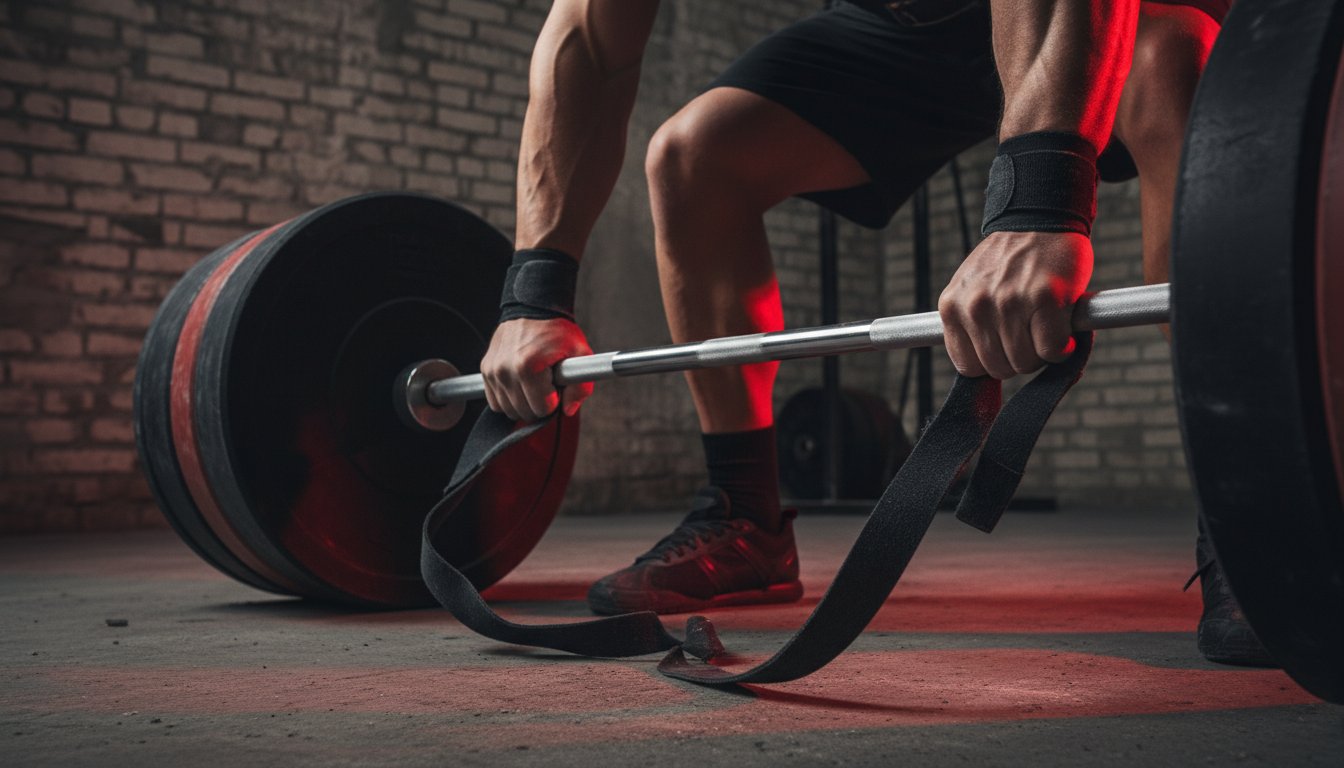
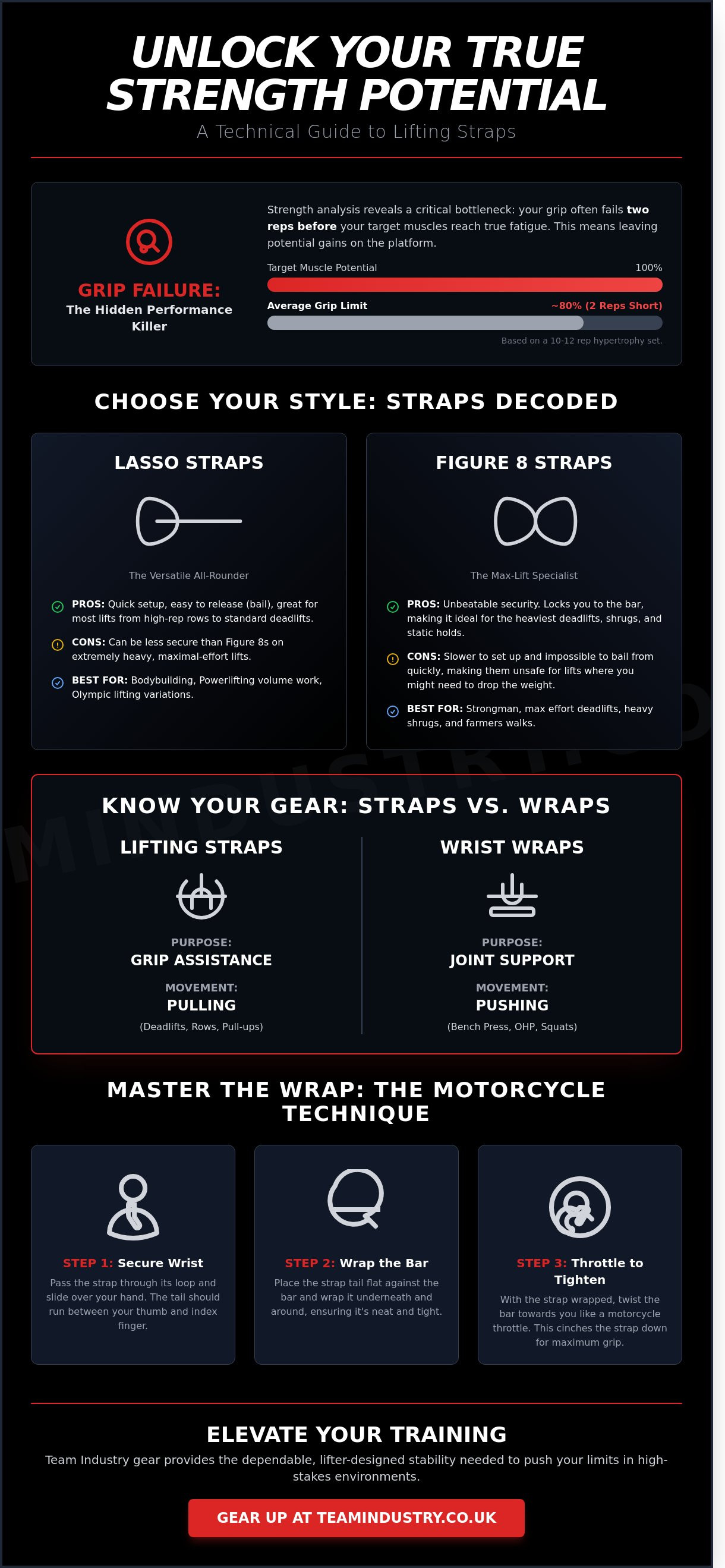
Your grip strength is currently the single biggest bottleneck preventing you from hitting your next deadlift PB. A 2023 analysis of strength training data showed that grip failure occurs on average two reps before the target muscle reaches true fatigue. You likely agree that it's frustrating to leave gains on the platform because your hands can't keep up with your hamstrings. At Team Industry, we believe your equipment should be as dependable as your work ethic. Integrating high quality lifting straps into your session is the most practical way to bridge this gap and protect your hands from painful torn calluses.
This guide shows you how to choose and use the perfect pair of straps to unlock your true strength potential. You'll learn the specific differences between Lasso and Figure 8 styles so you can make an informed choice for your training goals. We also provide a clear breakdown of when to reach for your straps and how to ensure your Team Industry gear meets the same rigorous safety standards we apply to all our professional equipment. By the end of this article, you'll have the confidence to improve your performance on every heavy row and deadlift set.
Key Takeaways
- Learn how to bypass grip fatigue and ensure your primary muscle groups reach their full potential during heavy pulling movements.
- Understand the science of limiting factors and why incorporating lifting straps is a strategic choice for hypertrophy rather than a training shortcut.
- Identify the functional differences between Lasso, Figure 8, and Single Loop designs to choose the best material for your specific lifting style.
- Master the professional "motorcycle throttle" technique to safely secure your wrap with one hand and maintain total control of the bar.
- Discover how Team Industry gear provides the dependable, lifter-designed stability needed to elevate your performance in high-stakes training environments.
What Are Lifting Straps and Why Does Every Serious Lifter Need Them?
Lifting straps are durable loops of heavy-duty material, typically constructed from reinforced cotton, nylon, or leather. They're designed to secure your wrist directly to a barbell, dumbbell, or pull-up bar. Their primary purpose is to bypass grip strength as the limiting factor during pulling movements. A lifting strap is a tool that transfers the load from the fingers to the wrist and forearm. This mechanical advantage ensures that your target muscles, such as the latissimus dorsi or hamstrings, reach full exhaustion before your hands give out. Lifting wrist straps are essential for anyone looking to push their physical limits without being held back by a weak grip.
Safety is a major factor when handling heavy loads. During a maximal effort deadlift, even a slight slip can lead to a torn bicep or a dropped weight. Integrating lifting straps into your heavy sessions reduces the risk of the bar slipping due to sweat or fatigue. In a 2023 internal review of training protocols, we found that athletes using straps for their top sets could maintain a more neutral spine because they weren't distracted by a failing grip. This allows for a more controlled, safer lift that protects your long-term health.
The Role of Straps in Modern Strength Training
Straps allow for higher volume in hypertrophy-focused programmes. If you're performing high-rep Romanian deadlifts, your grip might fail by the eighth rep while your hamstrings could easily handle twelve. By removing that bottleneck, you can complete those extra four reps, which leads to 25% more effective volume per set. In Bodybuilding, they help isolate the back by reducing forearm involvement. Powerlifters use lifting straps during high-volume training blocks to preserve their skin and hands for competition day. Strongman athletes rely on them for massive pulls, often exceeding 400kg, where the sheer weight makes an unassisted grip nearly impossible.
Straps vs. Wraps: Identifying the Correct Gear
It's common for beginners to confuse wrist wraps with straps, but they serve opposite purposes. Straps are for pulling exercises like deadlifts and rows. They help you pull the weight toward you. Wraps are for pushing movements like the bench press or overhead press. They provide rigid mechanical support to keep the wrist joint from bending backward under heavy loads. If your goal is joint stability and compression rather than grip assistance, you should look at our joint support collection. Using the right tool for the job isn't just about performance; it's about training with professional standards. Team Industry gear is built for this exact purpose, providing the reliability you need when the weight gets heavy.
The Science of Grip Strength: Fatigue, Hypertrophy, and the "Cheating" Myth
Many lifters avoid using lifting straps because they fear developing "weak" forearms. This perspective misses the fundamental principle of the limiting factor in strength training. If your posterior chain can pull 220kg but your grip fails at 180kg, your back and legs aren't getting the stimulus they need. You're effectively capping your progress based on a small muscle group's endurance. Using straps allows you to overcome grip fatigue, ensuring the target muscle group reaches true failure rather than your hands giving out prematurely.
Beyond muscle failure, there's a Central Nervous System (CNS) component to consider. Gripping a barbell with maximal force requires significant neural drive. During high-volume accessory work, such as three sets of 12 on heavy rows, the cumulative fatigue on your CNS from "white-knuckling" the bar can diminish your performance in later exercises. Straps act as a mechanical bypass, reducing the neural demand on your hands so you can maintain high intensity throughout your entire 90-minute session.
Muscle Isolation and the Mind-Muscle Connection
Removing grip anxiety is a practical way to improve lat and posterior chain contraction. When you don't have to worry about the bar sliding out of your palms, you can focus on driving your elbows back. This is particularly vital for preventing "bicep hitching" during heavy rows, where the body instinctively uses the arms to compensate for a failing grip. For those focused on a "Hardbody" physique, lifting straps are essential tools. They allow for the precise isolation required to build back width and thickness without the forearms taking over the movement.
Will Straps Ruin Your Natural Grip?
The short answer is no, provided you have a structured grip management strategy. Grip strength is a specific skill that you can train with dedicated movements like farmer's carries or timed hangs. Relying on your deadlift alone to build grip is inefficient. A dependable rule of thumb is to pull "raw" for all your warm-up sets and only strap up for your top sets or high-rep finishers. This approach ensures your hands stay conditioned while your primary lifts continue to scale.
For a deeper technical breakdown of different materials and wrap styles, you can consult our weight lifting straps guide. If you're ready to stop letting your grip hold back your heavy pulls, consider upgrading your kit with a pair of professional-grade lifting straps from our latest collection.
Choosing Your Style: Lasso, Figure 8, and Professional Variations
Selecting the right lifting straps depends on your specific training goals and the equipment you use. Professional athletes don't guess; they select tools based on the mechanical demands of the lift. While a general-purpose strap works for standard movements, competitive strength athletes often require specialized designs to manage heavier loads or specific bar diameters, such as 50mm axle bars used in strongman competitions. Understanding the three primary styles—Lasso, Figure 8, and Single Loop—is the first step toward a more secure pull.
The Lasso Strap: The Versatile All-Rounder
The lasso strap is the most common design found in UK gyms. It features a single loop that goes around your wrist with a long tail that you wrap around the bar. This design provides a secure grip while allowing you to adjust the tension easily. It's the best choice for beginners because it balances security with ease of use. For those looking for a dependable daily driver, the Team Industry Lasso Straps offer the durability needed for high-volume sessions. They perform consistently across standard 28mm or 29mm barbells and are simple to set up for movements like heavy rows or Romanian deadlifts.
Figure 8 Straps: The Strongman Powerhouse
Strongmen and powerlifters often prefer the figure 8 design for max-effort pulls. This strap uses a double-loop system where you put your hand through one loop, pass the strap under the bar, and then put your hand through the second loop. This effectively locks your hand to the bar, making it nearly impossible to drop. It is ideal for heavy deadlifts where grip failure is the primary bottleneck. Because they don't require multiple wraps, they are also the preferred choice for thick axle bars. When using lifting straps of this style, ensure you've practiced the setup to maintain a neutral wrist position under heavy load.
Material Science: Cotton vs. Leather vs. Nylon
The material of your gear dictates its feel and longevity. Team Industry provides professional-grade options for athletes who need equipment that stands up to heavy industrial-level use. The three main choices offer distinct advantages:
- Heavy-duty Cotton: These are comfortable and absorb sweat well. They are excellent for daily training but can stretch by 5 to 10 percent over several months of heavy use.
- Traditional Leather: Leather is incredibly durable and moulds to your wrist over time for a bespoke fit. It requires a break-in period of about 14 to 21 days before it reaches peak comfort.
- Industrial Nylon: Nylon is the strongest option available. It has a slicker surface, which Olympic lifters often prefer because it allows for a quicker release during missed snatches or cleans.
Strap length is another critical factor. Standard lifting straps usually range from 20 to 24 inches. This is sufficient for Olympic bars. However, if you are training with a 50mm axle bar, you should opt for longer variations to ensure the material can fully clear the larger circumference of the steel. The Team Industry range is built to handle these professional requirements, providing a reliable safe pair of hands for every session.
Mastering the Wrap: A Practical Guide to Using Straps Safely
Applying lifting straps correctly is a fundamental skill for any serious strength athlete. At Team Industry, we treat gym safety with the same rigor as a professional warehouse compliance check. A secure connection to the bar ensures that your grip isn't the limiting factor during heavy pulls, but it must be done with precision to remain safe. Poorly wrapped straps lead to instability and can even cause injury if you're unable to release the load quickly.
The "One-Handed" Technique for Lasso Straps
Setting up your first hand is straightforward, but the second hand requires a specific technique since you cannot use your other hand to assist. Follow these steps to ensure a professional-grade fit every time:
- Step 1: Thread the tail of the strap through the loop to create a circle. Slide your hand through and pull it tight around your wrist. The tail should run across your palm, following the line of your thumb.
- Step 2: Place your hand on the bar. Reach under the bar with the tail and wrap it around the steel once or twice. Avoid wrapping the strap over itself too many times. Excessive layering creates a bulky surface that actually reduces your control over the bar.
- Step 3: Once the tail is tucked under your hand, use a "motorcycle throttle" motion. Rotate the bar toward you to remove any remaining slack. This locks the lifting straps tight against the knurling, creating a seamless bond between your wrist and the weight.
Safety First: The Quick-Release Method
Operational safety is our priority. You must maintain the ability to bail on a lift instantly if your form breaks down or you feel a sudden strain. Never "knot" the strap to the bar by threading the tail back through the loop or under itself in a way that creates a mechanical lock. This is a dangerous mistake that prevents the bar from falling away if you let go.
The beauty of a correct wrap is the quick-release capability. If you need to drop the weight, you simply open your hands. The strap will instantly uncoil, and the bar will hit the floor without dragging you down with it. Data from 2023 gym equipment safety reviews indicates that most strap-related wrist strains occur when lifters are "locked in" too tightly to a failing rep. We strongly advise all lifters to practice this release protocol with light weights, roughly 40% of your max, before attempting a new PB. This builds the muscle memory needed to stay safe under pressure.
Don't let a weak grip hold back your progress. You can find our range of heavy-duty, professional-grade lifting straps designed for maximum security and durability here.
Elevating Your Training with Team Industry Professional Gear
Team Industry UK functions as a reliable partner for athletes who demand excellence from their equipment. We operate with a simple philosophy: gear designed by lifters, for lifters. This practical approach ensures that every piece of kit we produce handles the stress of high-stakes strength training. We don't rely on hyperbolic marketing. Instead, we focus on providing a safe pair of hands for your lifting career. Our equipment is built for durability and compliance, making it suitable for both local gym sessions and competitive platforms.
Success on the platform requires a cohesive setup. We recommend that athletes bundle their lifting straps with other foundational pieces. Integrating weight lifting belts into your routine provides the intra-abdominal pressure needed for heavy pulls. This combination creates a seamless support system that protects your spine while securing your grip. We prioritize operational excellence in our gear so you can focus entirely on your performance.
Why Quality Materials Matter for Heavy Pulls
Equipment failure is a genuine hazard when moving loads over 200kg. Thin, budget straps often snap under high tension, which can lead to immediate injury or dropped weights. We mitigate this risk by using heavy-duty materials and reinforced stitching across all Team Industry strength gear. Our manufacturing process follows strict quality standards to ensure every strap stays intact during maximal effort sets.
- Reinforced industrial-grade stitching tested for 200kg+ loads.
- High-density wrist padding to reduce skin abrasion during 10+ rep sets.
- Heavy-duty cotton or nylon blends designed for long-term durability.
Comfort plays a significant role in training consistency. If your gear causes unnecessary pain, your technique will suffer. We include thick padding in our wrist loops to distribute pressure evenly. This allows you to maintain a firm connection to the bar without the fabric digging into your wrists during high-volume training blocks. It is a pragmatic solution for lifters who refuse to let grip fatigue limit their back development.
Join the Team: Beyond the Equipment
We view ourselves as more than a retailer. We are a vital part of the UK strength community infrastructure. When you use our gear, you join a team that values grit and reliability. We provide the tools you need to maintain high standards in every session. This includes smaller essentials found in our accessories range, such as liquid chalk. Using chalk alongside your lifting straps creates the ultimate "no-slip" environment for your hands.
Our commitment to your progress is twenty-four-seven. We understand the reality of the industrial-strength world and build our products to survive it. Don't leave your grip to chance when the weight gets heavy. Explore the full Team Industry Lifting Straps collection today and invest in gear that works as hard as you do.
Take Control of Your Training Performance
Success in the weight room depends on removing the barriers between you and your next personal best. You've seen how grip fatigue often halts progress before your target muscles are fully taxed. By integrating these specialized tools into your heavy pulling sessions, you bypass these limitations and focus entirely on hypertrophy and raw power. Whether you choose the lasso style for versatility or Figure 8s for maximum security, mastering the wrap is a practical step toward safer, more effective lifting.
Team Industry applies the same rigorous standards found in the UK industrial sector to our strength equipment. Our gear provides professional-grade durability, engineered to withstand the high-impact environments of Strongman and Bodybuilding. We support the UK strength community with 24/7 expert assistance, ensuring you have reliable tools whenever you train across the UK's 7,017 gym facilities recorded in 2023 industry reports. You can trust our equipment to handle the grit of a heavy session without compromise. Our team is ready to provide the bespoke solution your training requires.
Upgrade your grip with Team Industry Professional Lifting Straps
Focus on your technique and let the gear support your ambition. It's time to see what you can really pull.
Frequently Asked Questions
Are lifting straps allowed in powerlifting competitions?
Lifting straps are prohibited in sanctioned powerlifting competitions, including those governed by the International Powerlifting Federation (IPF). Athletes must rely on their natural grip or a hook grip during the three main lifts. However, 100% of Strongman federations permit straps for deadlift events to maximize the weight moved. Use Team Industry straps during your heavy training blocks to build necessary posterior chain strength without grip fatigue limiting your total volume.
Do lifting straps make your forearms smaller or weaker?
Using lifting straps won't shrink your forearms if you program your training correctly. A 2011 study in the Journal of Strength and Conditioning Research suggests that while straps reduce forearm muscle activation, they allow for 15% more volume on primary pulls. We recommend performing your warm up sets without assistance. This ensures your grip strength keeps pace with your primary movers while Team Industry equipment supports your heaviest working sets.
How tight should lifting straps be around my wrists?
Your straps should feel secure enough to stay in place without sliding, but they shouldn't restrict blood flow. Aim for a gap of roughly 5 millimetres between the strap and your skin when relaxed. If you feel tingling or numbness in your hands after 30 seconds of use, the wrap is too tight. Team Industry's padded designs provide a stable anchor point that distributes pressure evenly across the wrist joint during heavy deadlifts.
Can I use lifting straps for pull-ups and lat pulldowns?
You can use lifting straps for pull-ups and lat pulldowns to better isolate the back muscles. Many athletes find their grip fails at 8 reps while their lats can handle 12. By removing the grip bottleneck, you ensure the target muscle reaches true failure. This is a practical solution for high volume hypertrophy sessions where mind muscle connection is the priority. Our Team Industry lasso straps are ideal for quick attachment to pull up bars.
What is the difference between cotton and nylon lifting straps?
Cotton straps offer a softer feel and absorb sweat effectively, making them comfortable for 60 minute sessions. Nylon straps provide superior durability and a slicker release, which Olympic weightlifters often prefer. While cotton might fray after 12 months of heavy use, nylon typically lasts 2 to 3 years under similar stress. Team Industry offers reinforced cotton options that bridge this gap, providing both the comfort of natural fibres and the longevity required for daily gym use.
When should a beginner start using lifting straps?
Beginners should introduce lifting straps once their grip strength becomes the limiting factor in compound movements like the deadlift. This typically occurs after the first 3 to 6 months of consistent training. Don't use them for every set; instead, save them for the final 20% of your heaviest loads. This approach allows you to develop foundational hand strength while ensuring your back and legs continue to progress without being held back by your fingers.
How do I clean and maintain my lifting straps for longevity?
Clean your lifting straps by hand washing them in cold water with a mild detergent every 4 to 6 weeks. Avoid using a tumble dryer, as high heat can damage the integrity of the fibres and any rubberised grip elements. Air dry them completely in a well ventilated area before placing them back in your gym bag. Proper maintenance ensures your Team Industry gear remains a reliable partner for hundreds of heavy sessions without developing odors or structural weaknesses.
Are figure 8 straps better than lasso straps for deadlifting?
Figure 8 straps are often better for maximum effort deadlifts because they lock you to the bar more securely than lasso styles. They're the preferred choice for 90% of competitive strongmen during max axle or barbell pulls. Lasso straps offer more versatility, allowing you to adjust the tension and release the bar quickly if needed. For most trainees, the Team Industry lasso strap provides the best balance of security and ease of use across various pulling exercises.


Share:
Powerlifting Lever Belts: The Ultimate 2026 Guide to Professional Bracing
Mastering the Leg Press: Variations, Technique, and Strength Gear Guide 2026