
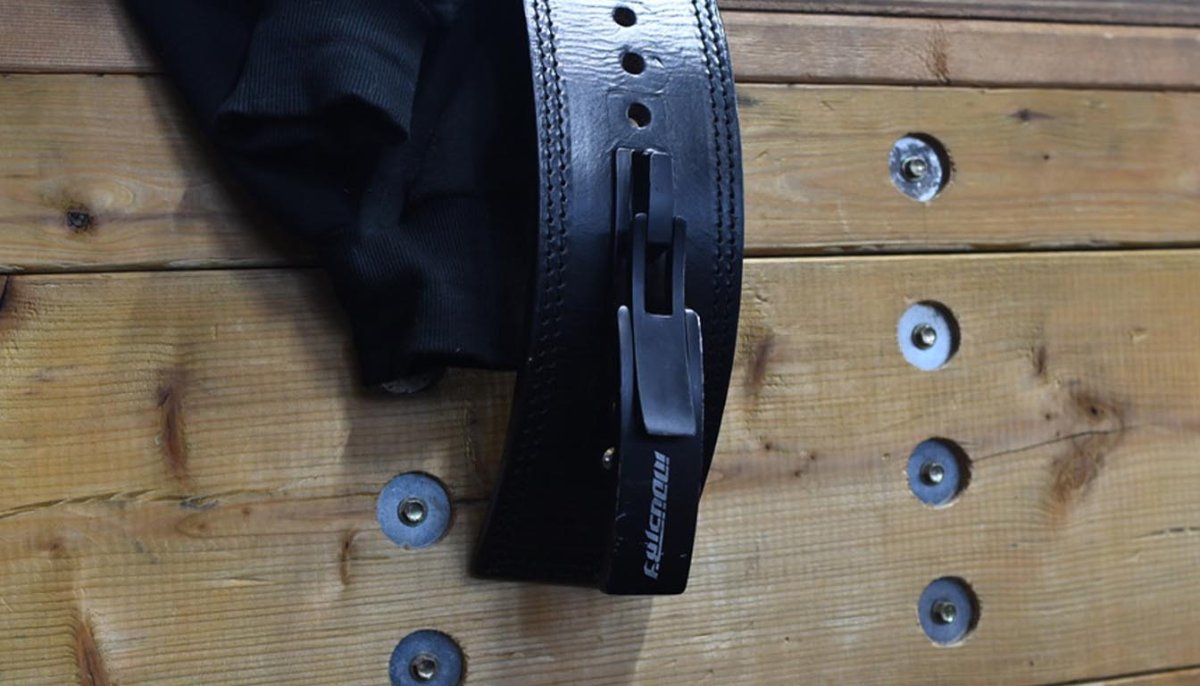
What if the piece of leather around your waist isn't actually a safety net for a weak back, but a precision tool designed to maximize your power output? Many lifters hesitate to buy gear because they fear it will stunt their core development or that they haven't "earned" it yet. If you've found yourself asking, when do you need to use a weight lifting belt? you're likely at the stage where your technique is solid but your progress on squats and deadlifts has started to stall. It's a common frustration. You feel your bracing give way before your legs do.
We understand that choosing the right equipment is about reliability and professional performance. This guide will clarify the exact point in your training where a belt becomes essential for both safety and hitting new personal records. Discover the mechanics of intra-abdominal pressure and how to select professional-grade gear, such as a Team Industry Lifting Belt, that aligns with your specific goals. We'll break down the practical differences between a 10mm Lever Belt for versatility and a 13mm Lever Belt for maximum support. Get the clear criteria you need to make an informed decision and return to the platform with confidence.
Key Takeaways
- Understand how a belt acts as a biofeedback tool to increase intra-abdominal pressure and stabilize your spine during heavy compound movements.
- Learn the specific strength milestones that answer the question, when do you need to use a weight lifting belt? including the "80% load rule" for squats and deadlifts.
- Identify the structural differences between a 10mm Lever Belt for general training and a 13mm Lever Belt for elite-level powerlifting.
- Master the "naked" brace technique to ensure your core is sufficiently developed before introducing a professional-grade Team Industry Lifting Belt.
- Apply the "two-finger rule" and correct anatomical positioning to ensure your gear provides maximum performance benefits without restricting movement.
The Mechanics of Support: What a Lifting Belt Actually Does
A Weightlifting belt serves a specific operational function that many lifters misunderstand. It isn't a passive support system like a medical back brace. Instead, it acts as a rigid biofeedback tool for your core muscles. This feedback loop is essential when you consider the question, when do you need to use a weight lifting belt? because the equipment relies on your ability to actively brace. If your form is poor and your back is rounding under load, a belt won't fix the underlying mechanical failure. It's designed to enhance good technique, not compensate for a lack of it.
To gain the most from this gear, you must master the Valsalva manoeuvre. This involves taking a deep diaphragmatic breath and holding it to create internal tension before you start the lift. This technique, combined with the belt, creates a pressurized environment that protects the spine and increases stability. It's a calculated collaboration between your internal physiology and your external equipment.
To better understand how this bracing mechanism works in practice, watch this helpful video:
The Myth of the Weak Core
Some athletes worry that using gear will lead to a lazy midsection. This is a common myth that doesn't align with the reality of high-level training. Evidence suggests that using a belt can actually increase muscle activation in the transverse abdominis and obliques. Professional powerlifters often possess the strongest cores in the industry, yet they use belts for nearly every heavy session. The belt doesn't replace your muscles; it provides a rigid surface for them to work against. This distinguishes structural support from active bracing, ensuring your midsection stays engaged throughout the entire movement.
Intra-Abdominal Pressure Explained
Intra-abdominal pressure is the internal force created by bracing against the belt to stabilise the torso. When you expand your midsection into a Team Industry Lifting Belt, you create a pressurized cylinder around your spine. This pressure increases spinal stiffness, which directly correlates to higher force production and improved power transfer. By reducing the compression on your spinal discs during heavy sets, you can move more weight with greater reliability. It's about creating a stable foundation so your legs and back can do their jobs effectively.
The Right Time to Belt Up: Identifying Your Strength Milestones
Determining exactly when do you need to use a weight lifting belt? depends more on your technical maturity than a specific number on the bar. A common mistake in many commercial gyms is reaching for gear too early. We recommend mastering the "naked" brace first. This means you can squat and deadlift with a neutral spine, proper hip hinge, and solid foot rooting without any external assistance. If you can't maintain a rigid torso with moderate weight, a belt will only provide a false sense of security.
A study on weight belt use suggests that many lifters employ them inappropriately, often using them as a crutch for structural weaknesses. Beginners should generally avoid belts for the first 6 to 12 months of consistent training. This period is vital for developing the deep core musculature and proprioception required to stabilize heavy loads naturally. Using a belt to mask poor mobility or a lack of bracing knowledge increases the risk of injury as the weights get heavier. Build the engine before you add the performance parts.
Technical Proficiency Before Mechanical Advantage
Before you buckle up, run through a form checklist. Are your ribs tucked? Is your pelvis neutral? Are you rooting your feet into the floor? If you answer no to any of these, stay belt-less until the movement is programmed into your muscle memory. Using a belt to overcome a "weak back" is a tactical error. The belt is there to amplify a strong core, not to replace a missing one. Professional standards dictate that gear should only be introduced once your raw mechanics are flawless.
Session Integration: Warm-ups to Work Sets
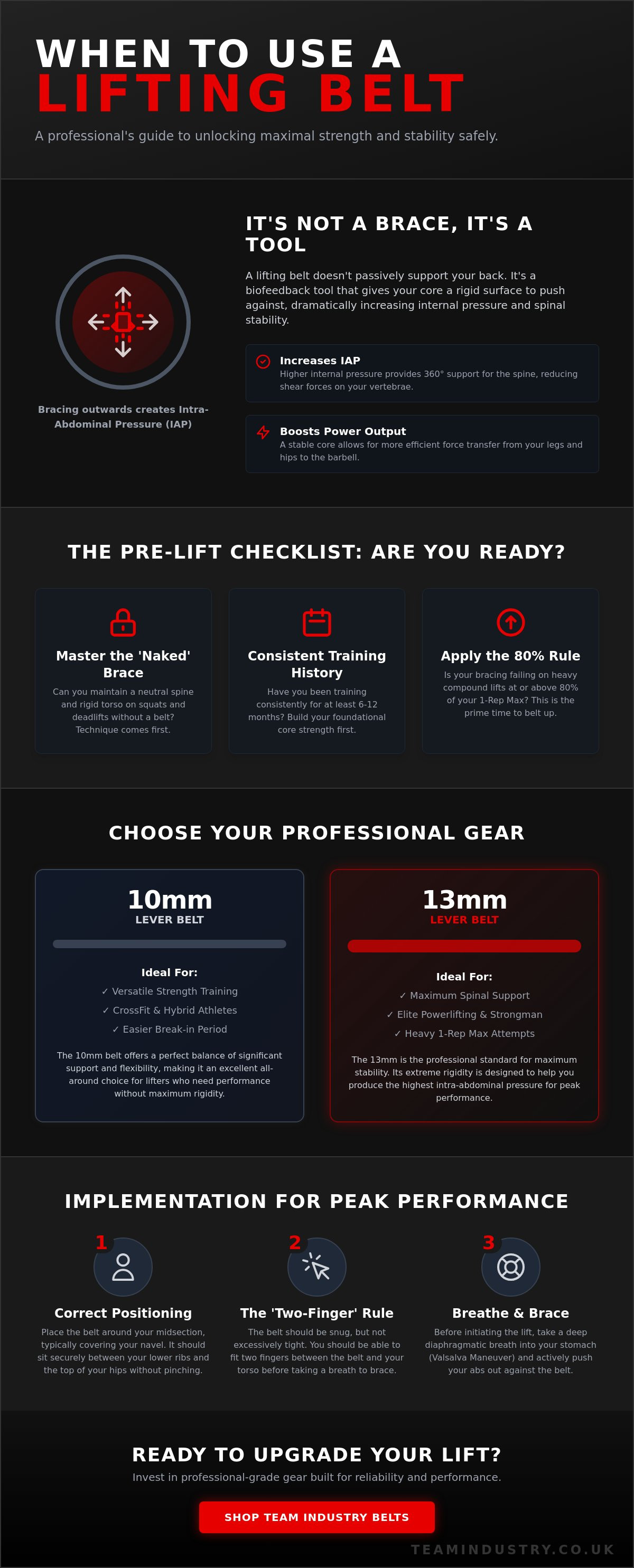
Once you've built a foundation, the "80% Rule" serves as a dependable standard. Introduce the belt when your working sets exceed 80% of your one-rep max. For everything below that, keep the belt off to maintain raw bracing strength. In a typical session, follow a warm-up pyramid. Don't put your belt on for the empty bar or your lightest sets. Wait until you reach your final one or two warm-up sets before your top working weight. This allows you to practice the transition from a raw brace to a belt-assisted brace.
There's also a significant psychological benefit to this approach. "Belting up" signals to your brain that it's time for high-intensity effort, helping you focus for heavy singles or triples. For accessory work like lunges or sub-maximal volume sets, leave the belt in your bag. This forces your core to stabilize the spine through different planes of movement. If you're ready to integrate gear into your heavy sessions, consider the range of professional Team Industry Lifting Belts to find a model that supports your specific strength milestones.
Choosing the Right Gear: 10mm vs. 13mm and Lever vs. Prong
Selecting the right equipment is a technical decision that directly impacts your lifting performance. While some commercial brands suggest choosing a belt based on comfort, professional lifters prioritize rigidity and force transfer. The University of New Mexico research on lifting belts highlights how different designs affect intra-abdominal pressure and spinal stability. When you reach the stage where you're asking, when do you need to use a weight lifting belt? you must also decide which tool matches your specific operational requirements. Genuine leather is the industry standard for heavy compound lifts because it provides a non-compressible wall for your core to brace against, unlike nylon alternatives that can stretch under extreme tension.
Lever Belts: The Industry Standard for Strength
Lever belts offer a consistent, repeatable level of tightness every set. This reliability is why they're preferred for maximal attempts. Once you set the lever position, you simply click it into place for a rock-solid fit. It's efficient. If you're using a 13mm lever belt, ensure you size it while wearing your typical lifting attire to maintain that precise tension. While prong belts offer easier adjustments for lifters whose waist size fluctuates during a session, the lever mechanism remains the benchmark for security during heavy singles and triples.
Selecting Thickness Based on Your Sport
The thickness of your belt should align with your specific discipline. A 10mm belt is the versatile choice for most gym-goers and bodybuilders. It offers substantial support while allowing enough mobility for movements like the front squat or clean and jerk. In contrast, a 13mm belt provides maximum rigidity. This is the "wall" required for competitive powerlifting and strongman events where spinal stiffness is the primary objective. Choosing between them depends on whether you value a balance of flexibility or absolute structural support. Use a 10mm belt for general strength training and reserve the 13mm for the most demanding maximal loads.
We've engineered our equipment to meet these specific professional demands. You can browse our full range of weight lifting belts to find the exact specifications for your training style. Whether you need a 10mm Lever Belt for daily strength work or a 13mm model for the platform, selecting professional-grade gear ensures your equipment never becomes the weak link in your progression.
Practical Implementation: How to Use Your Belt for Max Gains
Proper application is the final step in answering when do you need to use a weight lifting belt? because even the best gear fails if positioned incorrectly. To find your optimal placement, identify the "sweet spot" between the bottom of your rib cage and the top of your iliac crest. This is where the belt can best facilitate intra-abdominal pressure without obstructing your movement. For most athletes, a horizontal position across the navel is the standard starting point, but individual anatomy may require minor adjustments.
Achieving the correct tension is a matter of precision. We recommend the "two-finger rule" for optimal tightness. Once the belt is buckled, you should be able to slide two fingers between the belt and your stomach while relaxed. This gap allows you to take a full diaphragmatic breath and expand your core into the leather. If the belt is too tight, you won't be able to achieve a maximal brace; if it's too loose, the belt will slide and fail to provide a rigid surface for your transverse abdominis to push against.
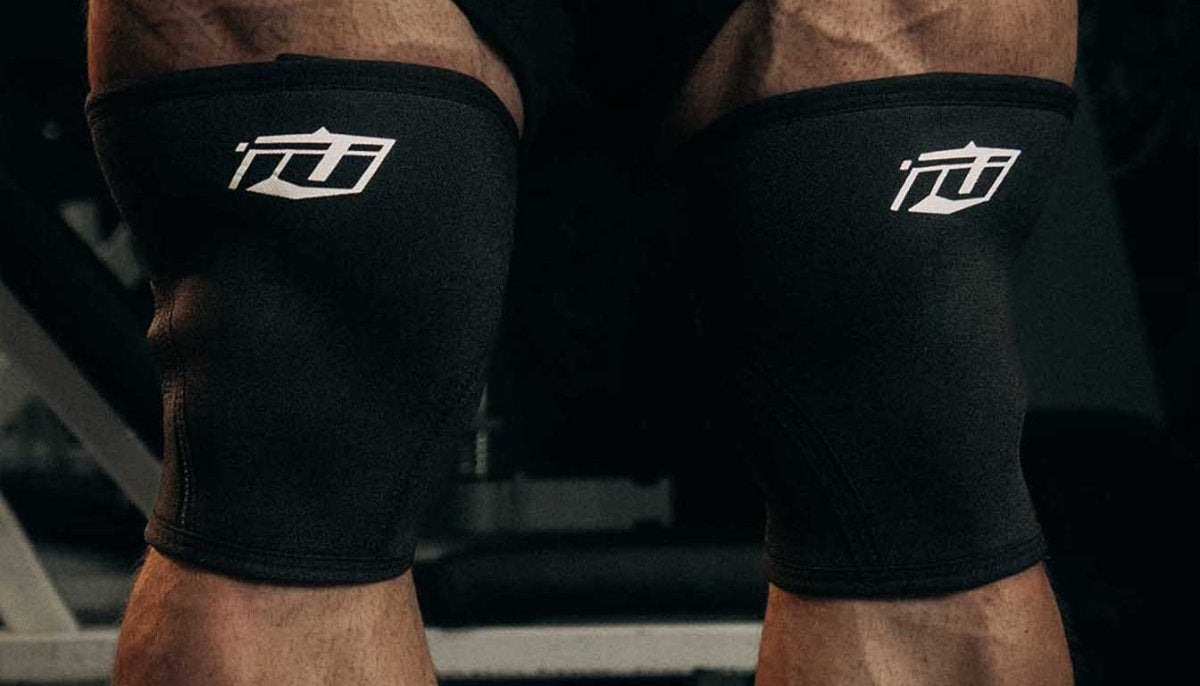
Understanding when do you need to use a weight lifting belt? also requires knowing how to integrate it with other support systems. For heavy squats, combining your belt with heavy duty knee sleeves provides a comprehensive stability package that protects both the spine and the patellar tendon. This synergy allows you to focus entirely on force production during maximal attempts.
Placement Strategies for Big Lifts
Your belt height should shift depending on the mechanics of the lift. During a low-bar squat, a lower position often feels more secure as you lean forward into the hole. For high-bar squats, keeping the belt slightly higher can prevent the bottom edge from digging into your hips. Deadlifting requires a different tactical approach. Many lifters prefer a slightly higher belt position for conventional or sumo pulls to allow for a deeper hip hinge without the belt pinching the thighs or catching on the ribs. Pair your belt with professional lifting straps for heavy pulls to ensure your grip isn't the limiting factor when your core is fully supported.
The Team Industry Approach to Strength
We don't just manufacture gear; we are active participants in the lifting community. Team Industry invests in events and federations because we believe in the collective collaboration required to push the sport forward. Our equipment is designed to meet the rigorous standards of the 2026 IPF rulebook, ensuring that your 10mm or 13mm lever belt is ready for the platform. We are committed to providing professional-grade equipment that stands up to heavy abuse in commercial and private strength facilities alike. When you are ready to reach your next milestone, upgrade your strength gear at Team Industry UK and experience the reliability that elite athletes depend on.
Maximise Your Performance with Professional-Grade Gear
Transitioning from raw lifting to using specialized equipment is a tactical move that requires both technical proficiency and the right tools. By mastering the "naked" brace and applying the 80% rule for your heavy sets, you ensure that your gear enhances your natural strength rather than masking a weakness. Understanding exactly when do you need to use a weight lifting belt? marks a significant milestone in your development as a serious lifter. Whether you select a 10mm model for general strength work or a 13mm lever belt for maximal platform attempts, your choice should reflect your specific performance goals.
We provide professional-grade strength equipment that's rigorously tested by athletes and trusted by the UK powerlifting and strongman community. Our range of 13mm and 10mm lever belt options ensures that your equipment meets the highest standards of reliability and stability. Don't let your progress stall due to a lack of proper support. Equip yourself with professional-grade Weight Lifting Belts and take the next step in your strength journey with confidence. Your next personal record is within reach.
Frequently Asked Questions
Does using a weight lifting belt make your core weak?
Using a lifting belt does not weaken your core; it actually provides a rigid surface that increases muscle activation during heavy sets. By pushing your abdominals against the belt, you create higher levels of intra-abdominal pressure than you could achieve raw. This biofeedback loop forces the transverse abdominis to engage more effectively. It's a performance tool designed to amplify your existing strength, not a crutch that causes muscular atrophy.
How tight should a lifting belt be for squats?
A lifting belt should be tight enough to provide resistance but loose enough to allow for a deep, diaphragmatic breath. Use the two-finger rule: you should be able to fit two fingers between the belt and your stomach while standing relaxed. This space is essential because it allows you to expand your midsection into the belt during your brace. If it's too tight, you won't be able to achieve the necessary internal pressure.
Can I use a lifting belt if I have a history of back pain?
Lifters with a history of back pain can use a belt, but it must not be used as a substitute for medical advice or proper form. Ensure you have clearance from a healthcare professional before returning to heavy training. While a belt increases spinal stability through pressure, it cannot fix mechanical issues. Focus on mastering your bracing technique raw before introducing gear to manage heavy working sets.
What is the difference between a 10mm and 13mm lifting belt?
The difference between these belts is the trade-off between flexibility and absolute rigidity. A 10mm belt is the most versatile option, providing significant support while remaining comfortable enough for various movements. A 13mm belt is the maximum thickness allowed in most federations, offering a rock-solid wall for elite powerlifters. Most athletes will find that a 10mm Lever Belt provides more than enough stability for their strength milestones.
Should I use a lever belt or a prong belt for powerlifting?
Lever belts are the professional standard for powerlifting because they offer repeatable, precise tightness with a single movement. They are ideal for the platform where consistency is key. Prong belts offer more adjustability if your waist size changes between sessions or exercises. However, for maximum security and ease of use during top sets, a Team Industry Lever Belt is the preferred equipment for serious strength athletes.
Is it okay to wear a lifting belt for every exercise in the gym?
You should not wear a belt for every exercise; instead, reserve it for heavy compound movements where spinal stability is critical. Wearing a belt for curls or light accessory work is unnecessary and can hinder your core's natural development. Knowing when do you need to use a weight lifting belt? means identifying loads that exceed 80% of your max. For sub-maximal volume and isolation work, keep the belt off to build raw stability.
Share:
When to Use Weight Lifting Straps for Maximum Gains
Top 3 Essential Weight Training Accessories for Strength