

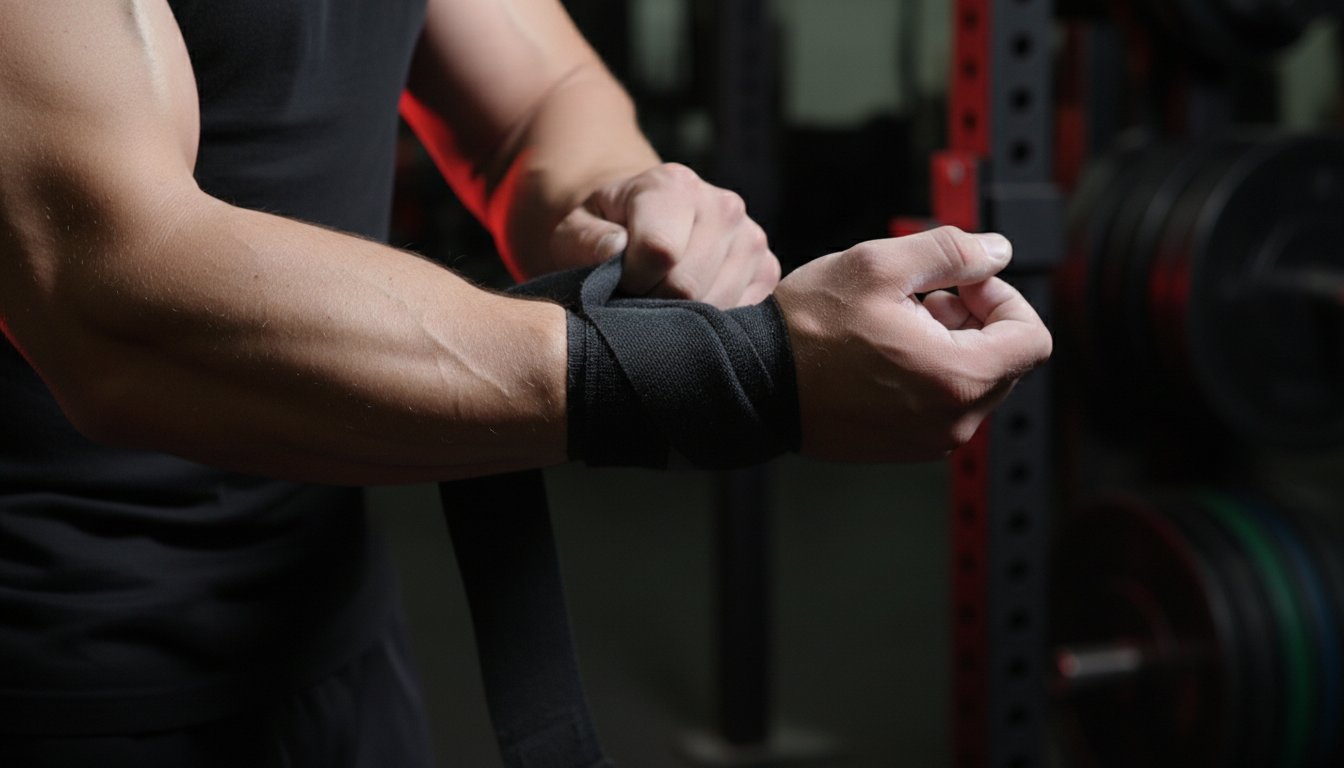
Your bench press strength isn't limited by your chest or triceps. It's often limited by the small, vulnerable joints in your wrists that act as a bottleneck for force. Understanding what are the main benefits of wrist wraps for weight training is the first step toward turning that weak link into a rigid pillar of support. You've likely felt that unsettling shake at the top of a heavy set or a sharp twinge of pain when attempting a new one-rep max. It's a common frustration that keeps many dedicated lifters from ever reaching their true potential because they lack the necessary stability to stay safe under load.
We're here to help you move past those limitations and lift with confidence. Discover how professional-grade Team Industry Wrist Wraps provide the structural reinforcement needed to lift heavier, protect your joints, and finally break through stubborn strength plateaus. This guide breaks down the mechanics of wrist stability, explains when to use them for maximum impact, and helps you choose the right gear for your specific training style. By the end, you'll know exactly how to use this tool to maximize your power output and maintain long-term joint health.
Key Takeaways
- Understand the anatomy of the carpal joint and why it often acts as the primary point of failure during heavy pressing movements.
- Discover what are the main benefits of wrist wraps for weight training, focusing on improved force transfer and joint stability under maximal loads.
- Master the "Threshold Strategy" to ensure you maintain natural wrist strength while still protecting your joints during your heaviest top sets.
- Learn the tactical differences between stiff and flexible Team Industry Wrist Wraps to select the right gear for your specific training goals.
Defining Wrist Stability: Why Support is Essential for Heavy Loads
Wrist wraps are heavy-duty elasticated bands engineered to stabilize the carpal joint during periods of maximal physical exertion. Unlike standard athletic tape, these wraps provide a customizable level of compression that secures the joint in a neutral position. Understanding what are the main benefits of wrist wraps for weight training begins with recognizing that your strength isn't just about muscle mass; it's about the joint that transfers that power to the barbell.
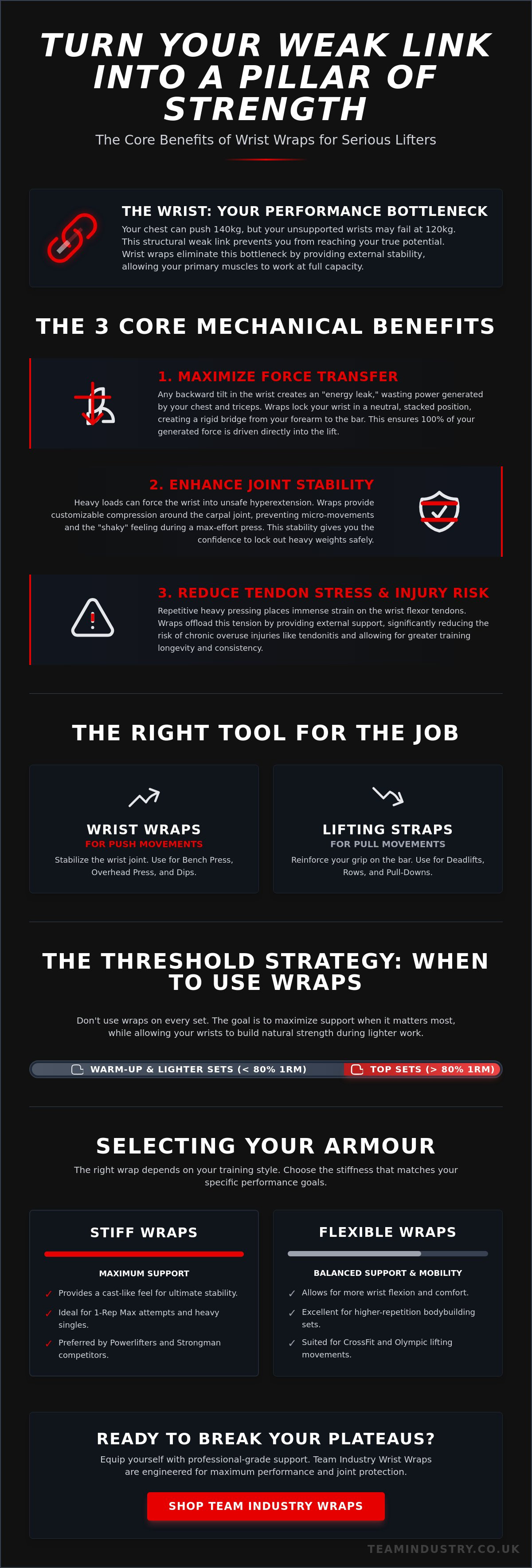
The human wrist is a complex arrangement of eight small carpal bones. While your chest and shoulders might have the capacity to bench press 140kg, your wrists often act as the 'weak link' that can only safely support 120kg. This discrepancy creates a bottleneck in your training. By reinforcing this small joint, you ensure that your primary movers can work at their full capacity without being limited by structural instability.
To better understand how this equipment impacts your performance, watch this helpful video:
The Vulnerability of the Carpal Joint
Heavy loads naturally force the wrist into excessive extension. This position creates a significant mechanical disadvantage and places immense strain on the ligaments. Structural integrity requires the distal radius and carpal bones to remain in a stacked, neutral alignment. Using a Wrist brace or wrap prevents the joint from collapsing backward, which keeps the weight centered directly over the forearm bones for safer force production.
Wrist Wraps vs. Lifting Straps: Know the Difference
There is often confusion between stability tools and grip aids. Wrist wraps are designed for 'push' movements like the bench press and overhead press where joint compression is required. In contrast, lifting straps are used for 'pull' movements like deadlifts or rows to assist with grip strength. Using the wrong tool can compromise both your safety and your performance. For those looking to maximize their pressing power, high-quality Team Industry Wrist Wraps offer the specific support needed to keep the carpal joint secure under heavy iron.
The 3 Core Mechanical Benefits of Wrist Wraps for Weight Training
Wrist wraps function as a tactical structural reinforcement for the carpal joint. They aren't merely comfort accessories; they're mechanical tools designed to transform the wrist into a rigid pillar for force production. When you understand what are the main benefits of wrist wraps for weight training, you can move away from treating them as a crutch and start using them as a performance enhancer. By compressing the carpal complex, they eliminate the micro-movements that cause instability at the top of a heavy lift. This compression stops the "shaky" sensation often felt during a maximal effort, providing the stability required to lock out heavy weight safely.
Force Transfer: From Forearm to Barbell
In a heavy bench press or overhead movement, any backward tilt of the wrist creates an "energy leak." This mechanical failure means force generated by your chest and triceps is lost rather than being driven directly into the barbell. A stiff wrap creates a seamless bridge between the forearm and the palm. This ensures that 100% of your power reaches the bar. While some academic research on wrist wraps suggests the primary benefit is rooted in subjective stability, that mental security is exactly what allows an athlete to commit fully to a heavy attempt without hesitation.
Reducing Tendon Stress and Inflammation
Repetitive heavy training puts immense strain on the tendons of the forearm, specifically the wrist flexors. Wraps offload this tension by providing external support, which reduces the risk of chronic issues like tendonitis. This protection allows for higher training frequency and volume without the accumulation of nagging joint pain that often stalls progress. Securing your form with specialized wrist support ensures you can focus on the weight rather than managing joint discomfort. By minimizing ligament strain, you prioritize long-term joint health and training longevity.
Strategic Application: How to Maximise Benefits Without Losing Strength
A common concern among lifters is that reliance on gear leads to "weak wrists." This is a myth when you apply a tactical approach to your training. To understand what are the main benefits of wrist wraps for weight training, you must treat them as a specialized tool for peak performance rather than a permanent fixture. We recommend the "Threshold Strategy." Perform all warm-up sets without support to build natural stability and grip strength. Only apply your wraps when you reach approximately 70% to 80% of your one-rep max or when you notice your form starting to break down. This ensures you maintain raw strength while using gear to push past your previous limits.
Integrating wraps into a professional strength gear system, alongside lifting belts and knee sleeves, creates a comprehensive safety net for high-intensity sessions. This allows you to focus entirely on the execution of the lift without the distraction of joint instability.
The 'Casting' Technique: How to Wrap Like a Pro
Effective wrapping requires more than just pulling the fabric tight. Follow these three steps for a professional-grade cast:
- Alignment: Position the wrap so it covers both the base of the palm and the top of the forearm. If it's too low on the arm, it functions as a sweatband rather than a stability tool.
- Tension: Pull the wrap tight enough to create a rigid, immobile structure. It should feel like a cast. Ensure it's not so tight that it causes numbness, as this indicates restricted circulation.
- Thumb Loop Removal: Once the wrap is secure, remove the thumb loop. Leaving it on is often a safety hazard; it also creates unnecessary pressure points that can distract you during a heavy set.
When to Wrap: Lift-Specific Recommendations
Different movements require different levels of support. For the bench press, use high tension to maintain a strict bar path and prevent any wrist extension. During the overhead press, moderate tension is often better. This allows for the slight natural movement needed at the top of the lockout. Interestingly, many athletes use wraps during low-bar squats. This tactical choice alleviates the intense pressure on the elbows and wrists caused by the bar position. To experience what are the main benefits of wrist wraps for weight training firsthand, browse the full range of Team Industry Wrist Wraps and secure your next personal best.
Selecting Professional Armour: Stiff vs. Flexible Wrist Wraps
Selecting the right equipment requires a pragmatic assessment of your training objectives. While the basic function of stability remains constant, the material construction of your gear determines how that support is delivered. Understanding what are the main benefits of wrist wraps for weight training allows you to choose between stiff and flexible materials with precision. One size doesn't fit all in a high-performance environment; your gear must match the specific demands of your discipline. Professional-grade Team Industry Wrist Wraps are engineered to provide this specific versatility for dedicated lifters.
Stiff wraps are designed for maximal attempts. They provide a casting effect that is essential for powerlifting or heavy singles. Flexible wraps offer more versatility. They support the joint during high-volume bodybuilding sessions without becoming overly restrictive during longer sets. For most athletes, 18-inch wraps are the industry standard. They provide enough length for multiple revolutions around the joint without adding unnecessary bulk that might interfere with your grip. Material quality is a non-negotiable factor. High-grade elastic and reinforced Velcro are essential for the high-intensity demands of strongman training.
Matching Your Gear to Your Goals
Bodybuilders should prioritize flexible wraps. These allow for adequate blood flow during accessory movements while still reinforcing the carpal joint against fatigue. Powerlifters and strongmen require high-grade stiff wraps to handle competition-style loads. Choosing the correct stiffness ensures your gear works with your body's mechanics rather than fighting against them. Team Industry Wrist Wraps are built for these operational realities, focusing on durability and reliable performance during every session.
Durability and Care for Long-Term Use
Maintaining your gear is a matter of training efficiency. Never put your wraps in a tumble dryer. Excessive heat breaks down the elastic fibers, which quickly compromises the structural integrity of the support. Look for signs of wear such as fraying edges or weakened Velcro. If the wrap no longer provides a rigid cast when tightened, it's time for a replacement to ensure your safety isn't compromised. Optimise your pressing power with Team Industry Wrist Wraps to ensure your equipment is as dependable as your work ethic.
Secure Your Progress with the Right Gear
Success in strength sports is built on a foundation of joint health and efficient mechanics. By now, you understand that what are the main benefits of wrist wraps for weight training extend far beyond simple comfort. These tools act as a tactical safeguard, allowing you to maximize force transfer and maintain neutral carpal alignment during your heaviest sets. Implementing the "Threshold Strategy" ensures you continue to develop raw stability while using professional armour to push through plateaus that would otherwise stall your training.
Don't let a small joint be the bottleneck for your big lifts. Our equipment is designed by strength athletes specifically for the UK lifting community. We use professional-grade materials that stand up to the rigors of competitive powerlifting, featuring heavy-duty Velcro for zero-slip performance during every attempt. Shop the full range of Team Industry Professional Wrist Wraps today to reinforce your training setup. It's time to lift with the confidence that your gear is as hardworking and dependable as you are. We'll see you on the platform.
Frequently Asked Questions
Do wrist wraps weaken your wrists over time?
Wrist wraps don't weaken your wrists if you use them strategically rather than for every set. Dependency only occurs when lifters use support for light warm-up sets, which prevents the carpal joint from developing natural stability. Follow the threshold strategy by lifting without gear until you reach 70% or 80% of your maximum load. This approach ensures you build raw strength while utilizing professional gear for its intended purpose: joint protection during peak exertion.
What is the difference between wrist wraps and lifting straps?
The primary difference lies in their mechanical function. Wrist wraps stabilize the carpal joint during pressing movements like the bench press or overhead press. Conversely, lifting straps secure your hand to the barbell to assist your grip during pulling exercises like deadlifts or rows. Understanding what are the main benefits of wrist wraps for weight training versus straps ensures you use the correct tool for the specific movement in your program.
At what weight should I start using wrist wraps?
You should start using wraps when the load exceeds your ability to maintain a neutral, stacked wrist position. There's no universal weight requirement, as it depends on your individual joint integrity and experience level. Most athletes apply support when they reach approximately 80% of their one-rep max or when they feel their wrists "giving way" during a set. If you experience sharp pain or excessive extension during heavy pressing, it's time to utilize gear.
Can I use wrist wraps for squats?
Yes, wraps are highly effective for alleviating joint pressure during low-bar squats. In this position, the wrists often take significant strain to keep the bar secure against the rear deltoids. Applying Team Industry Wrist Wraps creates a rigid support that prevents the wrist from bending back too far. This reduces the risk of tendonitis in the elbows and allows you to maintain a tighter, more stable upper back throughout the movement.
How tight should my wrist wraps be during a set?
Your wraps must be tight enough to create a "casting" effect that eliminates almost all movement in the carpal joint. It should feel like a rigid pillar that forces a neutral alignment between your forearm and hand. Because this level of compression can restrict blood flow, always loosen the wraps immediately after you complete your set. If you feel numbness or tingling in your fingers before you start the lift, the tension is too high and requires a quick adjustment.


Share:
Setting Up Figure 8 Straps for Axle Bar Deadlifts: A Strongman Guide
Using elbow wraps for bench press PR