

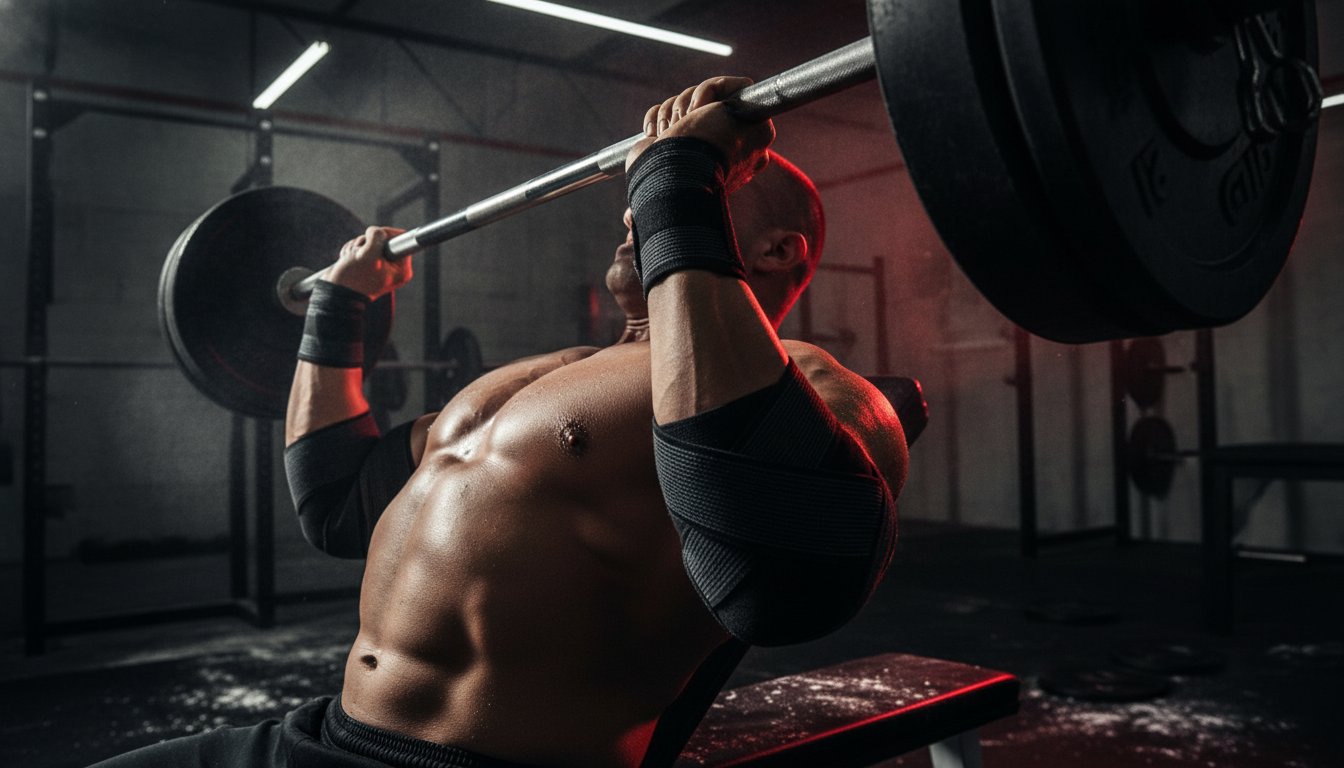
That nagging ache in your tendons isn't just a distraction; it's a mechanical leak that's actively draining your bench press PR. Many dedicated lifters accept elbow tendonitis as an unavoidable part of heavy training, but the reality is that joint instability at the bottom of the movement often limits your power long before your muscles give out. Finding the best elbow wraps for bench press can transform a shaky rep into a solid, controlled lift by providing the targeted compression your connective tissues need to handle maximum loads.
We understand the grit required to push through a plateau, and we're here to help you do it safely. You'll discover how to choose and use the right wraps to protect your joints and increase your bench press power. This guide compares the utility of wraps versus sleeves, breaks down the 2026 federation rules from the IPF and APO, and provides a step-by-step approach to achieving the perfect tension. While you're optimizing your upper body support, you can also pair your gear with our Wrist Wraps to ensure your entire kinetic chain is stable and ready for your next heavy session.
Key Takeaways
- Identify the specific stiffness and length requirements to select the best elbow wraps for bench press based on your training volume and intensity.
- Learn how to mitigate medial and lateral epicondylitis by using adjustable tension to stabilize the elbow joint under high-intensity loads.
- Understand the mechanical pop effect and how elastic wraps store potential energy to assist your drive from the bottom of the lift.
- Master the distal-to-proximal wrapping technique and choose between spiral or X-patterns to optimize joint coverage and venous return.
- Differentiate between the passive support of sleeves and the active, customizable compression of wraps for maximum effort training sessions.
##Table of Contents
##Why Elbow Wraps are Essential for Heavy Bench Pressing
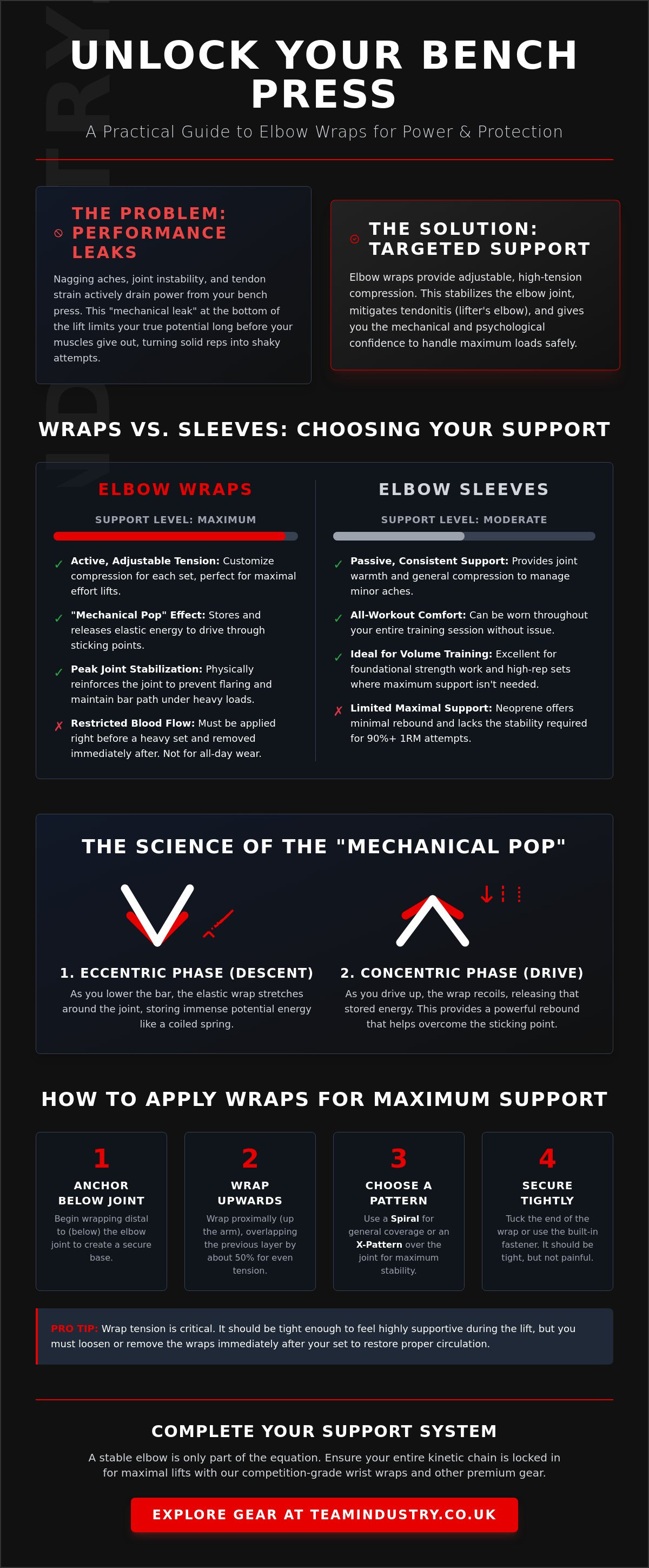
Elbow wraps are specialized, adjustable elastic supports designed specifically for high-intensity pressing movements. Unlike standard sleeves that offer a fixed level of compression, these tools allow you to customize the tension based on the specific weight on the bar. In a competitive strength sport, maintaining precise joint alignment is often the difference between a successful lift and a failed attempt. Selecting the best elbow wraps for bench press ensures you have the necessary mechanical support to handle maximal loads without compromising your lifting posture.
To better understand the practical application of this gear, watch this helpful video:
The primary benefit of these wraps lies in their ability to provide targeted compression, which is vital for mitigating medial and lateral epicondylitis, commonly known as lifter's elbow. By creating external pressure around the joint, wraps stabilize the tendons and help manage the inflammatory response associated with heavy volume. Choosing the best elbow wraps for bench press allows for a tighter wrap that physically reinforces the joint. Wraps reduce tendon load by distributing force across the elastic material.
During the "touch" phase of the bench press, lateral stability becomes a critical factor in your performance. As the bar reaches your chest, your elbows are under peak stress; any minor deviation in the bar path can lead to a missed lift or unnecessary strain. The wraps act as a stabilizing brace, keeping the joint tracking correctly and preventing the elbows from "flaring" or "tucking" uncontrollably under pressure.
Managing Joint Integrity Under Maximal Load
When you handle weights above 90% of your one-rep max (1RM), the psychological benefit of joint security is just as important as the physical support. Wraps provide a physical stop that helps prevent accidental hyperextension during heavy lockouts, allowing you to focus entirely on the drive. For a deeper look at how to integrate this gear into your training sessions, read The Ultimate Bench Press Guide to master your technique and build raw strength. This stability allows you to remain aggressive with your attempts while maintaining a high standard of safety.
##Elbow Wraps vs. Sleeves: Choosing the Right Support
Choosing between neoprene sleeves and elastic wraps depends on your specific training objectives. Neoprene sleeves provide passive support, primarily offering joint warmth and general compression to manage elbow pain in strength athletes. In contrast, the best elbow wraps for bench press provide active tension. Because they are made from heavy duty elastic materials, you can tighten them to a degree that neoprene cannot match. This distinction is crucial for lifters moving from foundational strength work into maximal effort territory.
One of the most significant advantages of using wraps is the "mechanical pop" they provide at the bottom of the movement. During the eccentric phase, which is the descent of the bar, the elastic material stretches and stores potential energy. As you transition into the concentric phase to drive the bar up, this energy is released. This helps you overcome the sticking point just off the chest. While sleeves offer a slight rebound, the high tensile strength of the best elbow wraps for bench press creates a much more pronounced assistance. For a more detailed gear analysis, check our Elbow Sleeves vs. Wraps comparison.
There is a clear trade off between comfort and absolute performance. Sleeves are convenient and can be worn throughout an entire workout, but they lack the adjustable nature of a wrap. Wraps must be applied before a heavy set and removed immediately after to restore circulation. If you find your current gear isn't providing enough stability for your top sets, consider upgrading your kit with our Wrist Wraps to ensure total arm stability.
When to Transition from Sleeves to Wraps
You should consider transitioning when the weight on the bar exceeds the structural integrity of your neoprene sleeves. Neoprene is effective for high volume accessory work, but it often compresses too much under extreme loads. This fails to keep the joint locked during a PR attempt. This is why wraps are the preferred choice for Strongman events like the Log Press or heavy Axle bench sessions. In these scenarios, the odd object nature of the lift requires the aggressive, non slip support that only a heavy duty elastic wrap can provide.
##Key Features of the Best Elbow Wraps for Bench Press
Finding the best elbow wraps for bench press requires an understanding of material physics. High-quality wraps typically use a blend of heavy-duty cotton and high-grade rubber filaments. This combination provides the necessary elasticity while maintaining structural integrity over hundreds of training sessions. Research shows that as muscles tire, the dangers of elbow joint fatigue increase. This makes the mechanical support of a well-built wrap essential for injury prevention during heavy sets. You won't find the same level of protection in basic, thin alternatives.
Length is a critical factor for effective compression. The industry standard sweet spot for most lifters is between 1 meter and 1.5 meters. This length allows for enough revolutions around the joint to provide maximum stability without creating excessive bulk. Bulk can interfere with your range of motion at the bottom of the press. For those seeking professional-grade gear to complement their training, explore the Team Industry Joint Support collection for reliable options that stand up to heavy use.
Matching Wrap Stiffness to Your Benching Style
Your grip width dictates the type of lateral shear your elbows experience. Wide-grip benchers should prioritize stiff wraps. These provide a rigid casting effect that counteracts the outward pressure on the joint. If you use a narrower grip or follow a high-volume bodybuilding programme, more flexible wraps are often superior. They allow for slightly more blood flow during high-rep sets while still offering protection. Choosing the best elbow wraps for bench press means aligning wrap resistance with your specific bar path and grip style.
Durability and Build Quality for Strength Athletes
Reliable gear must withstand the grit of a heavy lifting environment. When inspecting wraps, look for reinforced double-stitching along the edges and a high-density Velcro fastening system. Most lifters prefer heavy-duty Velcro for its speed and security, but some veteran athletes opt for tuck-in styles to avoid potential skin irritation. Lower-quality wraps often lose their stick after a few months, which can lead to dangerous slips mid-set. Non-slip textures or rubberized grip strips integrated into the fabric are also valuable. These features prevent the wrap from shifting as you sweat, ensuring the compression remains consistent. To ensure your grip is as stable as your elbows, pair your setup with our Wrist Wraps for total upper limb control.
##How to Apply Elbow Wraps for Maximum Support
Applying your gear correctly is just as important as selecting the best elbow wraps for bench press. To ensure safety and performance, always start the wrap distal, which means below the elbow joint on the forearm. Move proximal, winding the material toward the shoulder. This specific direction promotes venous return, helping blood flow back toward the heart rather than trapping it in the lower arm. Incorrect wrapping can lead to premature numbness or swelling, which compromises your grip and focus during a heavy set.
You have two primary options for coverage: the Spiral and the X-Pattern. The Spiral technique provides even, consistent compression across the entire joint area, making it ideal for general volume work. If you require maximum lateral stability for a PR attempt, the X-Pattern is superior. By crossing the material directly over the crease of the elbow, you create a reinforced hinge that mimics the natural movement of the joint while providing extra resistance. The wrap should be tight enough to limit range of motion slightly but not cut off circulation.
Solo lifters often struggle to maintain tension while anchoring the first revolution. Use the "loop and pull" method by threading the end of the wrap through the thumb loop or a pre-stitched anchor point. This allows you to create a secure base without needing a partner to hold the material in place. Once the anchor is set, keep constant tension on the elastic throughout every revolution to prevent the wrap from shifting mid-set.
Solo Wrapping: A Step-by-Step Guide
If you don't have a training partner, use the upright of a power rack to assist you. Hook the end of the wrap around a J-cup or the rack itself to provide a counter-tension point as you rotate your arm. Some lifters prefer using their teeth to hold the tail end for the initial anchor, though the rack method is generally more stable. After you finish wrapping, perform a few "air" reps without the bar to check for pinching or excessive restriction. If your fingers begin to tingle or turn blue, loosen the wrap immediately and re-apply with slightly less tension. To ensure you have the right equipment for the job, upgrade your gear with Team Industry Elbow Wraps and experience the difference in joint security.
##Ready for Your Next Bench Press PR?
Mastering the distal to proximal wrapping technique ensures your joints remain stable while promoting healthy circulation during your heaviest sets. Remember that matching wrap stiffness to your specific grip width is the primary way to counteract lateral shear and maintain a consistent bar path. By utilizing the mechanical pop provided by high grade elastic, you can effectively overcome sticking points and protect your tendons from the cumulative stress of maximal loading. These small adjustments in gear and technique often lead to the biggest breakthroughs in the gym.
Selecting the best elbow wraps for bench press is an investment in your long term lifting career and joint longevity. Our equipment features professional grade, heavy duty materials designed specifically for maximal loading. We are proud to be trusted by UK Strongman and Powerlifting athletes who require gear that stands up to the grit of elite competition. When you're ready to stabilize your press and push toward a new personal record, Shop Professional Strength Gear at Team Industry UK. Stay consistent, train smart, and keep the bar moving.
##Frequently Asked Questions
Are elbow wraps legal in powerlifting competitions?
No, elbow wraps are generally not legal for the bench press in most raw powerlifting competitions. The International Powerlifting Federation (IPF) March 2026 rulebook states that elbow supports are not permitted in classic divisions. The American Powerlifting Organization (APO) also prohibits their use for benching in raw divisions as of January 2026. If you plan to compete, check your specific federation guidelines to ensure your equipment is compliant for your division.
Can I use wrist wraps as elbow wraps for benching?
No, wrist wraps are typically too short to provide adequate coverage or stability for the elbow joint. Most wrist wraps range from 12 to 24 inches, while the best elbow wraps for bench press are usually 40 to 60 inches long. Using a shorter wrap prevents you from achieving enough revolutions to properly secure the joint. For optimal performance, pair dedicated elbow gear with our Wrist Wraps for full arm support.
How tight should my elbow wraps be for a max effort set?
Your wraps should be tight enough to significantly resist joint flexion without cutting off your circulation entirely. For a max effort set, aim for a level of compression that feels very restrictive but doesn't cause immediate numbness or sharp pain. You must remove them immediately after your set to restore full blood flow. This high level of tension provides the mechanical rebound necessary to handle weights that exceed your typical raw capacity.
Will using elbow wraps cause my muscles to get weaker?
No, using elbow wraps won't weaken your muscles if you use them strategically for your heaviest sets. They function as a tool for joint protection and handling supramaximal loads, which can help build strength by allowing for higher intensity with less joint fatigue. Perform your lighter warm up sets and accessory work without wraps to ensure your stabilizers remain strong. Finding the best elbow wraps for bench press helps you push past plateaus safely.
How do I wash my elbow wraps without ruining the elasticity?
Hand wash your wraps in cold water with a mild detergent to preserve the internal elastic filaments. Avoid using a washing machine or tumble dryer. High heat and aggressive agitation break down the rubber components that provide the wrap's tension. After rinsing thoroughly, lay them flat on a dry towel to air dry away from direct heat or sunlight. This simple maintenance routine ensures your gear remains dependable for long term use in high intensity training.


Share:
what are the main benefits of wrist wraps
Mental Preparation for a Max Lift Attempt: The Lifter's Tactical Guide