
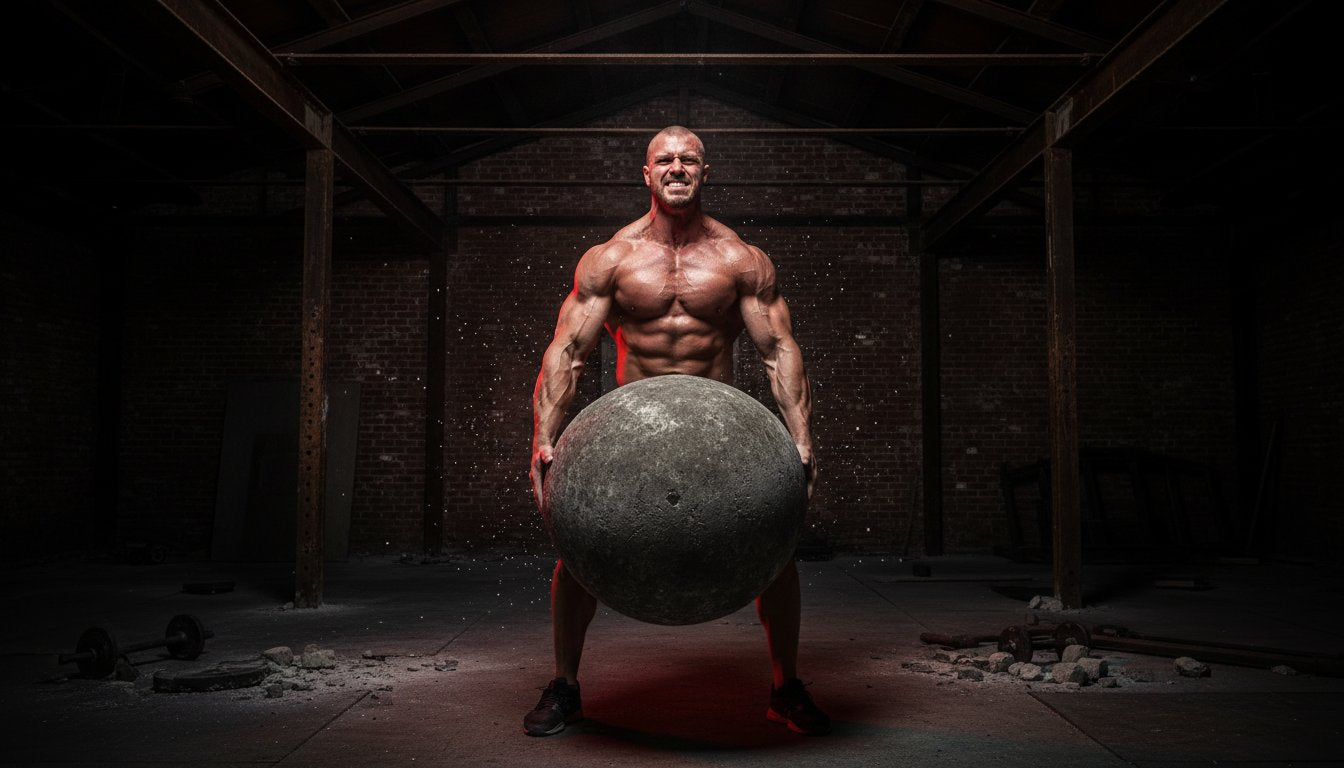
Your standard commercial gym belt will likely fail the moment you attempt to lap a 100kg Atlas stone. Moving into the world of strength athletics means leaving the predictable environment of the squat rack for the grit of heavy carries and awkward overhead presses. It's common to feel overwhelmed by specialized implements, but securing the right strongman training gear uk athletes trust is essential for your longevity in the sport. You recognize that standard gym equipment isn't durable enough for the rigours of a local qualifier or a heavy truck pull.
This guide will help you discover the professional-grade equipment and support gear you need to transition from standard lifting to competitive strongman training in the UK. At Team Industry UK, we value the same reliability in our gear that we expect in our logistics operations. We'll provide a clear list of essential starter gear, explain the technical differences in equipment, and show you how professional standards can improve your safety during every session. You'll gain the practical knowledge required to build a kit bag that's as hardworking and no-nonsense as your training program.
Key Takeaways
- Learn to distinguish between standard gym equipment and the professional-grade implements required for the specific demands of odd-object lifting and heavy carries.
- Understand the hierarchy of support needs to ensure your first investments focus on core stability and joint protection rather than non-essential accessories.
- Master the tactical use of strongman training gear uk to overcome common grip failure points and maintain consistent progress during heavy pulling events.
- Discover how to adapt your current training environment using versatile alternatives like sandbags and axles to simulate competitive conditions effectively.
- Follow a structured three-stage priority list to build a dependable kit bag that meets the high standards of safety and performance expected by Team Industry.
What Defines Strongman Training Gear in the UK?
Strongman training involves more than just barbells. It focuses on odd-object lifting and carries that test functional strength in ways standard gym equipment cannot. To understand What is Strongman?, you have to look at the unpredictability of the events. Professional-grade implements are built to withstand the torque and impact of 150kg sandbags or 300kg frames. Standard commercial equipment often lacks the structural integrity for these loads. High-quality strongman training gear uk must handle the sheer friction of concrete and the high-impact nature of heavy drops. At Team Industry, we view gear as a vital part of the local athlete's infrastructure, ensuring every lift meets rigorous safety and compliance standards.
Static Lifts vs. Moving Events
A standard gym belt works well for a static squat; however, it can become a liability during a 20-meter Yoke walk. Moving events require gear that supports core expansion while allowing for the natural mechanics of a stride. If a belt is too rigid or lacks the correct contour, it can restrict breathing or dig into the hips during a Farmers carry. Our weight-lifting belts are designed to provide the necessary bracing without compromising your gait. You need equipment that moves with you, not against you. This adaptability is essential when you're transitioning from a heavy overhead press to a high-speed carry.
The Durability Factor in Strength Gear
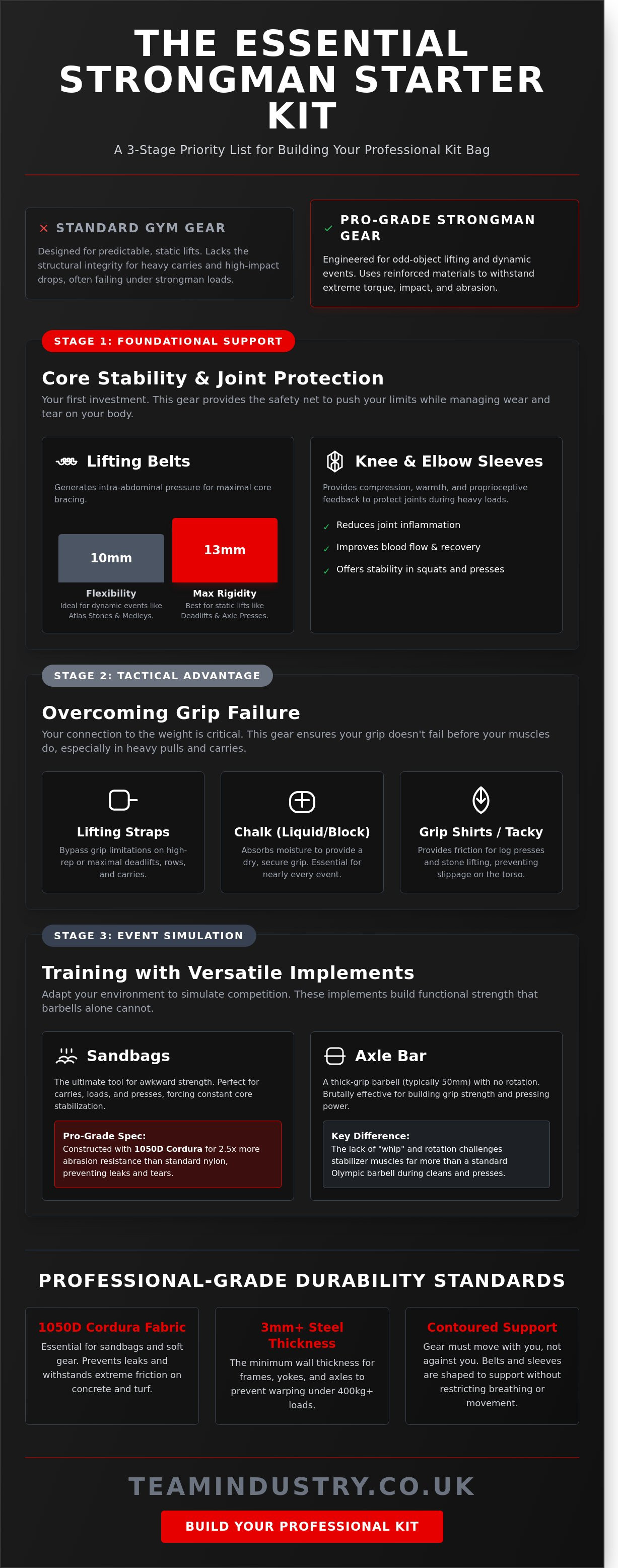
In the UK, heavy-duty is a baseline requirement for safety, not a marketing buzzword. We use materials like 1050D Cordura because it offers 2.5 times the abrasion resistance of standard 500D nylon. Professional-grade implements feature reinforced steel with a minimum wall thickness of 3mm to prevent warping under 400kg loads. Knurling on handles should be aggressive enough for a secure grip in wet British weather but precise enough to avoid tearing the skin. This attention to detail ensures your equipment remains a trusted partner throughout years of training. Team Industry defines professional-grade durability as the ability of an implement to maintain its structural integrity through 5,000 high-impact drop cycles without failure.
- 1050D Cordura: Essential for sandbags and soft stones to prevent leaks.
- 3mm Steel Thickness: The minimum standard for frames and yokes.
- Contoured Support: Necessary for maintaining mobility during moving events.
Essential Personal Support Gear for Strongman Training
Investing in personal support gear is the most cost-effective first step for any aspiring strongman in Britain. While gym memberships and specialized implements require ongoing investment, a one-off purchase of quality wraps or a belt provides immediate returns on safety. It's about building a foundation. High-quality strongman training gear uk allows you to push your physical limits while managing the inevitable wear and tear on your joints. This gear creates a reliable safety net, acting as a "safe pair of hands" for your body during maximal efforts.
The hierarchy of needs in strongman begins with core stability and moves outward to the extremities. When we examine the biomechanics of strongman exercises, research from 2019 suggests that the unique demands of moving odd objects require significant stabilization to prevent injury. Specialized support gear bridges the gap between your natural capacity and the extreme loads seen in competition. It allows for more frequent training sessions because your recovery isn't hampered by avoidable joint inflammation or minor strains. Integrating Team Industry lifting belts into your foundational kit ensures you have the necessary support to handle these stresses safely.
The Role of Lifting Belts in Strongman
A belt is your primary tool for generating intra-abdominal pressure. In strongman training, you'll generally choose between 10mm and 13mm thicknesses. A 10mm belt offers the flexibility needed for dynamic events like the Atlas stones or loading medleys. Conversely, a 13mm lever belt provides maximum rigidity for a heavy deadlift or axle press. Many athletes prefer a lever belt for strongman because of the quick transitions. You can flick the lever to loosen the belt instantly between a heavy yoke run and a press, ensuring you don't waste breath or energy during a timed event.
Joint Support: Knee and Elbow Sleeves
Heavy-duty knee sleeves are non-negotiable for events like the overhead press or stones. They provide more than just warmth; they offer essential proprioceptive feedback and lateral stability. A 7mm neoprene sleeve is the industry standard, balancing compression with enough give to allow for a full range of motion. This compression helps manage blood flow and reduces the "creaky" feeling in joints during cold morning sessions in unheated warehouses. For those pushing heavy poundages, investing in dedicated joint support is a pragmatic move to ensure longevity in the sport.
Wrist Wraps for Overhead Stability
The small bones of the wrist take a battering during Log presses and Axle cleans. Proper wraps prevent hyperextension under load, which is a common cause of missed lifts and wrist pain. Choosing the right length is a matter of your specific lifting style; a 24-inch wrap offers maximum "cast-like" stiffness for max effort days, while an 18-inch wrap provides enough support for high-rep conditioning. We encourage you to explore Team Industry wrist wraps to find the stability level that suits your training phase. Ultimately, investing in quality strongman training gear uk ensures you stay on the platform rather than on the sidelines.
Grip Strength and Tactical Accessories
Grip strength is frequently the first point of failure for those new to the sport. While your legs and back might have the capacity to move a 200kg frame, your hands often have other ideas. In the history of strongman competitions, the ability to maintain a vice-like hold on awkward, heavy objects has always been a primary separator between athletes. For anyone sourcing strongman training gear uk based, it's essential to distinguish between building raw grip strength and using tactical accessories to support your primary movers during heavy sessions.
Training your grip involves dedicated work on implements like rolling handles or captains of crush grippers. Supporting your grip, however, means using tools like Team Industry lifting straps to ensure your deadlift or row volume isn't limited by your finger strength. Relying on straps for every set can lead to underdeveloped forearms, but avoiding them during max effort attempts is a mistake that limits your overall power output.
Figure 8 vs. Lasso Lifting Straps
Figure 8 straps are the gold standard for max deadlift and axle bar events. They loop around your wrist, under the bar, and back over your wrist, effectively "locking" you to the implement. This is particularly useful for the 50mm diameter of an axle bar, which is notoriously difficult to hold. Lasso straps offer more versatility for general gym work and allow for a quicker release. If you need to bail on a lift quickly, lasso straps are the safer choice. Use raw grip for all warm-up sets, then switch to straps once you exceed 80% of your one-rep max to keep the focus on your posterior chain.
Grip Aids: Liquid Chalk and Smelling Salts
Liquid chalk has become a staple for UK lifters training in commercial or home gym environments. It provides the necessary friction to prevent the bar from slipping without the dust and mess associated with traditional block chalk. It dries in seconds and stays on your hands throughout high-rep sets of farmers walks or stone loads.
Smelling salts provide a different tactical advantage by delivering a sharp mental "kick" before a heavy attempt. The ammonia inhalant triggers an immediate respiratory reflex, increasing heart rate and focus for a brief 30-second window. While effective for hitting a new personal best, use them responsibly. Overusing stimulants can mask genuine fatigue and lead to burnout. Save the salts for your heaviest top sets or competition day to ensure they remain an effective tool in your kit bag.
Strongman Implements vs. Gym Alternatives
Finding a dedicated strongman facility in the UK often requires a long commute. Most athletes have to make do with commercial gyms or basic garage setups. While investing in a full suite of heavy, specialized strongman implements is ideal for those with ample space, it isn't always practical for the average lifter. You can bridge this gap by using specific strongman training gear uk athletes trust to turn standard equipment into specialized implements. The Team Industry approach focuses on versatility; we provide the tools that allow you to train for a competition without needing a warehouse full of iron.
The Versatility of the Strongman Sandbag
The sandbag is the most functional and cost-effective piece of strongman training gear uk lifters can own. It's a portable powerhouse that replicates the awkward, shifting weight of an Atlas stone or a Husafell carry. Unlike a barbell, the weight distribution changes constantly, forcing your core and stabilisers to work harder. You can implement several key movements with a single bag:
- Stone Loads: Mimic Atlas stone over-bar movements by lapping and extending the bag.
- Front Carries: Replicate the Husafell stone walk to build massive upper back and lung capacity.
- Ground to Overhead: Develop the explosive power needed for log or axle presses.
To keep your Cordura sandbags in top condition, don't drag them over abrasive concrete. Wipe them down after outdoor sessions to prevent dampness from weakening the fabric. Ensure your inner liners are double-sealed with heavy-duty tape to prevent sand leaks during high-impact drops.
Adapting Standard Gear for Strongman
You don't need a 2-inch thick axle bar to build a crushing grip. Adding fat grips to a standard Olympic barbell creates a similar stimulus for a fraction of the cost. If your gym doesn't have a log, use neutral grip dumbbells or a Swiss bar. These options allow for the palms-in position that's essential for a safe and powerful strongman press. This setup protects your shoulders while building the specific pressing strength required for the platform.
Your choice of clothing is just as important as your hardware. Training for strongman requires a massive range of motion, especially during the "lap" phase of a lift. We recommend Team Industry Oversized Tees because they offer the freedom of movement you won't get from standard high-street gym wear. They're built to withstand the grit of a sandbag session while keeping you comfortable during heavy carries. Practicality is our priority, and our gear reflects the hard-working nature of the UK lifting community.
Ready to upgrade your training setup? Explore the Team Industry accessories collection to find the gear you need for your next session.
Building Your Strongman Kit Bag: A 3-Stage Priority List
Success in strongman requires more than just raw power; it demands a strategic approach to your equipment. Trying to buy everything at once is often a waste of resources. Most athletes find that building a kit bag in stages allows them to adapt to the increasing weights and technical demands of the sport. This structured approach ensures you have the right strongman training gear uk for your current level of development without overcomplicating your sessions.
- Stage 1: The Foundation. This phase focuses on safety and grip. A 10mm or 13mm lever belt provides the necessary intra-abdominal pressure for heavy carries. You'll also need liquid or block chalk and a pair of standard lifting straps to ensure your grip isn't the limiting factor during high-volume pulling sessions.
- Stage 2: Joint Support. As your training intensity increases, protecting your connective tissue becomes vital. Investing in 7mm neoprene knee and elbow sleeves provides compression and warmth. This joint support helps prevent common overuse injuries during overhead presses and heavy squats.
- Stage 3: Advanced Performance. Once you're moving toward competitive weights, add specialised tools. Figure 8 straps are essential for max-effort deadlifts, while smelling salts provide a necessary CNS boost for heavy singles. These items are designed for peak output rather than every training session.
Investing for Longevity
Choosing high-quality equipment is a pragmatic financial decision. A cheap £20 belt might last six months; however, a professional-grade leather belt can serve you for a decade. Proper maintenance extends this lifespan even further. Wash your neoprene sleeves in cold water every fortnight to prevent bacterial buildup and store your leather weight lifting belts in a dry environment to prevent the material from cracking. The Team Industry commitment to supporting athletes at all levels ensures that every piece of gear we provide is built to withstand the grit of a commercial warehouse gym or a rain-soaked outdoor competition.
Final Checklist for the UK Strength Athlete
Before you step onto the platform, verify that your gear meets the specific requirements of your federation. Most UK organisations, such as the BNSF, follow standard rules regarding belt width, often capping them at 10cm. Don't wait until competition day to unbox new equipment. Test every piece of your strongman training gear uk at least 21 days before your event to ensure a familiar fit. This practice turns your equipment into a safe pair of hands you can trust when the pressure is on. Consistency in your gear leads to consistency in your lifts.
Build Your Strength on a Professional Foundation
Success in strongman requires more than just raw power; it demands equipment that stands up to the grit of a heavy session. You've seen that building a kit bag is a strategic, three-stage process. Start with essential personal support to protect your joints, then integrate tactical grip accessories and specialized implements as your numbers grow. High-quality gear prevents unnecessary setbacks and ensures your technique remains consistent when the weights get heavy. Don't settle for standard gym alternatives when your goals require specialist tools.
Team Industry delivers professional-grade durability for UK strength athletes who refuse to compromise. Our equipment is trusted by major federations and event organizers across the country to perform under the most demanding conditions. When you choose our gear, you're backed by 24/7 customer support and community-driven expertise that understands the reality of the platform. We focus on providing the reliable tools you need to move from novice sessions to competitive event wins. If you're looking for the strongman training gear uk athletes rely on for consistency and safety, we have the inventory to support your progress. Explore the Full Team Industry Strength Gear Collection and start training with the right kit today. Your strongest performance starts with a solid foundation.
Frequently Asked Questions
Do I need a specific belt for strongman training?
You need a belt that supports 360 degree abdominal pressure, usually a 13mm leather lever belt for static lifts or a triple-ply velcro belt for moving events. Strongman involves diverse movements like the Yoke or Farmers Walk, so a single belt might not cover every scenario. Team Industry provides heavy duty belts designed for these high load industrial environments. Use a leather belt for maximum deadlifts and switch to a soft belt for loading medleys to maintain your mobility.
Are Figure 8 straps better than standard lifting straps for strongman?
Figure 8 straps are superior for max deadlifts and axle cleans because they lock your wrists to the bar, making it impossible to drop the weight. When you're sourcing strongman training gear uk, prioritize these for heavy static pulls. 90% of competitors at the 2023 World's Strongest Man used this style for the deadlift event. Standard lasso straps are fine for rows, but Figure 8s let you focus entirely on your posterior chain without grip fatigue.
What is the best type of knee sleeve for strongman events?
Choose 7mm neoprene sleeves to provide maximum compression and joint warmth during heavy overhead presses or squats. While 5mm sleeves offer more mobility, the 7mm thickness is vital for handling the 150kg+ loads common in local UK competitions. Team Industry sleeves are built to withstand the abrasion of concrete stones and metal implements. Ensure your sleeves meet 100% of the compliance standards for your specific UK federation before you compete.
Can I use liquid chalk in a commercial gym in the UK?
Most UK commercial gyms allow liquid chalk because it reduces airborne dust by 95% compared to traditional magnesium blocks. Always check your specific gym’s 2024 membership handbook for updated health and safety policies. Team Industry liquid chalk provides a dependable grip for heavy pulls while keeping your training environment tidy. If you train in a warehouse or garage, you can use block chalk, but liquid remains the professional standard for shared spaces.
Is strongman training gear different from powerlifting gear?
Strongman gear differs by prioritizing multi-planar movement and durability against rough surfaces like Atlas Stones. Powerlifting gear is typically optimized for just the squat, bench, and deadlift. When selecting strongman training gear uk, look for reinforced stitching that handles the grit of outdoor training. Team Industry designs equipment to bridge this gap, offering the stability of powerlifting kit with the ruggedness required for dynamic, high intensity strongman events.
How do I choose the right size for a lever lifting belt?
Measure your waist circumference at the navel while bracing your core to find the correct size. Never use your UK trouser size, as this is often 5 to 10cm smaller than your actual lifting waist measurement. Team Industry belts come in sizes ranging from Small to 4XL to ensure a bespoke fit for every athlete. If you fall between two sizes, choose the larger one to accommodate the extra 13mm of thickness from a secondary under-belt.
When should I start using smelling salts in my training?
Start using smelling salts only when you're attempting lifts at or above 95% of your current personal best. The ammonia hit triggers an acute adrenaline response that lasts for 15 to 30 seconds, which is perfect for a heavy log press. Team Industry recommends using them sparingly to prevent desensitization over time. Overusing stimulants can lead to central nervous system fatigue, so keep them in your kit bag for top sets and competition day only.


Share:
The Ultimate Weight Lifting Belt Buying Guide for 2026: Maximise Your Bracing Power
Powerlifting Lever Belts: The Ultimate 2026 Guide to Professional Bracing