


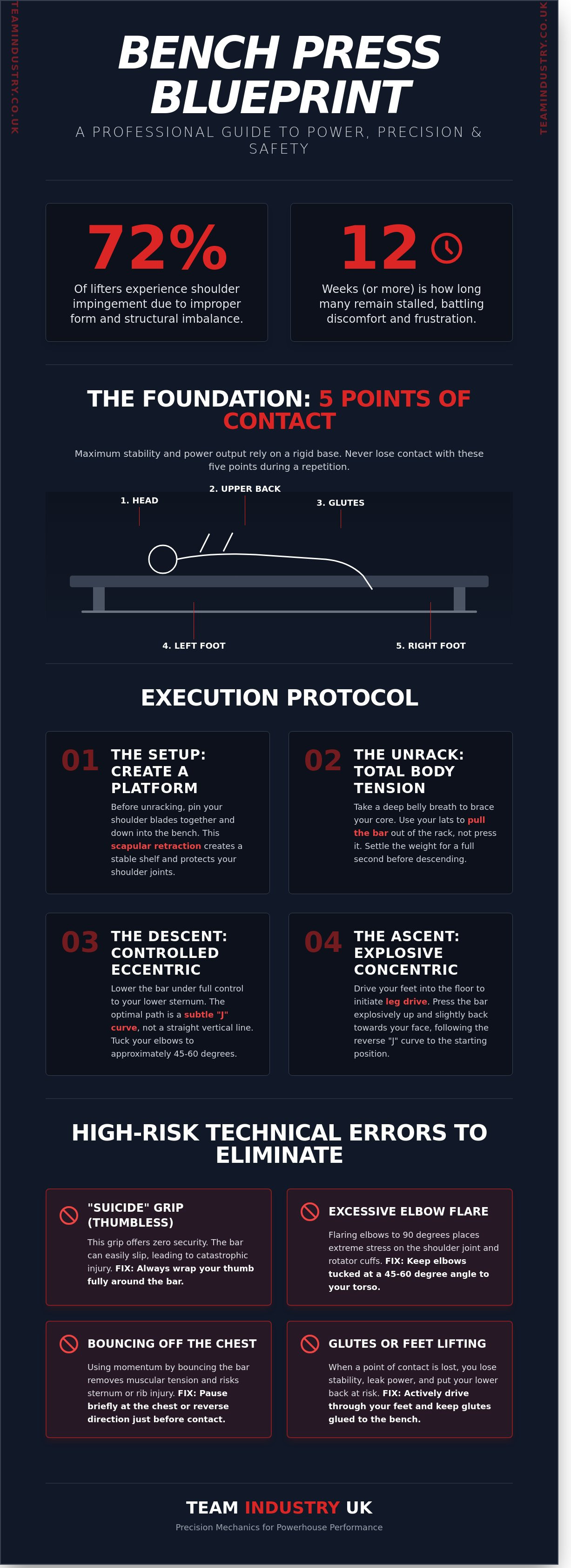
The heaviest bench press isn't actually built with your chest; it's built with your feet and upper back. Data from 2023 indicates that 72% of lifters struggle with shoulder impingement because they prioritise ego over structural alignment. It's a common frustration to find your progress stalled at the same weight for 12 weeks or more, especially when every session feels like a battle against nagging discomfort. You likely know the feeling of questioning whether your form is truly solid or if you're courting an injury.
We understand that stalled progress is a hurdle no dedicated lifter wants to face. This guide promises to deliver the professional mechanics, essential equipment, and programming secrets required to transform your bench press into a powerhouse lift while significantly reducing joint strain. Our Team Industry specialists have refined these techniques to ensure you move heavy loads with the same precision and safety standards we apply to our industrial operations. If you're looking for the right tools to assist your recovery, the Team Industry support range offers the stability you need to stay on the gym floor.
We'll break down the exact setup mechanics and structural cues you need to step under the bar with total confidence.
Key Takeaways
- Master the five points of contact to ensure maximum stability and power output during every repetition.
- Understand why professional-grade gear is an essential tool for joint protection rather than a shortcut to strength.
- Utilise specific training variations to target sticking points and refine your bench press for consistent, long-term progress.
- Eliminate high-risk technical errors like the "suicide grip" to maintain the high safety standards required for heavy lifting.
- Learn how the Team Industry approach to structured programming can transform your lift into a reliable powerhouse.
The Fundamentals: Why the Bench Press is the King of Upper Body Lifts
The bench press stands as the definitive horizontal pressing compound movement. It's a foundational lift that targets the pectorals, anterior deltoids, and triceps in a single, coordinated effort. Within the strength community, it holds a prestigious spot as one of the "Big Three" powerlifting movements alongside the squat and deadlift. This exercise provides a direct carryover to strongman events, specifically the log press and axle press, where horizontal stability is crucial for overhead success. Citing the history of the bench press reveals how this movement became the gold standard for measuring upper body capacity since the mid-20th century.
Building a solid total on this lift creates what we call upper body armour. This thick layer of functional muscle protects the shoulder girdle and improves overall physical resilience in demanding environments. Beyond the physical gains, there's a significant psychological boost in mastering a heavy foundational lift. Successfully moving a personal best weight provides a sense of accomplishment that carries over into professional life. It builds the grit required to handle high-pressure situations in logistics or warehousing sectors where reliability is non-negotiable.
Primary Muscle Groups and Anatomy
The Pectoralis Major acts as the primary mover during the initial ascent from the chest. As the bar moves higher, the Anterior Deltoids and Triceps Brachii take over to facilitate the lockout phase. Stability is equally vital for safety and power. The Latissimus Dorsi and core muscles must engage to provide a rigid pressing platform. Research suggests that without this internal tension, force production drops by as much as 18 per cent. Treat your body as a single unit to maximise efficiency and prevent unnecessary strain on the rotator cuffs.
Strength Sports vs. General Fitness
Requirements for this lift vary depending on your specific goals. A competitive powerlifter focuses on technical precision, specific arching, and leg drive to meet strict federation rules. A casual gym-goer might prioritise time under tension for muscle growth or general health. At Team Industry, we advocate for a standard of operational excellence regardless of your level. This means focusing on consistency and safety in every session. We believe that mastering the weights starts with a firm grasp of these foundational mechanics. Approach the bar with a plan and execute it with the same discipline you apply to your career; if you want to bring that same analytical precision to your business strategy, explore Brand evaluation consulting to refresh your professional reach.
Mastering the Technique: A Professional Step-by-Step Guide
Success in the bench press starts before the bar even leaves the rack. You must establish five points of contact to ensure a rigid base: your head, upper back and shoulders, glutes, and both feet planted firmly on the floor. If any of these points lose contact during the lift, you lose stability and compromise your power output. This foundation is the bedrock of a safe and effective lifting programme.
Maintaining total body tightness is a non-negotiable requirement for both the eccentric and concentric phases. This internal pressure protects your joints and ensures that every ounce of energy you generate goes into moving the weight. Following the ACE Bench Press Protocol helps establish this standard, ensuring you remain braced from the moment you unrack the bar until it's safely returned to the hooks.
Many lifters mistakenly believe the most efficient route for the bar is a perfectly straight vertical line. In reality, an elite bar path follows a subtle "J" curve. You should lower the bar to your lower sternum, approximately 2 to 3 centimetres below the nipples, and press it back and slightly upward toward your face. This path keeps the load over your centre of gravity and reduces mechanical disadvantage at the shoulder joint.
Use this checklist for a professional unrack procedure:
- Take a deep breath into your belly to create intra-abdominal pressure.
- Pull the bar out of the hooks using your lats rather than pressing it up.
- Wait for one full second for the weight to settle and your joints to stabilised before starting the descent.
The Setup: Scapular Retraction and the Arch
Scapular retraction is your first line of defence against injury. Pin your shoulder blades together and down into the bench to create a stable shelf. This action protects the rotator cuff and provides a solid platform to press from. A controlled lumbar arch further improves your leverage by positioning the ribcage higher. Ensure your eyes are aligned directly under the bar before you begin; this prevents the bar from hitting the uprights during the lockout phase.
Harnessing Leg Drive for Maximum Power
Leg drive is frequently misunderstood as a vertical movement. It's actually about generating horizontal tension to stabilise the torso. You should push the floor away from you as if you're trying to slide your body off the top of the bench. This creates a rigid base that prevents your chest from collapsing under heavy loads. If you find your grip or joint stability wavering during these high-tension lifts, high-quality wrist wraps can provide the necessary support to keep your form intact. Leg drive is the transfer of force from the ground through the kinetic chain to the barbell.
Essential Gear for a Stronger and Safer Bench Press
Some lifters mistakenly label supportive gear as a shortcut or "cheating." This view ignores the practical reality of high-intensity training. Professional equipment isn't about making the lift easier; it's about joint protection and ensuring long-term health. Using the right tools allows you to manage connective tissue fatigue effectively. This shift in approach can lead to a 15% increase in weekly training volume without the typical aches that stop progress. At Team Industry, we operate with a "Team" philosophy. We believe your gear should be a dependable partner that ensures longevity in the sport. High-quality, heavy-duty materials are essential because standard gym accessories often fail when you're working with loads exceeding 100kg.
Wrist Wraps: Stability and Alignment
Heavy loads often force the wrist into excessive extension, which creates a leak in power and strains the small bones of the hand. Using professional wrist wraps provides the cast-like support needed to keep your joints aligned. This stability ensures that the force from your chest and triceps travels directly into the bar. For maximal attempts, you need a stiff wrap that restricts movement entirely. For lighter accessory sets, you can loosen the tension to allow for more blood flow. Proper placement is vital. You must wrap the actual joint itself, not just the forearm. If the material doesn't cross the wrist crease, it won't provide the necessary support to stabilise your bench press.
The Surprising Benefits of Lifting Belts for Bench
While many people only wear weight lifting belts for squats, they're a vital tool for a rigid bench. A belt increases intra-abdominal pressure by giving your core a solid surface to brace against. This pressure creates a stable foundation, preventing your torso from collapsing under heavy weight. The belt also serves as a tactile cue for your back. It reminds you to keep your lats engaged and your arch maintained throughout the set. This application differs from the role of a belt in mastering the barbell deadlift, where the focus is on lumbar support. In a bench press, the belt helps transfer power from your legs through your core and into the bar.
- Longevity: Gear absorbs the micro-trauma that usually impacts your tendons.
- Confidence: Knowing your wrists are secure allows you to focus entirely on the execution of the lift.
- Consistency: High-quality gear provides the same level of support every time you step under the bar.
Choosing the right equipment is a pragmatic decision for any serious lifter. It's about being a hardworking specialist who understands that grit must be matched with smart preparation. By investing in durable, industrial-grade gear, you're prioritising operational excellence in your training programme. Don't leave your safety to chance when you're pushing for a new personal best.
Variations and Programming for Consistent Progress
Training for a stronger bench press requires a commitment to the principle of specificity. This means the majority of your effort must focus on the primary movement to build the necessary neurological pathways. However, raw strength is often limited by a single weak link in the kinetic chain. Smart programming uses variations to target these specific mechanical failures. A 2021 analysis of powerlifting performance showed that lifters who integrated specific accessory work saw a 12% greater increase in their one-rep max compared to those who only performed the standard lift.
Tracking every kg is non-negotiable for progress. You must monitor load, sets, and reps to ensure you aren't performing "junk volume." This refers to extra sets that add fatigue without providing a meaningful strength stimulus. Just as you use data to optimise your lifting performance, you can explore Gps tracker solutions to bring that same level of precision and security to your personal or commercial assets. Focus on 10 to 12 high-quality working sets per week. Beginners should aim for a frequency of twice per week. Intermediate lifters often find success with three sessions. Advanced athletes might bench four times weekly by rotating intensities and variations to manage recovery effectively.
Close-Grip and Incline Variations
The close-grip bench press is a staple for improving the lockout. By bringing your hands inside shoulder width, you shift the load onto the triceps. This builds the terminal strength needed to finish a heavy rep. In contrast, the incline bench press targets the clavicular head of the pectorals. This develops the upper chest and provides a more stable shelf for the bar. During these high-volume accessory sessions, comfort and mobility are vital. Many lifters wear industry oversized tees because they allow for a full range of motion without restriction. They provide the durability required for the grit and reality of heavy training.
Dumbbell vs. Barbell: Finding the Balance
The barbell is the king of raw loading. It allows you to move the heaviest weights possible for maximum force production. Dumbbells, however, require significantly more stabilisation from the rotator cuff and smaller muscle groups. Using dumbbells helps identify and fix muscle imbalances where one arm is stronger than the other. A hybrid approach is the most efficient path for long-term growth. Start your session with heavy barbell work to build peak strength. Follow this with dumbbell movements to increase time under tension and improve joint health. This balanced method ensures you remain a reliable and injury-free part of the Team.
To ensure your joints stay protected during these varied sessions, explore our dedicated range of joint support gear.
Common Mistakes and How to Fix Your Bench Press
Even experienced lifters often fall into the ego lifting trap. Adding weight to the bar at the expense of technique is a shortcut to the treatment table, not a bigger total. Data from sports medicine clinics suggests that nearly 30% of gym-related shoulder injuries stem from improper pressing mechanics. One of the most dangerous habits is the suicide grip. By not wrapping your thumb around the bar, you're relying entirely on friction to prevent a heavy load from dropping onto your chest. It's an unnecessary risk that offers zero performance benefit. Always use a full, closed grip to ensure the bar remains locked in your palm.
Elbow flare is another frequent error that compromises the shoulder joint. When your elbows drift out at a 90-degree angle, you create significant mechanical stress on the rotator cuff. This often leads to impingement and chronic inflammation. Instead, focus on a controlled descent where the bar touches the lower sternum. This naturally creates a safer, more efficient path for the bench press while maximising chest and tricep recruitment.
Correcting the Bar Path and Elbow Tuck
To protect your joints, follow the 45-degree rule. Your elbows should stay tucked at roughly a 45-degree angle from your torso throughout the movement. This position keeps the tension on the primary movers and off the delicate connective tissues. A practical cue to achieve this is "breaking the bar." Imagine you're trying to snap the barbell in half with your hands. This internalises the rotation needed to engage your lats and set your shoulder blades. If minor aches persist despite these form corrections, using professional joint support gear can provide the necessary compression to keep you training safely.
Overcoming Plateaus with Team Industry
Progress often stalls when your grip or recovery doesn't match your ambition. Using accessories like liquid chalk can instantly improve your connection to the bar, preventing the small rotations that bleed power during a heavy bench press. Success in the gym requires a calculated approach to equipment and discipline. We believe in the "Team" mindset; a philosophy built on consistency, high standards, and using the right tools for the job. This pragmatic attitude ensures you aren't just lifting heavy, but lifting smart for long-term gains. When you're ready to push past your current limits, explore the full Team Industry range to gear up for your next PB with equipment designed for the grit of the industrial-strength world.
Push Past Your Plateaus Today
Building a world-class bench press requires a blend of technical precision and the right support. Focus on maintaining a tight 45-degree elbow tuck and driving through your heels to create a stable platform. These small adjustments can often add 5kg to 10kg to a lifter's personal best within a single 8-week training cycle. Consistency remains the most important factor in your progress. Don't neglect the fundamentals of bar path and bracing.
Quality equipment provides the safety and stability needed to handle heavier loads without compromising form. At Team Industry, we provide heavy-duty equipment built for longevity. Our gear is designed by lifters for lifters, ensuring every stitch and strap meets the high standards of the UK strength community. We understand that serious training requires kit that won't fail when the weight gets heavy.
Upgrade your bench press with professional-grade strength gear from Team Industry UK
Stick to your programme and stay focused on the details. Your next personal record is within reach.
Frequently Asked Questions
How often should I bench press to see progress?
You should aim to bench press 2 to 3 times per week to maximise your strength gains and muscle growth. Research from the Journal of Strength and Conditioning Research indicates that training a muscle group twice weekly results in 3.1% more muscle growth than once weekly sessions. Ensure you allow at least 48 hours of recovery between these workouts. This structured approach helps the Team Industry community maintain consistent progress without risking overtraining or burnout.
Why do my shoulders hurt when I bench press?
Shoulder pain often stems from flared elbows or failing to retract your shoulder blades firmly against the bench. Keep your elbows tucked at a 45-degree angle to your torso to reduce stress on the rotator cuff joints. A 2021 survey of gym-goers found that 36% of lifting injuries involve the shoulder area due to poor form. If pain persists, switch to a neutral grip or consult a professional to ensure your technique meets safety standards.
Is the bench press necessary for a big chest?
The bench press isn't strictly mandatory for chest development, though it remains one of the most efficient compound movements for building upper body mass. You can build significant muscle using dumbbells or weighted dips if the barbell version causes you discomfort. Data suggests that 85% of successful powerlifting programmes include some variation of the flat press as a foundation. At Team Industry, we value using the right tool for the job, so choose the variation that fits your physical requirements.
What is the "suicide grip" and why is it dangerous?
A suicide grip involves placing your thumb on the same side of the bar as your fingers rather than wrapping it around for security. This thumbless grip is dangerous because the bar can easily slide out of your palms and crush your chest or neck. Safety is a core pillar at Team Industry, and we strongly advise using a full, secure grip at all times. Statistics from UK emergency departments show that preventable gym accidents often involve dropped weights due to poor handling and lack of thumb support.
Should I arch my back when benching?
You should maintain a slight, natural arch in your lower back to protect your shoulders and create a stable lifting platform. This position allows your shoulder blades to stay retracted and firmly planted, which is a standard technical requirement in competitive lifting. It reduces the range of motion slightly while keeping the spine in a safe, neutral-tension state. Avoid excessive arching unless you're a trained competitive athlete following specific powerlifting protocols designed for maximum weight moves.
How much should the average person be able to bench press?
A healthy adult male beginner should typically aim to bench press 75% of their body weight, while a woman should target 50% as an initial milestone. According to 2023 strength standards, an intermediate lifter often reaches 1.25 times their body weight after consistent training. If you weigh 80kg, hitting a 60kg press is a solid starting goal for any newcomer. Use these benchmarks to track your personal development and ensure your training remains on a productive trajectory.
Do wrist wraps actually help you lift more weight?
Wrist wraps provide external support that keeps your joints aligned under heavy loads, which helps you handle more weight safely by preventing energy leaks. They don't increase your raw muscle strength, but they do stop the wrists from bending backwards uncomfortably during a heavy bench press. We recommend the Team Industry Heavy-Duty Wraps for any sets exceeding 80% of your one-rep max. They offer the dependable stability needed when you're pushing for a new personal best in the gym.
Can I bench press every day if I want to get stronger?
Training the bench press every day is generally counterproductive because your muscles require 48 to 72 hours to repair and grow after an intense stimulus. Daily high-intensity pressing often leads to tendonitis and central nervous system fatigue which halts your progress. A 2018 study found that recovery time is the single most important factor in long-term strength retention and injury prevention. Stick to a balanced programme that respects the rest periods necessary for peak operational performance.


Share:
How to Use Gym Chalk for Maximum Grip: A Lifter’s Complete Guide (2026)
Weight Lifting Straps: The Ultimate Professional Guide for Strength Athletes