Your 220kg deadlift isn't limited by your posterior chain; it's often limited by the 40% reduction in grip strength that occurs during high-volume sets. We've all been there where the target muscle still has fuel in the tank, but the bar is sliding out of your palms. Using the right weightlifting lifting straps is a practical solution that bridges the gap between your raw power and your physical output. At Team Industry, we believe that safety and efficiency are the foundations of every successful lift. Our team focuses on providing gear that stands up to the grit of a heavy session without compromise.
You likely agree that nothing ruins a heavy session faster than cheap fabric digging into your wrists or fraying under a 180kg load. This comparison will help you master the technical differences between lifting strap designs to eliminate grip fatigue and hit your next personal best with confidence. We're going to break down the durability and mechanics of lasso, figure-8, and Olympic styles to ensure you select a reliable tool for your training kit.
Key Takeaways
- Learn how to bypass grip fatigue to ensure your posterior chain potential is never limited by your hand strength during heavy sets.
- Identify the specific design—whether Lasso, Figure 8, or Olympic—that aligns with your training style to maximize safety and bar security.
- Compare the durability and tactile feedback of different materials to select weightlifting lifting straps that withstand high-stress environments.
- Match your gear to your specific discipline, from time-under-tension bodybuilding sets to maximum-effort powerlifting overloads.
- Discover why professional-grade equipment, tested by the Team Industry community, is essential for maintaining operational excellence in the gym.
Why Weightlifting Lifting Straps are Essential for Breaking Grip Plateaus
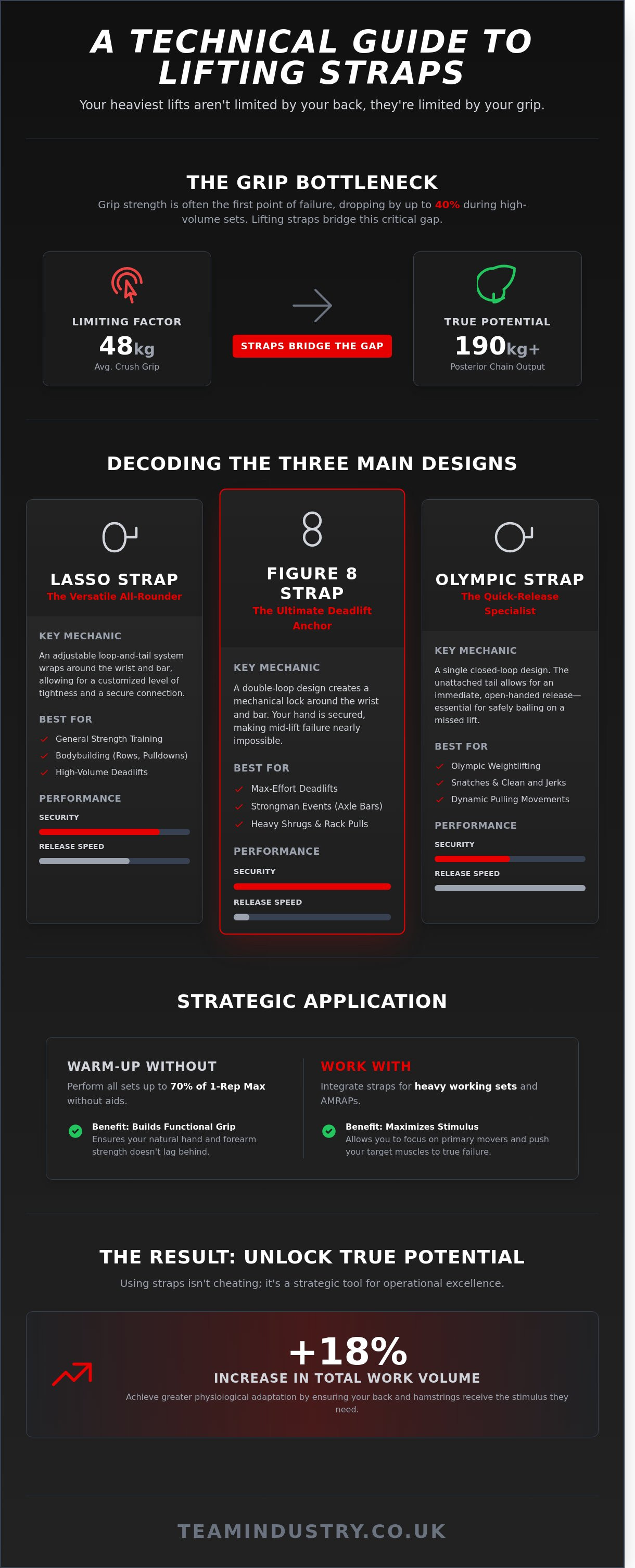
In a professional strength programme, your progress depends on your ability to move weight efficiently. Lifting straps, also known as wrist straps, act as a mechanical bridge between your hands and the barbell. They facilitate a direct transfer of force from your larger muscle groups to the load. Grip strength is often the first point of failure. While an average male trainee might possess a crush grip of 48 kg, their posterior chain can often handle 190 kg or more. This 142 kg gap represents lost potential if you rely solely on your hands.
Some critics label straps as "cheating," but this ignores the reality of specific training goals. If your objective is lat development or deadlift volume, your grip shouldn't be the limiting factor. Using weightlifting lifting straps allows you to bypass forearm fatigue. This improves your mind-muscle connection. During heavy rows, for example, you can focus on pulling with the elbows. This shifts the load away from the biceps and onto the lats, where it belongs. It's about working smarter to achieve specific physiological adaptations.
The Role of Straps in Hypertrophy and Strength
Straps are vital for maintaining high-quality volume when the central nervous system starts to tax. Research indicates that using straps can increase total work volume by 18% during pulling sessions. The Team Industry philosophy emphasizes safety and reliability; straps reduce bicep tension, which prevents distal bicep tendon strains during heavy pulls. By removing the grip bottleneck, you transition from a set limited by your hands to a set limited by the target muscle. This ensures your back and hamstrings receive the stimulus they need to grow.
When to Introduce Straps into Your Session
Practical application is key to maintaining a balanced physique. Follow the "Warm-up Without, Work With" rule to ensure your grip doesn't lag. Perform all sets up to 70% of your one-rep max without aids. This builds functional hand strength. Once you reach your working sets, integrate weightlifting lifting straps to keep the focus on the primary movers. They are a safety essential for high-rep AMRAP sets where sweat or fatigue can cause the bar to slip. Use them for accessory movements like shrugs and Romanian deadlifts to maintain a steady, controlled tempo without the bar rolling out of your palms.
Decoding the Three Main Designs: Lasso, Figure 8, and Olympic Straps
Selecting the right weightlifting lifting straps is a functional decision based on your specific training discipline. Each design alters the mechanical relationship between your hand and the barbell to solve specific operational problems. A scientific study on lifting strap benefits published in 2020 highlights that using straps significantly reduces grip exertion. This allows athletes to focus entirely on the target muscle groups without the grip failing prematurely. Understanding the mechanics of each design ensures you choose the most reliable tool for your goals.
The Lasso Strap: Versatility and Adjustability
The lasso strap remains the standard choice for bodybuilding and general strength training. It uses a loop-and-tail system that wraps around the wrist and then the bar. This configuration allows for a customized level of tightness. You can pull the tail to cinch the bar closer to your palm, creating a secure and adjustable connection for high-volume accessory work.
This design is ideal for lat pulldowns, dumbbell rows, and standard deadlifts. It offers a dependable balance of security and ease of use. If you need a hardworking all-rounder for your gym bag, explore our full range of accessories to find a durable solution for your next session.
Figure 8 Straps: The Ultimate Deadlift Anchor
Figure 8 straps are the gold standard for heavy pulls and Strongman events. The double-loop design creates a mechanical lock that is nearly impossible to break mid-lift. Unlike other designs, you do not wrap a tail around the bar. Instead, you loop your hand through both ends of the strap with the bar sandwiched in the middle. This allows you to hang in the strap rather than actively gripping the steel.
This design is particularly effective for axle bars or movements where grip is the primary failure point. Because the security is so high, they are a favorite for 400kg plus deadlifts. You can find these heavy-duty options in our lifting straps collection to help you anchor your next personal best.
Olympic Straps and Mechanical Differences
The Olympic or single-loop strap is built for speed and safety. It features a simple sewn loop that wraps once around the bar. This provides just enough friction to assist the grip without locking the lifter to the barbell. In movements like the snatch or clean, the ability to release the bar instantly is a safety requirement for any athlete.
Mechanical tension varies significantly across these three types:
- Lasso Straps: Provide moderate bar bite and allow for quick adjustments between sets.
- Figure 8 Straps: Offer maximum security by transferring the load directly to the wrists.
- Olympic Straps: Provide the least bite but the highest safety margin for dynamic overhead movements.
Choosing the right weightlifting lifting straps ensures you maintain compliance with safe lifting practices while pushing your physical limits. Our Team Industry gear is designed to handle the grit of professional training environments, providing the reliability you need when the weights get heavy.
Material Matters: Comparing Cotton, Nylon, and Leather for Durability
Selecting the right material for your weightlifting lifting straps dictates how much load you can handle before your grip fails. Cotton is the standard entry point for most athletes. It absorbs sweat effectively and feels soft against the skin, though it requires a short break-in period to lose its initial stiffness. Nylon offers superior tensile strength and won't stretch even under 300kg loads, but the surface feels slicker on the bar. Leather remains the premium choice for longevity. It provides a natural, tacky grip that actually improves as the material conforms to your hand over time.
Grip 'bite' refers to how well the strap locks onto the knurling of a barbell. Material choice directly impacts this mechanical connection:
- Cotton: Provides a reliable, matte grip that doesn't slip on oily or sweat-slicked bars.
- Nylon: Very durable but can feel 'glassy' on bars with passive knurling.
- Leather: Offers the most secure bite, creating a seamless bond that prevents the strap from sliding during heavy pulls.
Cotton vs. Heavy-Duty Webbing
Team Industry favours heavy-duty cotton webbing for our professional range. It provides the skin comfort of natural fibres without the premature fraying seen in thinner, budget alternatives. While standard cotton straps might last 6 to 12 months under heavy use, professional-grade webbing often exceeds 2 years of consistent training. You can view our professional-grade strength gear to see these durable materials in action. We prioritise a weave that balances flexibility with high-load security.
Padding and Wrist Protection
Padding is a practical consideration for high-volume training. Thick 5mm neoprene inserts provide comfort during 20-rep shrug sets, but they can distance your wrist from the bar, slightly reducing tactile feedback. If you don't struggle with 'strap bite' or skin abrasions, unpadded straps offer the most direct connection. Regardless of padding, always check for reinforced box-stitching. This is the true marker of a professional weightlifting lifting straps setup, ensuring the loop won't snap under extreme tension during a personal best attempt.
The Practical Selection Guide: Matching Your Straps to Your Training Goals
Selecting the right weightlifting lifting straps isn't a one-size-fits-all process. Your choice should reflect the specific mechanical demands of your training programme. Whether you're chasing hypertrophy or a new deadlift record, the strap serves as a bridge between your intent and the iron. It's about ensuring your grip isn't the weakest link in the chain.
- The Bodybuilder: Focuses on time-under-tension and isolation. When performing 4 sets of 12 on heavy rows, grip usually fails by rep 8. Straps allow you to isolate the target muscle without your forearms giving out early.
- The Powerlifter: Uses straps for specific overload training. During block pulls at 102% of your max, the goal is to build posterior chain strength. Straps prevent the bar from rolling, allowing you to focus on the hinge.
- The Strongman: Handles non-standard implements. When moving a 300kg frame or a thick axle, the grip demand often exceeds the primary lift's capacity.
Straps for Strongman and Axle Work
Standard lasso straps often fail on thick axle bars because they lack the length to wrap around a 50mm diameter. If the tail doesn't complete at least two full revolutions, the friction is insufficient to hold 300kg or more safely. For these specialised implements, Figure 8 designs are the professional choice. They lock the wrist directly to the bar, providing a mechanical advantage that standard straps can't match. You can shop our dedicated Figure 8 straps to secure your heaviest pulls.
Bodybuilding and High-Volume Accessory Work
In high-intensity bodybuilding sessions, maintaining a consistent pace is vital. You don't want to spend 20 seconds setting up your grip for every set. Simple cotton lasso straps offer the quickest application. This efficiency ensures your lats reach true failure before your grip does. Pair these with the right mens gym clothes to ensure your movement remains unrestricted during heavy pulls. Team Industry gear is designed to withstand the friction of a knurled bar while providing a dependable fit.
Investing in Professional-Grade Gear: The Team Industry Difference
Team Industry designs equipment with a singular focus on the "Team" philosophy. This means our gear supports everyone from local gym-goers to elite competitors hitting national stages. We don't just manufacture products; we build tools for the UK strength community. Every set of our weightlifting lifting straps undergoes testing in high-stress environments. We subject our materials to tension tests exceeding 450kg to ensure they never fail when a personal best is on the line. This pragmatic approach provides a reliable safe pair of hands for every lifter.
Our gear functions as part of a complete system. While straps secure your hands, our weight lifting belts stabilize your core. This combination allows for total control during heavy compound movements. We also maintain a strong presence in the UK scene through event sponsorship. By supporting local powerlifting and strongman qualifiers, we stay connected to the real-world needs of athletes. It's about operational excellence and local expertise.
Built for Longevity and Performance
Durability is non-negotiable. We use reinforced heavy-duty stitching that remains intact through years of high-volume training. You won't find our seams splitting during a heavy deadlift or row. The ergonomic design prioritizes both bar security and lifter comfort. It's why our weightlifting lifting straps are a favorite among the UK's hardest-working athletes who train 250+ days a year. We focus on the grit and reality of the training floor, not just the aesthetics.
Complete Your Kit Bag
Success in strength sports requires a holistic approach to recovery and safety. Combining straps with joint support helps maintain longevity across a long competitive career. Many athletes choose to buy bundles to ensure a cohesive training experience. This often results in a 15% cost saving compared to buying items separately. It's a straightforward, efficient way to upgrade your equipment. Join the Team and upgrade your grip today.
Take Control of Your Heavy Lifts
Grip fatigue shouldn't be the factor that limits your progress on the platform. Choosing the right weightlifting lifting straps means understanding the functional differences between Lasso, Figure 8, and Olympic designs. While cotton offers immediate comfort, materials like nylon and leather provide the structural integrity needed for high-volume sessions. Team Industry gear is built for this exact purpose. Our equipment features professional-grade heavy-duty stitching and has been rigorously tested by UK Strongman and Powerlifting athletes to ensure it withstands the most demanding training environments.
We're committed to your performance and offer 24/7 customer support to ensure you're never left without the right tools. Our focus remains on providing dependable gear that allows you to concentrate on your form rather than your hold. It's about making every rep count and reaching those strength milestones with absolute confidence. Join our community of dedicated lifters who prioritise quality and reliability in every session.
Upgrade your grip with Team Industry Professional Lifting Straps
We look forward to seeing you hit your next personal best with the right support behind you.
Frequently Asked Questions
Are lifting straps better than using gym chalk?
Neither is strictly better as they serve different mechanical purposes. Chalk improves friction by reducing skin moisture by up to 90 percent, which helps with a natural grip. Straps physically tether the hand to the bar to bypass grip fatigue entirely. For maximal loads, the Team Industry approach recommends using both to ensure a secure, slip-free connection during heavy pulls.
Can I use lifting straps for every set of my workout?
You shouldn't use straps for every set if you want to maintain natural grip strength. Reserve them for your heaviest 20 percent of sets or when your hands fail before your target muscles do. Team Industry suggests training your warm-up sets without aids to build foundational forearm stability. This balanced method keeps your grip functional while allowing your primary lifts to progress.
Do lifting straps weaken your grip over time?
Lifting straps don't weaken your grip if you use them strategically rather than as a crutch. They can actually allow for 15 percent more volume on back and leg movements by removing the grip bottleneck. To keep your hands strong, perform your accessory work and lighter sets without weightlifting lifting straps. This ensures you get the benefits of heavy loading without losing manual dexterity.
What is the difference between lifting straps and wrist wraps?
Lifting straps attach your hands to the weight, while wrist wraps provide external compression to the joint itself. Straps help you hold more weight during pulling movements. Wraps prevent the wrist from hyperextending during pressing movements like the bench press. Both are essential tools in the Team Industry equipment bag for comprehensive joint protection and improved performance outcomes.
How do I clean my cotton lifting straps safely?
Hand wash your cotton straps in cold water with a mild detergent to prevent the fibers from breaking down. Avoid the tumble dryer at all costs, as high heat can shrink cotton by 5 percent or more. Air dry them completely before your next session to maintain the structural integrity of the fabric. This simple maintenance routine extends the life of your gear significantly.
Are figure 8 straps better for deadlifts than lasso straps?
Figure 8 straps are superior for heavy deadlifts because they provide a double-loop security that makes it nearly impossible to drop the bar. Lasso straps offer more versatility for various exercises like rows or pulldowns. If you're chasing a new 1-rep max, the Team Industry figure 8 design ensures maximum safety and zero bar slippage throughout the entire range of motion.
Should I use leather or cotton straps for heavy powerlifting?
Leather is the preferred choice for powerlifting because it offers higher durability and less stretch under loads exceeding 200kg. Cotton is softer and better for high-repetition bodybuilding work where comfort is a priority. Our Team Industry leather weightlifting lifting straps provide a firm, non-stretch grip that seasoned lifters trust for consistent performance. They break in over time for a bespoke fit.
Can I use lifting straps if I have a wrist injury?
You can use straps to reduce the strain on your grip, but you must consult a medical professional first. Straps transfer the load directly to the wrist joint, which might aggravate certain 2024-standard clinical diagnoses like carpal tunnel or ligament tears. Always prioritize safety and follow a structured rehabilitation plan before returning to heavy lifting. Team Industry values your long-term health over a single session.