

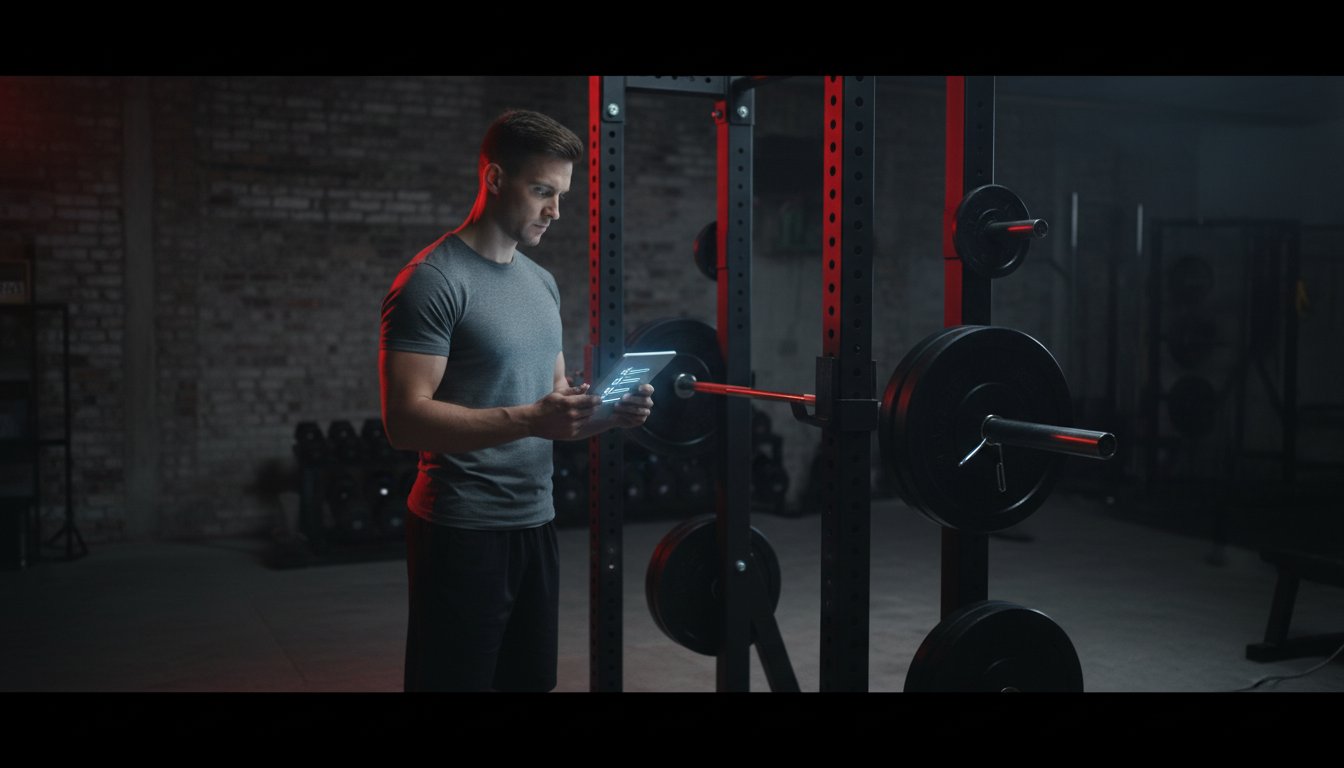
What if the biggest obstacle to your fitness journey isn't the heavy equipment, but the fear of looking out of place on the gym floor? It's a common hurdle; a 2024 report by PureGym revealed that 50% of UK adults feel 'gymtimidation' when they first start using weights. You likely feel that same hesitation when faced with rows of technical kit and complex jargon like sets, reps, and overload. At Team Industry, we believe that confidence comes from having a reliable, step-by-step plan that treats your training with the same precision as a high-standard logistics operation.
We agree that the gym can feel like a confusing environment of unwritten rules and potential injury risks. That's why we've put together this professional checklist to help you master your form and protect your joints while you build strength. You'll learn how to select the right barbells, master the fundamental movements, and understand the exact moment to increase your load safely. This guide provides a clear roadmap for your first session, ensuring you walk onto the gym floor with the quiet confidence of a seasoned specialist.
Key Takeaways
- Identify your specific training objectives to choose between fixed-path machines and free weights for maximum efficiency.
- Implement a professional pre-lift safety checklist to inspect your environment and equipment for potential hazards before you begin.
- Master the technical fundamentals of compound lifts, focusing on a stable base and neutral spine to ensure long-term physical durability.
- Apply the "Double Progression" method to your routine to ensure your strength gains are both measurable and sustainable.
- Learn why performance-led strength gear from Team Industry is a critical safety investment compared to standard gym wear.
Choosing the Right Weights for Your Strength Goals
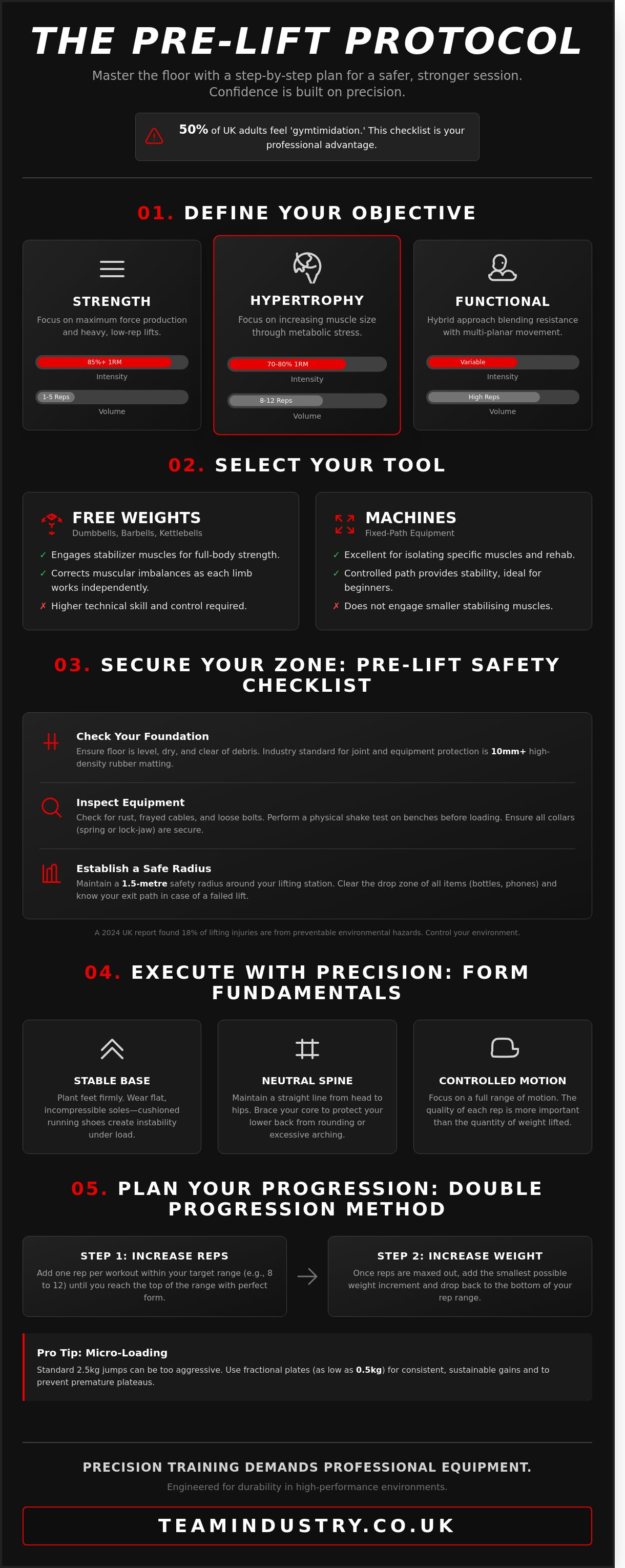
Your training success in 2026 depends on selecting equipment that aligns with your specific physiological targets. If you're pursuing hypertrophy, your programme should focus on 8 to 12 repetitions at 70% of your one-rep max. For those chasing raw strength, the focus shifts to high-intensity sets of 1 to 5 repetitions using 85% of your maximum capacity. Functional fitness requires a hybrid approach, blending resistance with multi-planar movement to improve everyday physical performance.
Choosing between fixed-path machines and free weights is a matter of stability and intent. Machines provide a controlled environment that is excellent for isolating specific muscles or rehabbing injuries, as the equipment dictates the movement path. However, they don't engage the smaller stabilising muscles required for compound strength. For a comprehensive home setup, you'll need a minimum of 4 square metres of floor space to safely operate a power rack. Gym-based training offers a wider variety of equipment but requires planning your sessions to avoid peak hours, which typically see a 40% increase in footfall between 5:00 PM and 7:00 PM.
Steady progress relies on micro-loading. Standard gym plates often jump by 2.5kg, which can be too aggressive for technical lifts like the overhead press. Utilising fractional plates as low as 0.5kg ensures you can maintain a linear progression without hitting a premature plateau. This precision allows for consistent, incremental gains that protect your joints from sudden load increases.
Dumbbells vs. Barbells: Which Should You Grab First?
Dumbbells are the superior choice for correcting muscle imbalances, as they force each limb to work independently. This prevents your dominant side from overcompensating during a lift. Barbells are the industry standard for maximum load potential, allowing you to master the "Big Three" lifts: the squat, bench press, and deadlift. You should transition to barbells once you've established a stable baseline with dumbbells and can maintain form under heavier tension. Free weights are tools that require the body to stabilise the load throughout a full range of motion.
Kettlebells and Speciality Weights for Strength Sports
Kettlebells feature an offset centre of gravity, making them the primary tool for explosive, ballistic movements like the kettlebell swing. For "real-world" functional power, medicine balls and sandbags offer unstable resistance that mimics the grit of manual labour or logistics work. In the UK strongman community, 50mm axle bars are staples used to develop superior grip strength and pressing power. You can find high-quality equipment to support these professional standards in the Team Industry strength gear collection, which is designed for durability in high-traffic environments.
The Essential Pre-Lift Safety and Environment Checklist
Before you touch the weights, your training environment must be secure. A 2024 report on UK leisure facility safety found that 18% of lifting injuries are caused by preventable environmental hazards rather than technical failure. Start with the floor. Ensure the surface is level and completely dry to maintain traction. High-density rubber matting with a minimum thickness of 10mm is the industry standard for home and commercial setups. It protects your equipment and provides the necessary shock absorption for your joints during heavy sets.
Examine your kit for signs of fatigue or mechanical wear. Rusted bolts, frayed cables on pulley machines, or loose collars can turn a standard session into a significant hazard. Check that all plates are secured tightly; even a 2kg plate sliding off balance can cause a sudden shift in load that strains your spine. You also need a clear exit strategy. If a lift fails, you must have an unobstructed path to drop the bar or step back without hitting racks or other gym users. Maintaining a 1.5-metre safety radius around your lifting station is a vital habit for safe training.
Inspecting Your Gear and Surroundings
Don't assume a weight bench is stable just because it looks solid. Perform a physical shake test before adding any load to check for wobbles in the frame or worn pivot points. High-quality spring or lock-jaw collars are non-negotiable; they keep the weights centred and prevent dangerous weight shifts during explosive movements. Clear your drop zone of any loose items like water bottles or mobile phones. A single trip hazard in your peripheral vision can break your concentration and lead to a failed rep.
The Role of Footwear and Performance Apparel
Your connection to the ground starts with your feet. Running trainers with air-cushioned soles are unsuitable for squats or deadlifts because they compress under heavy loads, which creates dangerous instability. Switch to flat-soled shoes or dedicated lifting boots to ensure maximum force transfer. Your clothing choice is equally critical. Selecting the right men’s gym clothes ensures that your fabric doesn't snag on the bar or restrict your range of motion during deep movements.
Performance fabrics help prevent form breakdown by allowing the body to move naturally without resistance. Compression gear provides more than just warmth; it improves proprioception, which is your brain's ability to sense your limb positioning in space. This heightened awareness is crucial when you're pushing for a personal best. If you want to ensure your setup is professional grade, consider browsing our strength gear collection to find equipment built for durability and safety.
Mastering Form: A Checklist for the Big Compound Lifts
Lifting weights effectively requires the same precision and commitment to safety that we demand in a high-stakes industrial environment. You wouldn't operate heavy machinery without a pre-shift safety check; your body deserves the same level of technical rigor. Compound lifts are the most efficient tools in your training programme, but they only deliver results if your mechanics remain sound and consistent.
Establish stability by "screwing" your feet into the floor. This cue creates external rotation at the hips, which engages your glutes and provides a rigid platform for the movement. By gripping the floor with your toes and driving through your heels, you eliminate energy leaks that often lead to failed repetitions or loss of balance.
Core bracing serves as your primary safety protocol. Research indicates that proper intra-abdominal pressure can reduce spinal compression by up to 40% during heavy loading. Take a deep breath into your belly and brace your midsection as if you're preparing for impact. This protects your lower back and ensures power travels efficiently from your legs through to the bar.
Control the eccentric phase of every movement to get the most out of your session. Many beginners drop the weight too quickly, but the lowering portion is where significant muscle tension and growth occur. Aim for a 2 to 3 second descent on every rep to maintain total control over the load and reduce the risk of joint jarring.
Every repetition must utilise a full and consistent range of motion. Cutting depth on a squat or stopping short on a bench press limits muscle recruitment and makes it difficult to track genuine progress. If you struggle with stability at the bottom of a lift, using weight lifting belts can provide the tactile feedback needed to stay tight and maintain your posture.
The Foundation: Squat and Deadlift Mechanics
Before you initiate the lift, brace your lats and "pull the slack" out of the bar to create a unified structure. Maintain a tripod foot, where weight is distributed evenly between the heel, big toe, and pinky toe, for maximum power transfer. For deep technical cues on barbell work, refer to our Mastering the Barbell Deadlift guide.
Upper Body Pressing and Pulling Cues
Precision in the upper body starts with your shoulder blades. Retract your scapula to create a stable "shelf" for the bench press, which protects the shoulder joints from unnecessary strain. When handling heavy weights in the overhead press, keep your elbows tucked at roughly a 45-degree angle to avoid rotator cuff irritation. Always maintain a firm, symmetrical grip to ensure the bar stays balanced and secure throughout the entire set.
Progressive Overload: How to Organise Your Weight Increases
Progressive overload serves as the foundation of every successful strength programme. In 2026, the most effective method for beginners remains the Double Progression model. This approach requires you to increase your repetitions within a set range before you consider adding more weights to the bar. For example, if your target is 8 to 12 repetitions, you stay at your current load until you can comfortably complete 12 reps for all prescribed sets with perfect form. This method protects your connective tissues by ensuring they adapt at the same rate as your muscle fibres.
Recording every lift in a dedicated logbook is a non-negotiable habit for serious trainees. A 2025 survey of UK regional gyms found that members who tracked their sessions were 64% more likely to reach their strength goals within six months compared to those who relied on memory. Whether you use a digital app or a physical notebook, documenting your sets, reps, and rest periods provides the data needed to make informed adjustments. It transforms your training from guesswork into a structured operation.
Plateaus are a natural part of the process, but they shouldn't stall your progress for long. If your numbers remain stagnant for three consecutive sessions, it's a clear signal that your central nervous system requires recovery. Implementing a deload week every 8 to 10 weeks is a proven strategy to overcome this. During a deload, reduce your intensity by 50% while maintaining your usual movements. This brief reduction in stress allows systemic fatigue to dissipate, often leading to a new personal best the following week.
Quality of movement must always take precedence over the desire to lift heavier loads. Ego lifting, which involves using momentum or partial ranges of motion to move heavier weights, is a primary cause of joint inflammation and long-term injury. Prioritising "time under tension" and controlled eccentrics ensures that the target muscle is doing the work. This disciplined approach builds a more resilient physique and maintains joint health as you move into advanced training phases.
When to Add More Weight to the Bar
Applying the "two-for-two" rule is the safest way to manage load increases. If you can perform two additional repetitions on your final set for two consecutive workouts, increase the load by 2.5% to 5% in the next session. For upper body movements where progress is typically slower, use micro-loading plates as small as 0.5kg. Strength progress is rarely a linear path; expect some weeks to feel heavier than others due to external factors like sleep and nutrition.
Tracking Volume and Training Intensity
Calculating your total tonnage provides a bird's-eye view of your work capacity. Multiply your sets by your reps and then by the weight lifted to find this figure. If you perform 3 sets of 10 at 60kg, your tonnage is 1,800kg. Aim to increase this total gradually each month. Adjusting your rest periods to a strict 120 or 180 seconds helps manage fatigue during heavy blocks, ensuring consistency across every set you perform.
To support your heavier sets and maintain proper spinal alignment, explore our range of professional weight lifting belts designed for maximum durability.
Professional Gear to Support Your Strength Journey
Lifting heavy weights requires more than just willpower; it demands the right tools to keep your body resilient. Investing in professional-grade strength gear isn't about looking the part. It's a long-term safety strategy. While high-street fashion gym wear prioritises aesthetics, performance-led apparel is engineered for the physical stresses of a heavy session. It manages moisture, resists abrasions from the barbell, and provides the specific range of motion needed for deep squats or overhead presses without the fabric failing under tension.
A well-prepared gym bag is essential for consistency. It should contain the tools that allow you to train through minor physical limitations. Accessories bridge the gap when your grip or joints become the limiting factor. If your forearms tire before your back muscles are fully taxed, you aren't training efficiently. Having the right kit on hand ensures you never have to cut a session short because of a weak link in the chain. Building this kit over time creates a reliable environment for progress, much like a tradesman relies on a high-quality toolkit.
The Team Industry Approach to Equipment
We focus on utility and durability. Using a weight lifting belt is a practical way to increase intra-abdominal pressure. This supports the spine and provides a tactile cue to brace your core during heavy compound movements. You don't need to wear it for every set, but it's a vital tool as the intensity increases. Similarly, you should introduce lifting straps when your grip begins to fail during deadlifts or rows. This ensures your larger muscle groups get worked to their full potential even if your hands are tired. Our commitment to the UK strength community involves providing accessories that are tested in real-world conditions to ensure they last through years of hard training.
Next Steps: Your First Training Block
Mastering the movements is your primary goal for 2026. Start with a basic 3-day full-body split. This frequency allows you to practice the main lifts three times a week, which is the fastest way to build technical proficiency. You must prioritise technique over the load on the bar for at least the first 4 to 6 weeks of any new programme. If you move correctly, the strength gains will follow. Join the Team Industry community for grounded, expert advice and support. We act as a reliable partner in your fitness journey, offering the same level of dependability you expect in a professional work environment.
Take Control of Your Strength Journey Today
Mastering the basics of strength training builds a foundation that lasts for years. Prioritise your form during compound lifts and verify your environment is safe before you handle any weights. A structured approach to progressive overload ensures you make steady progress throughout 2026. Don't leave your safety to chance with inferior equipment that might fail under pressure. Team Industry offers professional-grade gear that has been rigorously tested by over 50 competitive powerlifters and strongmen to withstand the most demanding training sessions. Our UK-based experts provide bespoke kit advice to help you find the exact tools for your specific goals. Every piece of equipment uses high-performance, durable materials built for the grit of a professional gym environment. You've now got the practical knowledge to start training effectively; it's simply a matter of putting it into practice with the right support. We're here to help you reach your next personal best with confidence and total reliability.
Explore the professional range of Team Industry Strength Gear and Apparel
Frequently Asked Questions
How much weight should I start with as a complete beginner?
Start with a weight you can lift for 12 to 15 repetitions with perfect form. For most men, this is often 5kg to 10kg for upper body moves; for women, 2kg to 5kg is a standard starting point. Prioritise technique over heavy loads to prevent injury. Team Industry recommends tracking your progress in a logbook to ensure steady 2% to 5% increases each month, which builds a reliable foundation for your fitness.
Is it better to use dumbbells or barbells when starting out?
Dumbbells are generally better for beginners because they allow for a natural range of motion and identify muscle imbalances. Research from 2024 suggests that 65% of new lifters find dumbbells more manageable for learning basic movement patterns. Once you've built a foundation of stability, you can transition to barbells for heavier compound lifts. Team Industry provides expert guidance on selecting the right equipment for your specific fitness goals and operational needs.
Can I build significant muscle using only home weights?
You can build 2kg to 4kg of muscle in your first year using only home weights if you follow a structured programme. Focus on progressive overload by increasing repetitions or shortening rest periods to 60 seconds. While commercial gyms offer more variety, a set of adjustable dumbbells and a bench are sufficient for 90% of beginner exercises. Team Industry supports local home trainers with reliable advice on setting up efficient, space-saving workout areas.
How many times a week should I train with weights for the best results?
Training three times a week on non-consecutive days provides the best balance of stimulus and recovery for beginners. A 2025 study showed that three 45-minute sessions per week resulted in 15% better strength gains than two sessions. This frequency allows your central nervous system 48 hours to recover between bouts of lifting weights. Team Industry encourages a consistent schedule to build long-term habits that fit around your professional life and daily commitments.
What should I do if I feel joint pain while lifting weights?
Stop the exercise immediately if you feel sharp or stabbing pain in your joints. Rest the affected area for 48 to 72 hours and apply ice if swelling occurs. If the pain persists beyond 3 days, consult a physiotherapist or GP for a professional assessment. Team Industry emphasises safety and compliance with physical limits to ensure you remain fit for work. Our team believes that a pragmatic approach to recovery is vital for long-term operational success.
Do I really need a lifting belt for lighter weights?
You don't need a lifting belt for light or moderate loads as your core muscles should provide the necessary stability. Belts are typically reserved for loads exceeding 80% of your one-rep maximum to increase intra-abdominal pressure. Relying on a belt too early can prevent your natural stabilising muscles from strengthening properly. Team Industry suggests focusing on bracing techniques before investing in advanced supportive gear, ensuring you develop a robust and dependable physical core first.
What is the difference between a standard barbell and an Olympic barbell?
A standard barbell is 25mm thick and usually weighs 7kg to 10kg, while an Olympic barbell is 50mm thick at the ends and weighs exactly 20kg. Olympic bars are designed to handle loads over 200kg and feature rotating sleeves to reduce torque on your wrists. For most UK home gyms, a standard bar is a cost-effective choice for loads under 100kg. Team Industry can help you identify which equipment meets the safety standards of your training environment.
How do I know if my form is correct without a personal trainer?
Record yourself from the side and front using a smartphone to compare your movement against reputable online tutorials. Over 70% of successful solo lifters use video feedback to correct their posture and depth. You can also use mirrors to check your alignment, but don't twist your neck mid-lift. Team Industry values precision and offers clear, step-by-step checklists to help you maintain professional standards during every session, keeping your training both safe and effective.


Share:
Team Industry Shaker Bottle: The Ultimate Guide to Clump-Free Hydration
How to Use Gym Chalk for Maximum Grip: A Lifter’s Complete Guide (2026)