

Research shows that mental imagery alone can boost muscle strength by 22 percent, nearly rivaling the gains from physical exercise. Yet, many dedicated lifters still approach the platform with doubt, letting the weight on the bar dictate their success. If you've ever felt intimidated by a heavy load or experienced inconsistent performance during testing days, you aren't alone. Mastering mental preparation for a max lift attempt is a technical skill, just like your squat or deadlift form. It requires a pragmatic, tactical approach to ensure your mind is as reliable as your equipment.
This guide will help you master the psychological rituals and tactical mindset required to execute a successful one-rep max without second-guessing the weight. We'll cover how to build a repeatable pre-lift routine, the impact of the 2026 IPF rule changes on platform conduct, and how to use tools like Smelling Salts to improve CNS activation. You'll gain the tools to stay focused and perform with absolute certainty when it matters most.
Key Takeaways
- Balance your arousal levels using the Inverted-U theory to ensure you don't burn out mentally before the lift even begins.
- Build a consistent 5-step tactical framework that signals performance readiness to your brain every time you approach the platform.
- Use sensory anchors and professional-grade gear to neutralise the "heavy" feeling during the unrack, making mental preparation for a max lift attempt a predictable process.
- Eliminate mid-lift hesitation by identifying the "point of no return" and using specific commitment cues to drive through the sticking point.
The Psychology of the Platform: Building Mental Resilience for 2026
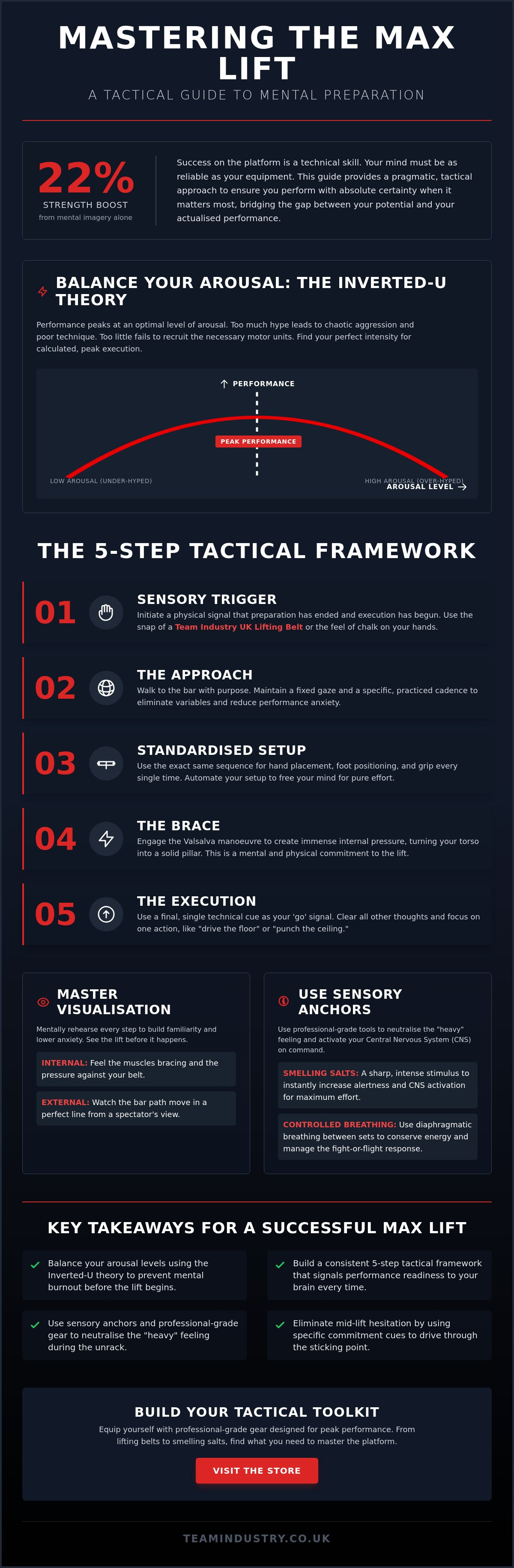
Success on the platform depends on more than just physical training. Effective mental preparation for a max lift attempt serves as the critical bridge between your potential strength and your actualised performance. Developing Mental Toughness allows you to maintain technical integrity when the load feels heaviest. The Inverted-U Theory suggests that performance peaks at an optimal level of arousal. If you're too "hyped," your technique often degrades into chaotic aggression; if you're under-aroused, your Central Nervous System (CNS) won't recruit the necessary motor units for a personal best.
To better understand this concept, watch this helpful video:
True performance requires calculated execution rather than raw gym aggression. Your CNS must "switch on" with purpose. This means treating the unrack and the setup with the same precision as the lift itself. With the 2026 IPF rule changes requiring stricter technical standards, emotional outbursts are less effective than a disciplined, tactical mindset. Every movement must be intentional to ensure you meet the updated criteria for a successful lift.
Visualisation: Seeing the Lift Before it Happens
Visualisation works through two lenses: the internal perspective and the external perspective. Internal visualisation focuses on the feeling of your muscles bracing and the pressure against your lifting belt. External visualisation involves watching the bar path move in a perfect line from a spectator's view. Mentally rehearsing every step of your setup creates a sense of familiarity that naturally lowers anxiety during the high-pressure walk-out. For a practical edge, spend 30 seconds in total silence before your final warm-up sets to lock in your focus.
Managing Arousal and the Fight-or-Flight Response
Managing your fight-or-flight response is essential for sustained performance. Use controlled, diaphragmatic breathing between sets to shift from a sympathetic state to a parasympathetic state, preserving your energy for the platform. Identify your "Personal Best Arousal Level" by reviewing past successful PRs. Some lifters thrive on the intense stimulus of heavy metal and smelling salts, while others require the quiet confidence of total silence to execute perfectly.
The Pre-Lift Ritual: A 5-Step Tactical Framework
Establishing a repeatable sequence is the most effective way to automate your performance. Consistency in the small things creates a sense of mental safety, allowing you to focus entirely on the effort. By standardising how you grip the bar or where you look, you remove variables that cause doubt. This tactical approach to mental preparation for a max lift attempt ensures you don't fall victim to paralysis by analysis when the load is at its heaviest. Every step should be deliberate and practiced until it becomes second nature.
Step 1 to 3: From Chalk to the Grip
Step 1 involves a sensory trigger. This might be the application of Liquid Chalk or the specific way you tighten your Team Industry UK Lifting Belt. Tightening your belt provides a physical signal that the preparation phase has ended and the execution phase has begun. Step 2 is the approach. Walk to the bar with a fixed gaze and a specific cadence. Step 3 is the setup. Use the exact same order for hand placement and foot positioning every single time. If you are preparing for a heavy press, The Ultimate Bench Press Guide offers specific technical anchors to integrate into this phase.
Step 4 to 5: The Breath and the Pull
Step 4 focuses on bracing. Use the Valsalva manoeuvre to create internal pressure, turning your torso into a solid pillar of armour. This physical bracing is supported by your psychology. Research into gaining strength by using the mind shows that mental training enhances the brain's signals to the muscles, effectively increasing your force output. Finally, Step 5 is the execution. This is your final go signal. It should clear all thoughts except for one single technical cue, such as "drive the floor" or "punch the ceiling." If you need extra support during the unrack, consider our Team Industry UK Wrist Wraps for added stability.
Overcoming the 'Heavy' Feeling: Sensory Cues and Gear
The "crush" is a psychological hurdle that occurs when the bar feels significantly heavier during the unrack than your brain expected. This sensation can instantly derail your mental preparation for a max lift attempt, causing you to hesitate before the first rep begins. To counter this, you must rely on sensory anchors that shift your focus from the load to your own technical execution. High-quality gear plays a vital role here by providing proprioceptive feedback. In the context of a tight lever belt, proprioception is the body's ability to perceive its position and movement in space through the sensory pressure against your torso.
Smelling Salts and Liquid Chalk as Mental Anchors
Smelling salts provide a sharp physiological jolt that acts as a central nervous system wake-up call. This intense stimulus forces your brain to shift from a passive state to one of immediate alertness. Similarly, using liquid chalk creates a reliable tactile connection to the bar. This physical certainty reduces the mental bandwidth spent worrying about the bar slipping. Use these hype aids sparingly. Reserve them for your heaviest attempts to avoid desensitisation and ensure they remain effective when you truly need them.
The 'Tightness' Factor: Belts, Sleeves, and Wraps
A 13mm lever belt offers more than just spinal support. It provides a physical wall for your abdominals to breathe against, which significantly increases mental confidence under load. This sensation of being "locked in" allows you to focus entirely on the lift rather than the weight itself. Integrating wrist wraps or other joint support further eliminates the distraction of minor aches or joint discomfort. When you feel physically secure, your mind is free to commit to the attempt without reservation.
Ensure you are fully prepared for your next session by browsing our range of professional strength gear designed for maximum security.
Execution and Aftermath: Committing to the Attempt
The moment you unrack the bar, you reach the "point of no return." Hesitation mid-lift is the primary cause of failed max attempts, as it disrupts the neurological drive your brain sends to your muscles. Effective mental preparation for a max lift attempt culminates in this single second of total commitment. Instead of thinking about the weight, focus on aggressive commitment cues. If you're deadlifting, think about "driving the floor away." If you're benching, focus on "punching the ceiling." These cues shift your focus from the external load to your internal power.
Maintain a professional, objective view of the result. Whether you hit the lift or miss it, record the attempt to refine your ritual for the next session. A successful lift is a data point confirming your process; a miss is an opportunity to identify technical or mental leaks. Under the 2026 technical standards, staying calm and objective on the platform is essential for long-term progress.
The 'All-In' Mindset: Eliminating the Exit Strategy
You must treat the bar like it's already moving before you even touch it. This "all-in" mindset removes the possibility of an exit strategy. Follow the "100 percent or 0 percent" rule: if you start the eccentric phase, you've already decided to complete the concentric. There is no middle ground. This level of certainty is what separates a standard training set from a true max-effort attempt. It requires absolute trust in your preparation and your equipment.
Learning from the Miss: Psychological Recovery
Psychological recovery is just as important as the physical lift. Differentiate between a "strength miss," where the weight was simply too heavy for your current capacity, and a "technical or mental miss," where your focus wavered. Reset your ego after a fail to ensure you don't chase a weight you aren't ready for. Use your post-lift analysis to determine if you need to adjust your setup, your bracing, or your mental cues. Equipping yourself for your next PR with Team Industry UK Strength Gear ensures your equipment is as committed to the lift as your mindset.
Secure Your Next Personal Best
Successful lifting is a matter of tactical execution rather than emotional outburst. By implementing a repeatable five-step ritual and managing your arousal levels, you bridge the gap between physical potential and platform performance. Remember that mental preparation for a max lift attempt is a skill you must train alongside your physical strength. Using sensory anchors and professional equipment allows you to ignore the "crush" of the bar and focus entirely on the movement. This disciplined approach ensures that your mind remains as reliable as your training logs when you step onto the platform.
Our gear is designed for the grit of the UK strength community and is trusted by competitive strongmen and powerlifters across the country. Whether you need the absolute rigidity of our professional-grade 13mm lever belts for maximum bracing or the reliable tactile connection of liquid chalk, your equipment should never be a point of doubt. You deserve tools that match your commitment to the sport.
Maximise your next PR attempt with Team Industry UK Professional Strength Gear.
Approach the bar with quiet confidence and a refined plan. You've put in the hard hours at the gym; now use these tactical principles to ensure your next attempt is a success.
Frequently Asked Questions
How do I get over the fear of a heavy squat or bench press?
Manage fear by standardising your setup and ensuring your equipment is reliable. When you use professional gear like our Heavy Duty Knee Sleeves or a 13mm lever belt, you create a physical sense of security that calms the mind. Focus on the technical steps of your ritual rather than the total weight on the bar. Familiarity breeds confidence, so treat your heavy warm-up sets with the exact same intensity as your max attempt.
Should I use smelling salts for every heavy set?
Reserve Smelling Salts for your top sets or platform attempts to prevent desensitisation. Using them too frequently can lead to a diminished central nervous system response, making them less effective when you truly need that physiological jolt. Use them as a tactical tool for your final PR attempt rather than a crutch for every working set. This approach ensures the "wake-up call" remains potent for your most demanding lifts.
How long should I rest between my last warm-up and a max lift attempt?
Rest for three to five minutes to allow for full ATP replenishment and central nervous system recovery. While you want to stay warm, rushing into a max attempt before your heart rate settles can lead to premature fatigue. Use this time for quiet visualisation and mental preparation for a max lift attempt. Keep your muscles warm by wearing an Industry Oversized Tee between sets to maintain your body temperature without burning excess energy.
What is the best mental cue for a max deadlift?
The most effective cue for a max deadlift is often "push the floor away" rather than "pull the bar up." This shift in perspective encourages better leg drive and keeps your hips from rising too quickly. Incorporating this cue into your mental preparation for a max lift attempt helps maintain a neutral spine under heavy loads. If grip is a concern, using Figure 8 Lifting Straps can remove that mental distraction, allowing you to focus entirely on the push.
How do I stay calm if my first max attempt feels heavier than expected?
Acknowledge the weight is heavy but remain focused on your technical execution rather than the sensation of the load. This "heavy feeling" is often just a lack of CNS readiness rather than a lack of physical strength. Tighten your Lever Belt and trust the bracing you've practiced. If the bar felt slow but moved with good form, stay with your planned numbers and trust that your second attempt will often feel smoother as your nervous system fully wakes up.


Share:
Using elbow wraps for bench press PR
Essential Equipment for Strongman Training: The Professional’s Kit Guide