

Adding an extra 25kg to your squat might have less to do with your quad strength and more to do with the specific tension of the fabric around your joints. You've likely felt that nagging hesitation at the bottom of a heavy rep or wondered why your progress has stalled at a specific weight. Every serious lifter in the UK eventually faces the knee sleeves vs knee wraps for powerlifting debate when seeking that next performance edge. At Team Industry, we believe in providing the practical tools and reliable gear you need to maintain operational excellence in the gym, just as we do for our partners in the logistics sector.
It's frustrating when joint pain or equipment confusion holds you back from a new personal best. This guide provides the technical clarity you need to choose between simple compression and high-tension mechanical carryover. You'll learn how to optimise your squat poundage while maintaining strict compliance with British Powerlifting standards. We'll examine the specific performance benefits of both options and provide a clear roadmap for your next training block to ensure your joints remain healthy and your lifts stay heavy.
Key Takeaways
- Understand the technical distinction between neoprene compression for joint warmth and elasticated wraps for mechanical energy storage.
- Analyse the performance metrics of knee sleeves vs knee wraps for powerlifting to determine if you require a 5-10kg or a 20-40kg squat carryover.
- Navigate IPF competition standards to ensure your chosen gear complies with specific "Raw" or "Raw with Wraps" division regulations.
- Optimise your lifting longevity by investing in professional-grade Team Industry gear designed for the durability required by heavy-duty training.
- Learn how to balance training volume and recovery by selecting the appropriate support level for your specific strength goals.
Knee Sleeves vs Knee Wraps: Understanding the Core Differences
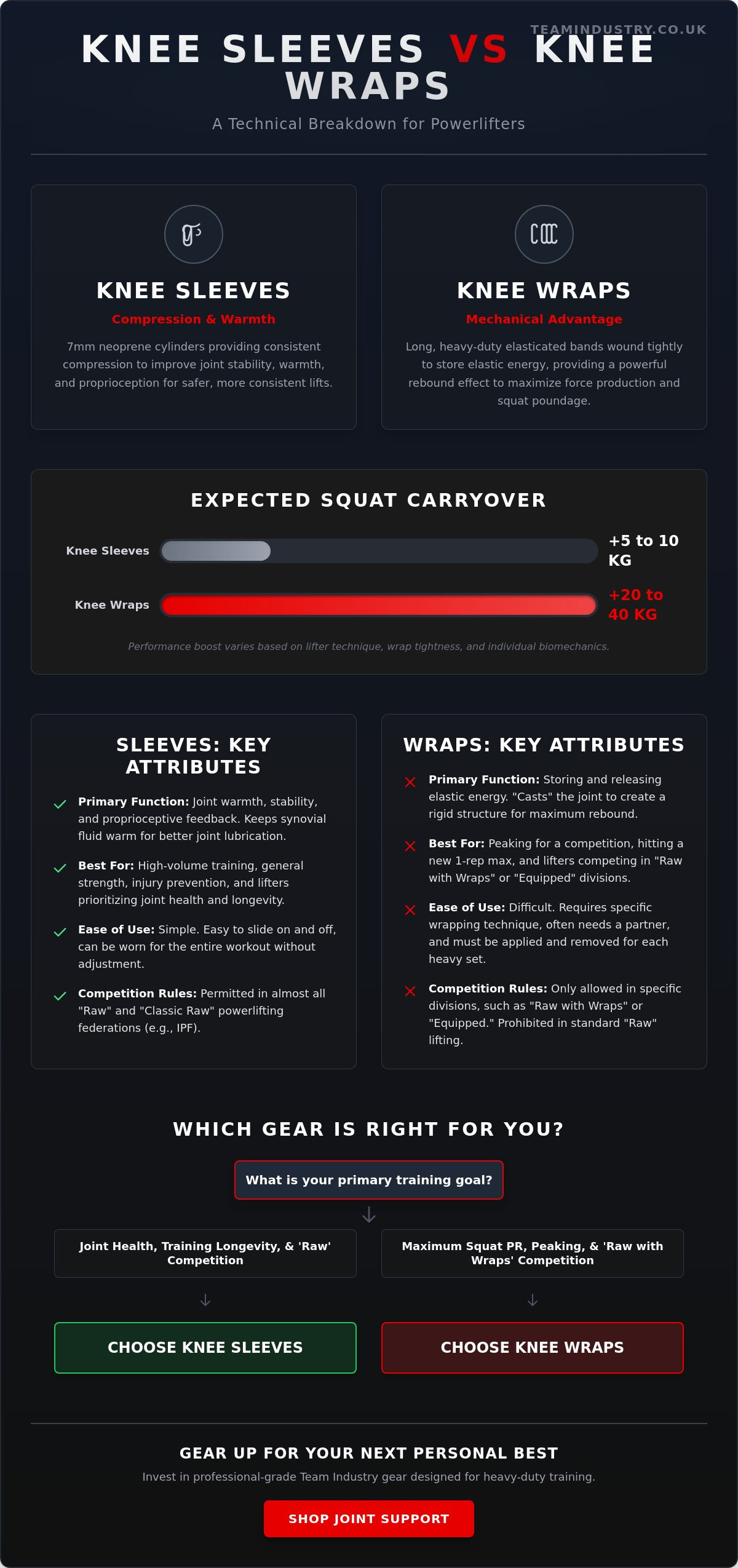
Selecting the right support for your squat depends entirely on your competitive goals and training style. While both tools provide stability, they serve fundamentally different functions under the bar. Knee sleeves are neoprene cylinders designed for consistent compression and joint warmth. Conversely, knee wraps are long strips of heavy-duty elasticated fabric engineered for mechanical energy storage and maximum force production. Understanding the nuances of knee sleeves vs knee wraps for powerlifting is essential for any lifter looking to optimise their performance safely.
The primary distinction lies in the level of assistance provided. Sleeves offer a protective layer that aids joint health, while wraps act as a performance enhancer by physically assisting the ascent of a squat. Your choice often aligns with your specific federation rules within Powerlifting, where "Raw" lifting typically permits sleeves and "Equipped" or "Classic Raw" categories allow wraps. At Team Industry, we focus on providing the gear that matches your specific discipline without overcomplicating the selection process.
What Are Knee Sleeves?
The industry standard for serious strength training is the 7mm neoprene sleeve. This thickness provides a balance of support and mobility that doesn't compromise your natural range of motion. The core benefit is compression, which improves joint proprioception. This refers to your body's ability to sense the position and movement of the joint, leading to more stable and consistent squat patterns.
Beyond stability, sleeves keep the synovial fluid within the joint warm. In the UK's often cold gym environments, maintaining this internal temperature is vital for lubrication and injury prevention. For lifters prioritising longevity and daily training comfort, our joint support collection offers the reliable protection needed for heavy sessions. They're easy to pull on and stay in place throughout your entire workout, making them a practical choice for most gym-goers.
What Are Knee Wraps?
Knee wraps are a more specialised tool. Usually measuring between 2m and 2.5m in length, these elasticated bands are manually wound around the knee joint. This process, often referred to as "casting" the joint, creates a rigid structure that stores potential energy on the descent. As you reach the bottom of the squat, the tension in the wrap provides a powerful rebound effect. This allows lifters to move significantly more weight than they could unaided, often adding 10% to 15% to a personal best.
Wraps generally fall into two categories: rebound and stiff. Rebound wraps are more pliable and suit lifters with faster descent speeds who rely on explosive power. Stiff wraps offer maximum "stop" at the bottom, providing a solid platform for lifters with a slower, more deliberate squat style. Using wraps requires specific technique and often a training partner to ensure the tension is applied consistently across both legs. They're a high-maintenance option, but for those chasing maximum poundage, they're indispensable.
The Mechanics of Support: Compression vs Elastic Energy
Understanding how gear interacts with your anatomy is vital for any lifter. When comparing knee sleeves vs knee wraps for powerlifting, the primary difference lies in how they manage force. Sleeves rely on material displacement. As you descend, the 7mm neoprene bunches behind the knee, creating a subtle rebound effect. This compression keeps the patellar tendon warm and increases blood flow to the joint, which helps manage the wear and tear of heavy training. In contrast, wraps act as heavy-duty springs designed for maximum force production.
It's a mistake to think this gear does the work for you. You still have to move the load. Equipment simply allows you to apply your strength more efficiently while managing the physical toll of 90% plus intensity sessions. While sleeves offer a passive form of support, wraps require an active technical adjustment to master the aggressive recoil they provide.
How Sleeves Improve Movement Quality
Sleeves offer a sense of security that's hard to replicate with bare knees. This psychological boost is especially noticeable during high-volume training blocks where fatigue might lead to sloppy form. They help ensure your knees track correctly over your toes, reducing the risk of lateral shift during a heavy triple or a set of eight. Proprioception is the body’s ability to sense its position in space. By increasing this sensory feedback, sleeves help you stay tight in the hole and maintain a consistent bar path. If you're looking to maintain this stability across all your sessions, exploring our range of joint support can help you find the right fit for your lifting style.
The Mechanical Advantage of Knee Wraps
Wraps provide a significant mechanical advantage by storing kinetic energy during the eccentric phase. As you squat down, the tightly wound elastic material stretches and builds tension. This stored energy is released as you drive upward, providing a "pop" that helps you bypass the common sticking point just above parallel. In fact, research has shown that wraps can alter the horizontal movement of the bar, potentially making the lift more efficient but also changing your natural squat mechanics.
- Wraps can add 20kg to 30kg to a squat compared to raw lifting.
- The extreme tension can pull a lifter's weight forward, requiring a more upright torso.
- They provide superior patellar protection by physically reinforcing the joint against shearing forces.
The trade-off for this power is a shift in technique. Because the wraps are so restrictive, they can make it harder to reach depth and may force you to sit back further into the movement than you would in a standard sleeve. Mastering knee sleeves vs knee wraps for powerlifting requires understanding these subtle shifts in leverage and balance.
Performance Impact: Squat Carryover and Training Volume
The choice between knee sleeves vs knee wraps for powerlifting usually depends on the specific kilogramme carryover you need for your total. Most lifters find that a 7mm neoprene sleeve provides a dependable 5-10kg boost. This gain is largely due to increased joint warmth and better proprioception. Wraps offer a different level of mechanical assistance. Depending on the material and how tightly they're applied, wraps can add 20-40kg to your squat. This elastic rebound helps you move weights that exceed your raw capacity.
Performance gains from wraps involve a "pain tax" that many beginners don't anticipate. High-tension wrapping causes skin irritation, deep bruising, and burst capillaries. There's also a significant fatigue factor. Self-wrapping between sets is a workout in itself; it spikes your heart rate and drains energy that should be reserved for the lift. Sleeves are more practical for high-volume training because they allow for quicker transitions and don't damage the skin, meaning you can hit heavy sessions more frequently.
When to Use Sleeves for Volume
Sleeves are the primary tool for the bulk of your training. They're best for work in the 70-85% 1RM range and all your accessory movements. Using sleeves ensures you're building genuine raw strength in the off-season without relying on the "crutch" of elastic tension. For lifters who need a dependable, all-rounder for daily sessions, our Heavy Duty Knee Sleeves offer the right balance of support and durability. They're a staple for anyone following a high-frequency programme.
When to Deploy Wraps for Max Effort
Wraps serve a specific purpose in overload training. They help desensitise your nervous system to weights that sit above your raw max, which is vital for peaking. However, their use is restricted by competition rules. The USA Powerlifting Raw/Unequipped Standards, for instance, don't allow wraps in raw categories. If your federation permits them, aim to have a training partner or "loader" apply them. A partner ensures the tension is consistent every time, which prevents the technical breakdown that often happens when you're too exhausted from wrapping yourself.
Choosing Your Gear: Competition Rules and Training Goals
Your choice between knee sleeves vs knee wraps for powerlifting depends largely on your federation's rulebook and your specific lifting stage. In the UK, most lifters follow British Powerlifting (IPF affiliate) or GBPC standards. British Powerlifting rules for the "Raw" division are strict; you're limited to neoprene sleeves that are a maximum of 30cm long and 7mm thick. If you want to use wraps, you'll need to enter the "Raw with Wraps" or "Equipped" categories. These divisions allow for more mechanical assistance, but they require a different technical approach to the squat.
Deciding which path to take involves looking at your current progress. Use this checklist to determine your needs:
- Experience Level: Novices should stick to sleeves for the first 12 to 18 months to build foundational technique without equipment interference.
- Competitive Goals: If you're chasing a maximum total in a non-tested federation, wraps are often the standard.
- Joint Health: Sleeves provide consistent warmth and compression for everyday training, making them better for general injury prevention.
Don't believe the myth that wraps make you a weaker lifter. They don't. While wraps provide a mechanical advantage, they allow you to handle supramaximal loads. This exposure trains your central nervous system to stay calm under weights that would otherwise feel crushing. You're still moving the weight; you're just using a tool to change the force curve at the bottom of the lift.
Navigating UK Federation Rules
Compliance is everything on the platform. British Powerlifting and other IPF affiliates enforce a strict 30cm length limit for sleeves. If your gear is even slightly over, the equipment marshal will reject it. For wraps, the limit is typically 2m in the IPF, while the GBPC often allows up to 2.5m. Stiff sleeves have recently surged in popularity within raw divisions. These offer a compromise, providing significantly more rebound than standard neoprene while remaining competition-legal. To manage the increased drive these sleeves provide, a Team Industry Lifting Belt is essential to keep your core stable and your spine protected during heavy attempts.
The Transition: Moving from Sleeves to Wraps
If you decide to switch to wraps, give yourself a 4-6 week acclimatisation period. You can't just put them on and expect a PB. The "kick" out of the hole is aggressive and can throw your balance off. You'll likely need to widen your foot stance by 2 to 5 centimetres. A wider base helps you sit back into the wrap tension and stay upright. Always pre-roll your wraps as tightly as possible before your set. A wrap applied from a loose roll won't provide the necessary compression to actually aid your lift. It takes practice to get the tension right, so don't rush the process during your warm-ups.
Ready to push your squat to the next level with professional-grade protection? Explore the Team Industry joint support collection here.
Maximising Longevity with Team Industry Strength Gear
Team Industry takes a pragmatic approach to strength equipment. We build gear for athletes who train four to five days a week and expect their kit to last through multiple 12 week peaking blocks. When you evaluate knee sleeves vs knee wraps for powerlifting, the immediate performance boost is only one part of the equation. Longevity matters. High grade 7mm neoprene used in professional gear maintains its shape after 500+ heavy squats, whereas cheaper alternatives often lose their rebound after just 90 days of consistent use.
To get the most out of your investment, follow a strict maintenance routine. Wash your sleeves every 14 days in cold water with a mild detergent to prevent bacteria buildup and fabric breakdown. Always air dry them; the heat from a tumble dryer can ruin the structural integrity of the neoprene. For wraps, roll them tightly and store them flat after every session. This simple habit prevents the elastic fibres from overstretching while they sit in your gym bag, which can extend the life of the gear by up to 40%.
Why Quality Material Matters for the Team
The Team Industry Heavy Duty Sleeves feature reinforced double stitching designed to withstand the lateral pressure of a wide stance squat. We use a high density fabric that provides a distinct "bite" against the skin. This texture is vital for wraps as it prevents the material from slipping or shifting during the descent. If you're building out your kit to handle more than just squats, check out our guide on Mastering Your Pull to ensure your grip strength matches your leg drive.
Building Your Professional Kit
A professional kit should be versatile. Many of our athletes bundle their gear, using sleeves for daily volume and transitioning to wraps during the final three weeks of a meet prep. This strategy keeps the stimulus fresh and reduces unnecessary wear on your competition equipment. Don't forget the importance of the upper body during a heavy squat. Adding Wrist Wraps to your kit helps maintain a rigid shelf for the bar, especially for low-bar specialists who experience high wrist strain.
The ultimate goal isn't just a single heavy lift. It's about staying in the sport for decades. Listen to your body and use your gear as a tool for support rather than a crutch for poor mechanics. If a joint feels "off," don't just wrap it tighter to hit a number. Take the recovery day and let the gear protect you during your next healthy session. Explore the full Team Industry Strength Collection to find the right support for your specific lifting style.
Take Control of Your Squat Performance
Deciding on the right support depends on your specific lifting goals and competition rules. High-grade knee sleeves provide consistent 7mm neoprene compression for high-volume sessions, while knee wraps offer the elastic energy needed for maximal squat attempts. When evaluating knee sleeves vs knee wraps for powerlifting, remember that sleeves are the standard for daily joint warmth and stability. Wraps are specialized tools for those chasing a specific squat carryover in equipped divisions.
Team Industry gear is built for the grit of the industrial gym world. Our equipment is trusted by competitive UK Strongmen and Powerlifters who require dependable performance under heavy loads. We use heavy-duty 7mm neoprene to ensure maximum compression and longevity, meeting the high standards of the UK lifting community. You don't need to settle for gear that fails when the weight gets heavy. It's time to invest in equipment that supports your progress every time you step under the bar.
Upgrade your squat with Team Industry Professional Strength Gear
Keep pushing your limits and stay focused on the work ahead.
Frequently Asked Questions
Can I wear knee sleeves and knee wraps at the same time?
You cannot wear both knee sleeves and knee wraps simultaneously in any sanctioned UK powerlifting competition. Doing so violates technical rules and provides no additional safety benefit. In training, the combination creates excessive bulk that interferes with your natural squat depth and blood flow. Team Industry advises athletes to master one specific piece of equipment rather than doubling up, as this ensures your technique remains consistent and legal.
Do knee sleeves actually prevent injuries or just hide pain?
Knee sleeves primarily improve joint warmth and proprioception rather than providing structural support like a medical brace. Research indicates that maintaining a higher joint temperature increases the elasticity of connective tissues, which helps reduce the risk of minor strains during heavy sets. While they aren't a cure for existing pathology, they offer a reliable layer of protection. Team Industry sleeves provide the consistent compression needed to keep your joints ready for maximum loads.
How tight should my knee wraps be for a competition squat?
Your wraps should be tight enough to significantly limit your range of motion when standing, requiring the weight of the barbell to help you reach depth. A common standard is to pull the wrap until it stretches 100 percent of its resting length during application. If your toes go numb in under 60 seconds, they're likely too tight. Team Industry suggests practicing your wrap tension at least 4 weeks before your meet to ensure comfort.
Are 7mm knee sleeves legal in all UK powerlifting federations?
Yes, 7mm neoprene sleeves are legal in British Powerlifting, the ABPU, and the GPC-GB, provided they don't exceed 30cm in length. When evaluating knee sleeves vs knee wraps for powerlifting, always check your federation's approved list. Most UK organisations require sleeves to be a single piece of neoprene without additional straps or Velcro. Team Industry equipment is built to meet these rigorous standards for competitive reliability and performance.
How often should I replace my knee sleeves for maximum support?
You should replace your knee sleeves every 12 to 18 months if you train 3 or more times per week. Over time, neoprene loses its memory and the material thins, which reduces the compression benefits. Look for signs like fraying seams or a 15 percent reduction in the pop you feel out of the hole. Team Industry designs its gear for durability, but consistent heavy use eventually wears down any performance fabric.
Will using knee wraps make my natural squat weaker?
Using wraps won't make your muscles weaker, but it can change your lifting mechanics if you rely on them for every session. Wraps allow you to lift 10 to 15 percent more weight by providing mechanical assistance and elastic energy. To maintain raw strength, perform 70 percent of your training volume without wraps. This ensures your tendons and stabilising muscles remain strong enough to support your long term progress.
Should I use knee sleeves for deadlifts as well as squats?
Many lifters wear sleeves during deadlifts to keep the joints warm, but they don't provide the same rebound effect as they do in the squat. If you choose to wear them, pull them down slightly so they don't catch on the bar during the pull. Team Industry sleeves feature a contoured fit that stays secure, preventing the bar from dragging against the material during the critical lockout phase of your lift.
How do I measure my leg for the correct knee sleeve size?
Measure the circumference of your knee joint at the center of the patella with your leg locked straight. For a more aggressive competition fit, take a second measurement around the thickest part of your calf to ensure the sleeve can slide over it. If you fall between sizes, Team Industry recommends sizing down for increased support or staying true to size for daily training comfort. Accurate measurements ensure 100 percent compliance with performance standards.
Share:
Bodybuilding Meal Prep on a Budget UK: The Lifter’s Guide to Maximum Gains for Less
Liquid Chalk vs Block Chalk for Grip: The Professional Lifter’s Comparison