


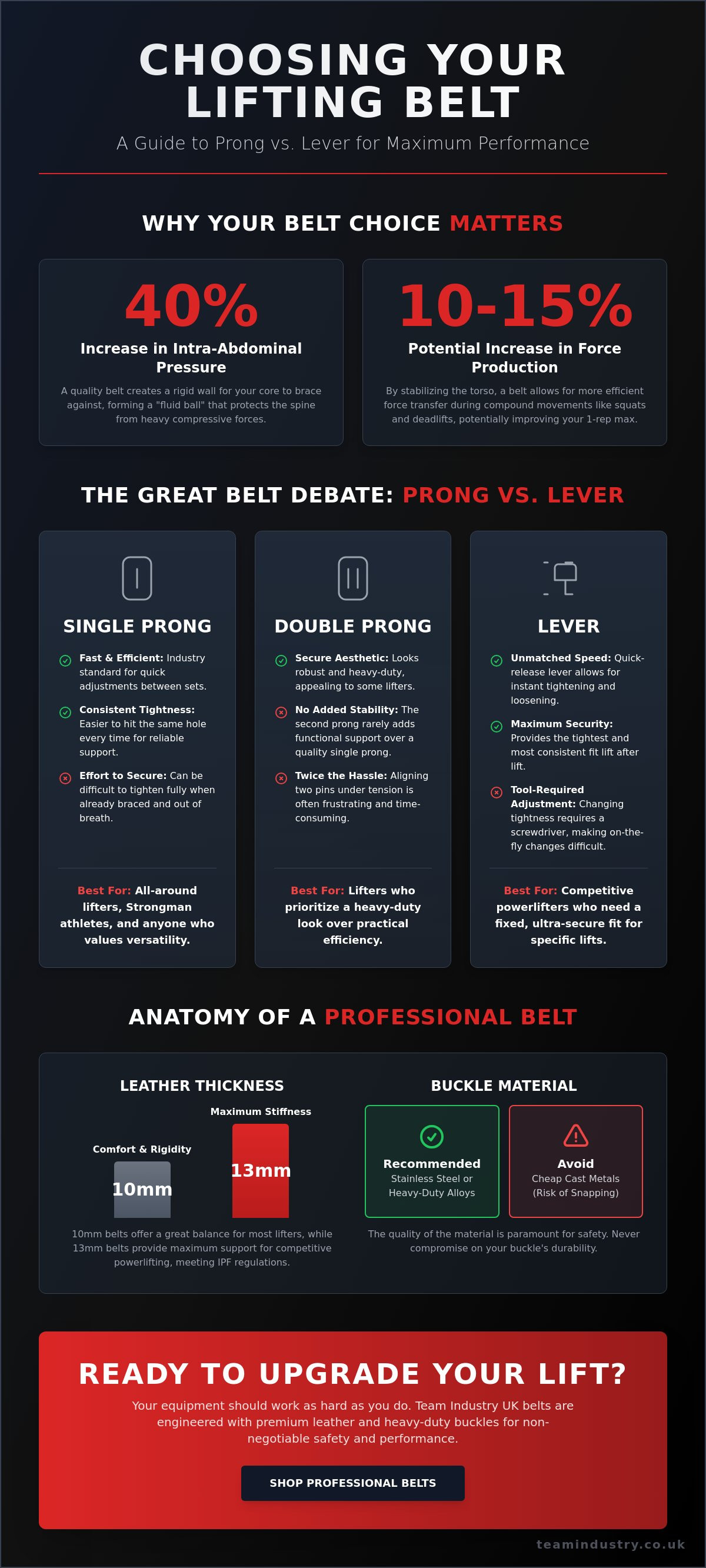
A double prong belt looks twice as secure as a single prong, but in reality, it's often just twice the hassle. That extra pin rarely translates to better spinal stability, yet it frequently leads to frustration when you're trying to tighten your gear while braced. For most lifters, the real challenge isn't the number of prongs. It's the struggle to reach a consistent tightness without pinching your skin or fighting a bulky buckle. When comparing a lever belt vs prong belt, the decision usually comes down to whether you prioritise the quick-release efficiency of a lever or the versatile adjustability of a traditional prong. Research indicates that a quality belt can increase intra-abdominal pressure by up to 40%, making your choice of fastener a critical part of your lifting setup.
We know that your equipment needs to work as hard as you do during a high-intensity session. You want a belt that provides maximum support without becoming a distraction when you're under the bar. This guide breaks down the practical differences between single and double prong designs, including how they compare to our 10mm and 13mm Lever Belts. You'll learn which configuration offers the best ease of use for your training style and how to ensure your gear meets the latest 2026 IPF regulations. We'll help you choose a dependable partner for your next heavy lift so you can focus on the weight, not the equipment.
Key Takeaways
- Understand how a prong belt creates a rigid wall for your core to increase intra-abdominal pressure and spinal stability during heavy compounds.
- Discover why single prong belts remain the industry standard for athletes who need to adjust their fit quickly between sets.
- Evaluate the trade-off between the heavy-duty aesthetic of double prongs and the practical difficulty of securing them while braced.
- Analyse the lever belt vs prong belt debate to determine which system provides the best balance of security and convenience for your specific lifting discipline.
Understanding the Mechanics of Prong and Lever Belts
A professional Weightlifting belt is a precision tool designed to provide spinal stability through circumferential tension. While many athletes focus on the buckle, the real work is done by the leather strap. A prong belt uses a traditional buckle system built to withstand extreme tension, functioning much like a heavy-duty version of a standard trouser belt. The ongoing lever belt vs prong belt debate often centres on adjustment speed and security, but the underlying mechanics of support remain the same for both designs.
Prongs serve as the anchor point that keeps the belt in place during a lift. However, the thickness and quality of the leather determine the actual support level, not the number of pins. A double prong might look more robust, but it's the material's resistance to stretching that creates the necessary wall for your torso. For most lifters, the choice comes down to how they prefer to engage that tension before a heavy set.
To better understand the practical differences between these two systems, watch this helpful video:
The Role of Intra-Abdominal Pressure (IAP)
Bracing against a rigid belt creates what experts call a fluid ball in the core. This internal pressure protects the spine by providing an outward force that counteracts the heavy load on your back or in your hands. A consistent, snug fit is far more important for maintaining this pressure than whether you have one or two pins in your buckle. Some research suggests that a properly utilised belt can lead to a 10-15% increase in force production during compound movements like the squat or deadlift. If the belt is too loose because a buckle is hard to manage, you lose that vital stability.
Anatomy of a Professional Strength Belt
Choosing between 10mm and 13mm leather thickness depends on your specific discipline. A 10mm belt offers a balance of comfort and rigidity, while a 13mm belt provides maximum stiffness for competitive powerlifting. Safety is non-negotiable. Ensure your buckle is made from stainless steel or heavy-duty alloys rather than cheap cast metals that can snap under load. You can find these professional standards across the Team Industry UK Weight Lifting Belts range, where we prioritise durability and operational excellence for every lifter. Whether you prefer a lever belt vs prong belt, the quality of the leather remains the foundation of your safety.
The Case for Single Prong Belts: Speed and Consistency
Single prong belts are the industry standard for most competitive powerlifters and strongmen. While a double prong might suggest extra security, the single pin remains the pragmatic choice for those who value efficiency under pressure. It's a tool designed for the grit of a heavy training session where simplicity often equals performance. When you're out of breath after a grinding set, the ability to exit your gear without a struggle is a significant operational advantage. The ongoing lever belt vs prong belt debate often focuses on speed, but the single prong offers a middle ground of reliability and quick adjustment.
Choosing a single pin setup is about more than just convenience. It's about consistency. It is far easier to hit the same tightness every time with one pin than it is to align two separate pins under tension. You don't need a screwdriver or a complex alignment process to find your fit. You simply pull, pin, and prepare for the lift. This straightforward design is why many hardworking specialists prefer the single prong for their daily training sessions.
Why Efficiency Matters Between Sets
The physical toll of a one-rep max or a high-volume set is immense. Your priority after the bar hits the floor is to restore normal breathing and release the pressure on your core. Single prongs eliminate the fumble factor often found with double-pin designs. You won't waste time or energy on the platform trying to align two separate points of contact while your heart rate is elevated. This speed is especially vital in Strongman competitions where transitions between implements are timed and every second counts. If your waist size fluctuates due to intra-session bloating or changing layers of clothing, the single pin allows for immediate, precise adjustments.
Is a Single Prong Secure Enough?
A common myth suggests that a single pin is a potential weak point in the equipment chain. In reality, the shear strength of the high-grade steel pins used in professional equipment like the Team Industry Lifting Belt far exceeds the forces generated during human movement. Scientific research on the Effects of a belt on intra-abdominal pressure confirms that stability comes from the belt's ability to resist expansion, not the number of pins in the buckle. No major federation, including the IPF or IPL, bans single prongs due to safety concerns. They are trusted at the highest levels of the sport because they provide dependable support without unnecessary complexity. If you are looking for a reliable partner for your heavy sessions, consider checking out the 10mm or 13mm options in our weight lifting belts collection.
Double Prong vs Single Prong: Is More Always Better?
Double prong belts are the heavyweights of the lifting world in terms of appearance. They feature two pins stacked vertically, designed to distribute stress across more surface area of the strap. While they offer a rugged, heavy-duty aesthetic, they are notoriously difficult to manage during a high-intensity session. The primary issue is misalignment. If you're using a 13mm leather belt, getting both pins into the holes simultaneously is a genuine struggle. You're often fighting the stiffness of the material while trying to brace your core, which can lead to inconsistent tightness between sets.
When weighing up the lever belt vs prong belt decision, remember that a second pin does not compensate for poor material. A double prong on thin, low-quality leather is still less secure than a single prong on a professional-grade strap. Security comes from the tensile strength of the leather, not the number of metal points in the buckle. A second pin is often a redundant feature that adds complexity without increasing spinal stability.
The Practical Disadvantages of the Double Buckle
Cranking a double prong belt to the required tightness requires significant effort. The extra hardware creates more bulk at the front of your torso, which can interfere with your setup. For example, during a deadlift, a bulky double buckle can catch on your thighs or the bar as you pull into the start position. There's also a high risk of pinching your skin when forcing the second pin into place while fully braced. This distraction is a liability before a maximal attempt. As discussed in The Weight Belt Controversy, the effectiveness of any belt relies on its ability to be used correctly and consistently.
When Should You Consider a Double Prong?
Double prongs were popular before the widespread availability of modern lever systems and high-tensile single prongs. Today, they're largely an aesthetic choice for lifters who appreciate the classic, old-school powerlifting look. If you value tradition over the efficiency of a single pin or the quick-release nature of a lever, a double prong might suit your style. However, for the hardworking specialist who needs speed and reliability, the single prong remains the superior choice for daily training. If you want a belt that balances maximum support with ease of use, explore our range of professional Team Industry Lifting Belts today to find the right fit for your next heavy session.
Lever Belt vs Prong Belt: Selecting Gear for Your Discipline
Selecting the right support depends on your specific movements and competition goals. In the lever belt vs prong belt debate, your training environment usually dictates the winner. Strongman athletes face challenges that static powerlifters don't. Moving between a heavy yoke and a log press often requires different levels of tightness. A single prong belt allows you to make these rapid adjustments on the fly. Conversely, many athletes prefer the quick-release function of a lever belt for loading events, allowing them to drop the tension immediately after the rep. For more discipline-specific advice, consult our Strongman Training Gear UK guide.
Static powerlifting movements like the squat and deadlift require absolute rigidity. In these scenarios, the buckle is just a fastener; the leather quality is the deciding factor. A 13mm Lever Belt is the ultimate option for static strength. It provides a level of immovable support that helps you stay braced through the most difficult part of a maximal lift.
The Team Industry Standard
We design our equipment for the grit and reality of the strength world. Our belts aren't just accessories; they're dependable partners for your heaviest sessions. We prioritise high-grade leather that provides the Team Industry level of stability, ensuring the strap doesn't stretch or fail under load. If you need a balance of support and flexibility, the 10mm Lever Belt offers excellent protection without the extreme stiffness of a 13mm version. It's ideal for lifters who incorporate more varied movements into their training routine.
Final Verdict: Which Should You Buy?
The lever belt vs prong belt choice depends on your daily workflow. For 95% of lifters, a single prong belt is the most practical choice. It's versatile, easy to adjust, and built to last. However, if your training is focused entirely on maximal squat and deadlift security, a lever belt is the superior investment.
Before you make a purchase, follow this checklist:
- Leather Thickness: Choose 10mm for general strength or 13mm for competitive powerlifting.
- Buckle Material: Ensure the hardware is made from high-tensile alloy or steel.
- Federation Approval: Check if the belt meets the 2026 IPF regulations for width and thickness.
Ready to commit to your next PB? Upgrade your strength gear at the Team Industry store and experience the difference of professional-grade support.
Optimise Your Strength Training Setup
Choosing the right belt is a pragmatic decision based on your training discipline and personal workflow. We've established that while double prongs offer a traditional aesthetic, the single prong remains the industry standard for its efficiency and consistent fit. Whether you're navigating the lever belt vs prong belt choice or deciding on leather thickness, the priority remains the same: reliable spinal stability that doesn't distract you from the lift.
Our equipment is built for the grit of the UK strength community. We offer professional-grade 10mm and 13mm leather options that have been rigorously tested by UK strongman and powerlifting athletes. Every belt features heavy-duty hardware designed to withstand maximal loads, ensuring your gear stays as stable as your brace. You shouldn't have to worry about your equipment when you're under the bar.
Shop Professional Weight Lifting Belts at Team Industry UK
Invest in gear that works as hard as you do. Focus on your technique, stay braced, and we'll provide the support you need to push your limits safely.
Frequently Asked Questions
Are double prong belts more supportive than single prong?
No, double prong belts don't offer more support than single prong versions. The support level is determined by the leather's quality and thickness rather than the number of pins in the buckle. A single steel pin is more than strong enough to handle the forces generated during a maximal lift. Most professional lifters choose a single pin because it provides the same stability with less hassle.
Why do some powerlifters prefer single prong belts?
Powerlifters often choose single prong belts for their versatility and ease of adjustment. If your waist size changes slightly due to intra-session bloating or different clothing layers, you can adjust a prong belt in seconds. When comparing a lever belt vs prong belt, the prong design is often preferred by those who don't want to carry a screwdriver to the gym for adjustments.
Is it harder to tighten a double prong belt?
It's significantly harder to tighten a double prong belt compared to a single prong design. You have to align two separate pins into two separate holes simultaneously while pulling the belt under high tension. This process is frustrating when you're trying to stay focused before a heavy set. The extra pin frequently leads to misalignment and wasted energy during your setup.
Can I use a single prong belt in a powerlifting competition?
Yes, you can use a single prong belt in competition as long as it adheres to your federation's technical rules. For example, the IPF 2026 guidelines state that belts must not exceed 13mm in thickness or 10cm in width. Single prong, double prong, and lever fasteners are all legally accepted. Always check your specific federation's approved brand list before stepping onto the platform.
Should I get a 10mm or 13mm prong belt?
A 10mm belt is usually the best choice for the majority of lifters. It provides a solid balance of support and comfort and breaks in much faster than thicker alternatives. If you're an advanced powerlifter moving extreme loads, a 13mm belt offers the maximum rigidity required for top tier performance. Both options are available in our Team Industry Lifting Belt range.
How do I know if my lifting belt is tight enough?
Your belt is tight enough when you can still take a full breath and brace your abdominals hard against the leather. A common rule of thumb is to have enough space to slide your hand between the belt and your stomach before bracing. If the belt is so tight that you can't get a full breath into your belly, it'll actually hinder your performance rather than help it.
Share:
Mastering Squat Depth: The Ultimate Mobility Guide for Strength Athletes
Team Industry: Redefining Gym Gear in Just 15 Months