


What if you could build the crushing power needed to load a 160 kg stone without ever touching a piece of concrete during your weekday gym sessions? Many lifters assume that without a dedicated stone pit, their Strongman progress is stalled. You likely recognize that the Atlas Stones are the iconic finale of any competition, yet the fear of lower back injury or a grip failure during the pick is a constant concern. Learning how to train for atlas stones effectively requires a calculated approach that prioritizes technical precision over raw, unrefined force.
We understand the grit required to excel in these high-stakes movements. This guide provides a clear roadmap to help you master the technical phases and gym-based accessory lifts needed to dominate the stones safely. You'll gain a firm grasp of the pick, the lap, and the final extension while learning which tools, such as Heavy Duty Knee Sleeves or a Team Industry Lifting Belt, provide the reliable stability you need. We'll ensure you're prepared for the 2026 season with the technical proficiency and safety standards required to succeed on the platform.
Key Takeaways
- Understand the unique mechanics of lifting non-linear, center-less objects to build a foundation for specialized Strongman strength.
- Master the three critical technical phases—the pick, the lap, and the load—to ensure every repetition is executed with maximum efficiency.
- Discover how to train for atlas stones in a commercial gym environment using high-carryover movements like Zercher squats and deficit deadlifts.
- Implement a professional support system using a Team Industry Lifting Belt and Heavy Duty Knee Sleeves for essential joint protection and stability.
- Prioritize technical patience and specific hip-hinge accessories to transition safely from raw power to competitive stone loading proficiency.
Understanding the Mechanics of Atlas Stone Training
Atlas Stone lifting stands as the undisputed crown jewel of the Strongman world. Unlike the standardized dimensions of a barbell, a stone is a non-linear, center-less object that demands a complete shift in how you apply force. To understand the history of lifting stones is to realize that this event is the ultimate test of functional, raw power. As you learn how to train for atlas stones, you must transition from moving a weight around your body to becoming one with the object itself.
To better understand this concept, watch this helpful video:
Success in this event relies on a specialized recruitment of the glutes, hamstrings, erectors, and lats. You aren't just performing a standard pull; you're executing a stone-specific hip hinge that requires the torso to wrap around the sphere. This positioning places a unique shear force on the spine, making a reliable Team Industry Lifting Belt essential for maintaining the necessary intra-abdominal pressure.
Why Barbell Strength Isn't Enough
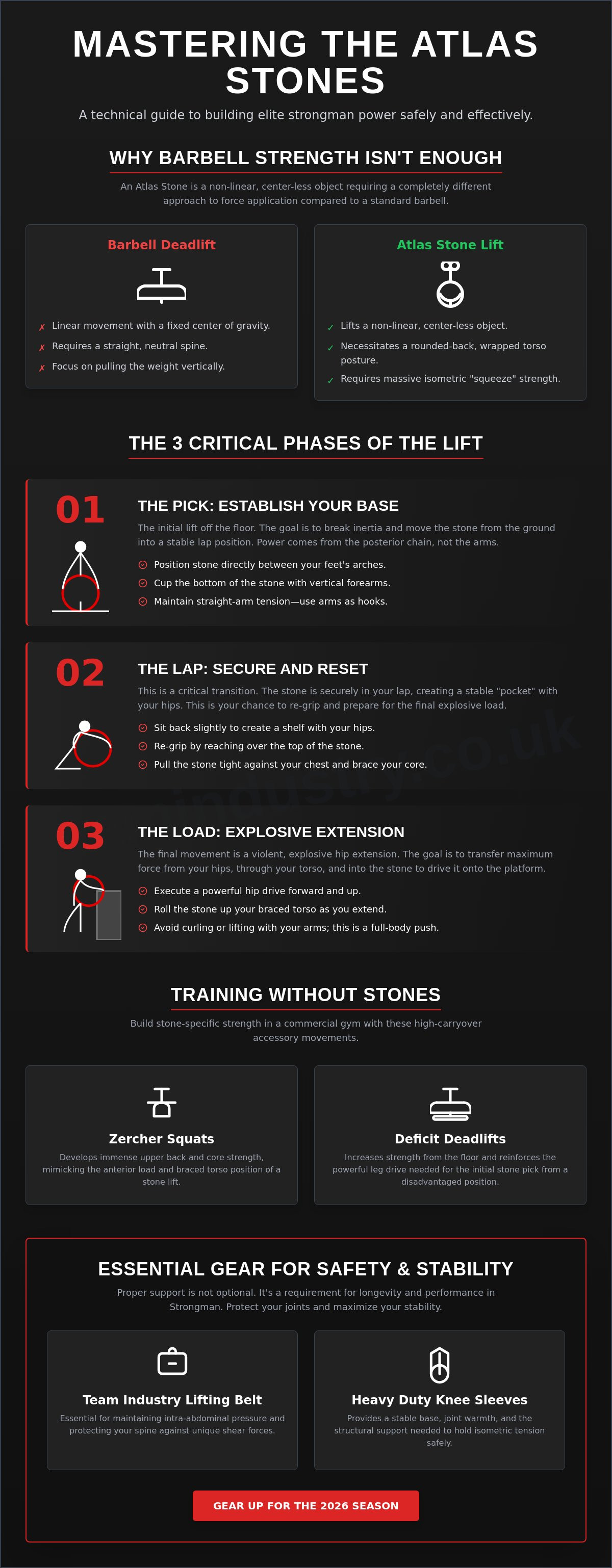
A heavy barbell deadlift is a linear movement with a fixed center of gravity. In contrast, the stone pick requires a rounded-back posture that would be considered technical failure in powerlifting. You must brace against the stone rather than sitting under it. This shift in leverage means that even a 300 kg deadlifter can struggle with a 120 kg stone if they don't respect the mechanical differences.
The Role of Isometric Strength
Understanding how to train for atlas stones involves more than just lifting heavy; it's about mastering the "squeeze." You need massive isometric strength in the lats and forearms to maintain a constant inward pressure. Lap isometric tension is the key to a successful load because it secures the stone before the final explosive extension. Utilizing Heavy Duty Knee Sleeves provides the stable base and joint warmth required to hold this tension without compromising your structure.
Master the Technical Phases: Pick, Lap, and Load
Lifting a stone is a three-stage operation that requires a specific sequence to move the object efficiently from the floor to the platform. Research into The Biomechanical Characteristics of the Atlas Stone Lift shows that peak force occurs during the initial lift and the final transition. Understanding these phases is crucial when learning how to train for atlas stones. The process begins with the pick, where you establish your base. Next is the lap, where you secure the stone for a reset. Finally, the load involves a violent hip extension to reach the target height.
A common technical error is attempting to "curl" the stone with your arms. This mistake places immense strain on the biceps and often leads to serious injury. Keep your arms straight and use them as hooks rather than primary movers. To maintain the necessary core stability during this high-tension start, many athletes rely on a Team Industry Lifting Belt to secure their midsection and support intra-abdominal pressure.
Perfecting the Stone Pick
Position your feet so the stone sits directly between your arches. If the stone is too far forward near your toes, you will lose leverage immediately. Cup the bottom of the stone with your hands, keeping your forearms as vertical as possible. Maintain straight-arm tension throughout this phase. This technique protects your tendons and ensures the power comes from your posterior chain rather than your upper body.
The Transition: From Lap to Load
Once the stone is in your lap, sit back slightly to create a stable "pocket" with your hips. This is your moment to re-grip. Reach over the top of the stone and pull it tight against your chest. Take a deep breath and brace your core. The final load is not a slow lift; it is an explosive drive. Push your hips forward and up, rolling the stone up your body until it clears the platform. Using Heavy Duty Knee Sleeves during this transition provides the joint warmth and stability needed for a confident, powerful extension.
Training Without Stones: Effective Gym-Based Alternatives
Many lifters believe that without access to a stone pit, their progress is impossible. This is a misconception. You can build the foundational strength required for the platform within a standard commercial gym. Understanding how to train for atlas stones without the stones themselves involves selecting movements that replicate the specific leverages and awkward center of gravity found in Strongman events.
The Zercher squat is the premier barbell movement for stone carry-over. By holding the bar in the crooks of your elbows, you force your body to manage a weight that sits in front of your center of gravity. This mimics the exact positioning of a stone during the lap and load phases. Aim for 3 sets of 5-8 reps to build the mid-back endurance necessary for high-rep stone runs. To build the "off the floor" power needed for the initial pick, incorporate deficit deadlifts. Standing on a 2 to 4 inch platform increases the range of motion and forces the hips to work harder from a deeper position. Pair these with stiff-legged deadlifts (SLDL) to strengthen the posterior chain. These movements ensure your hamstrings and erectors are prepared for the unique demands of the stone-specific hip hinge.
You can also use heavy duty accessories or weighted packs to mimic the shifting physics of a stone. These tools are excellent for practicing the "squeeze" and carrying the load over short distances.
The Power of the Zercher Variation
The Zercher variation is not just about leg strength; it is a total-body stability test. It trains the upper back to remain rigid under a forward-pulling load, which is exactly what happens during a stone load. To maximize safety during these heavy sets, ensure you are wearing a Team Industry Lifting Belt to maintain core pressure and protect your spine from the forward shear forces.
Upper Back and Grip Accessories
Crushing strength is the final piece of the puzzle. Weighted pull-ups and chest-supported rows build the lat thickness required to secure the stone against your chest. Maintaining a secure hold on gym equipment is vital during these accessory blocks. Using Liquid Chalk ensures your grip remains dependable even during high-volume sessions. For those looking to push their accessory limits, explore our full range of industry strength gear to optimize your training environment.
Essential Gear and Safety for Stone Lifting
Selecting the correct equipment is not merely a matter of comfort; it is a calculation of operational safety and mechanical advantage. When you are learning how to train for atlas stones, the interaction between your gear and the stone's surface determines your efficiency. High-standard gear provides the reliability required to handle non-linear loads without compromising your physical integrity.
A robust support system is the foundation of a successful load. Weight Lifting Belts are critical for generating the intra-abdominal pressure needed to stabilize the spine during the high-shear forces of the pick. Additionally, Heavy Duty Knee Sleeves provide a stable base and essential joint warmth during the deep squat required for the lap phase. For your apparel, a durable Industry Oversized Tee acts as a necessary barrier, preventing the skin abrasions and "stone kisses" common when hugging concrete spheres. While you should use Liquid Chalk during your foundational training to build raw grip, transition to tacky as you approach competition to meet the specific demands of the 2026 Strongman Corporation standards.
Choosing the Right Belt for Stones
The choice between a lever and a prong belt often comes down to the "shelf" effect. Lever belts, such as the professional standard Team Industry Lifting Belts, provide a more rigid surface. This rigidity allows the stone to sit securely on the belt during the lap phase, preventing it from slipping and reducing the strain on your lower back. This mechanical advantage is vital for maintaining a vertical torso before the final extension.
Safety Protocols and Recovery
Never bypass a thorough warm-up for the lower back and biceps. These areas are under constant tension throughout the lift. Bicep preservation is the most important safety rule in stone training. To maintain stability during heavy gym-based accessories, utilize Wrist Wraps to secure the joint. This allows you to focus on the technical execution of the movement rather than grip fatigue or wrist discomfort. Prioritizing these safety standards ensures you remain operational for the long term.
Prepare for the 2026 Platform
Mastering the Atlas Stones requires a combination of technical patience and a disciplined approach to accessory training. By focusing on the specific mechanics of the pick and the lap, you move beyond raw power into the realm of efficient execution. Remember that your progress in the commercial gym, through Zercher squats and deficit deadlifts, directly translates to your performance on the platform. Consistency in these foundational movements builds the durability needed for the heavy loads of the 2026 season.
Success also depends on the reliability of your support system. Understanding how to train for atlas stones is only half the battle; you must also ensure your equipment can withstand the grit of the sport. Our professional-grade gear is constructed from high-durability materials designed for extreme loads. It's trusted by the UK strength community and used by top strongmen across the country. To ensure you have the stability and protection required for your next session, Shop Professional Strength Gear at Team Industry UK. We are committed to supporting your journey toward operational excellence in every lift. Stay focused on the technical cues, trust your preparation, and dominate the stones.
Frequently Asked Questions
Can I train Atlas Stones every day?
No, you shouldn't train Atlas Stones daily because they're extremely taxing on the central nervous system and the connective tissues of the lower back. Most professional programs schedule stone sessions once per week or even once every fortnight. This recovery period is essential for allowing the spinal erectors and bicep tendons to repair after the high shear forces of a heavy session.
What muscles do Atlas Stones primarily work?
Atlas Stones primarily target the posterior chain, specifically the glutes, hamstrings, and the entire length of the spinal erectors. The "crushing" motion needed to secure the stone heavily recruits the latissimus dorsi and the forearms. Additionally, the final extension requires significant power from the calves and hips, making it a true full-body movement that tests your total-body bracing capability.
How do I avoid bicep tears when lifting Atlas Stones?
You avoid bicep tears by keeping your arms straight and using them as hooks rather than primary movers during the pick. Never attempt to "curl" the stone into your lap. Instead, use your lats to pull the stone tight against your torso. This technique shifts the load from the vulnerable bicep tendons to the larger, more capable muscles of the back and hips.
Is it possible to train for stones in a commercial gym?
Yes, it's entirely possible to learn how to train for atlas stones in a commercial gym by using specific barbell variations. Exercises like Zercher squats and deficit deadlifts replicate the leverages and center of gravity required for a successful load. Using a Team Industry Lifting Belt during these heavy gym accessories will help you develop the intra-abdominal pressure necessary for the platform.
What is the best weight to start stone training at?
The best weight to start with is one that allows you to master the technical phases without compromising your posture. For most beginners, a stone between 40 kg and 60 kg provides enough resistance to feel the mechanics of the "pocket" without risking injury. You should focus on the speed of the hip extension rather than the total weight until your technique is consistently repeatable.


Share:
Essential Equipment for Strongman Training: The Professional’s Kit Guide
Log Press Technique for Beginners: A Grounded Guide to Strongman’s Iconic Lift