

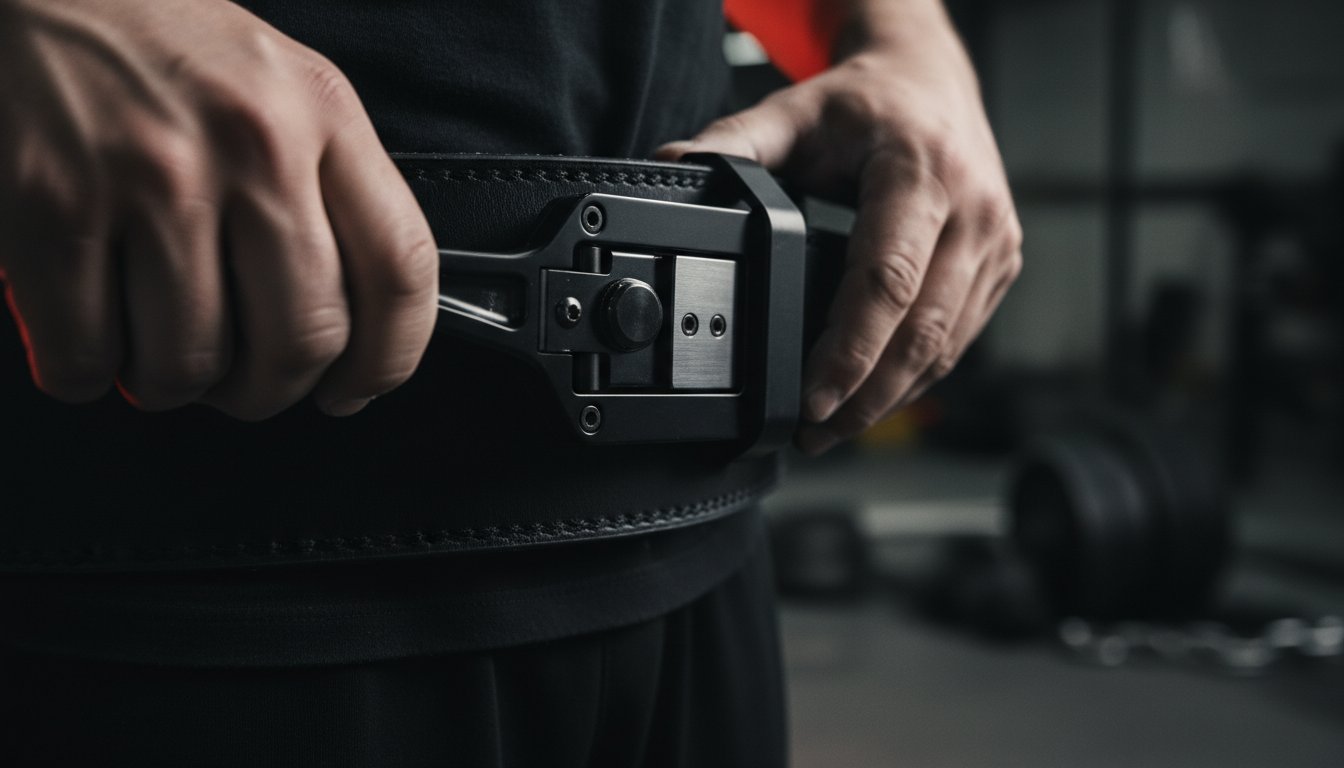
The most frustrating part of a heavy training block isn't the weight on the bar; it's the gear that fails to adapt to your body. You've likely experienced the "screwdriver struggle" when mid-workout bloating or a strict weight cut makes your belt fit poorly between sets. This is where the adjustable lever buckle becomes an essential tool for the serious powerlifter. Most athletes agree that a fixed lever is reliable until your waist measurement shifts by even 1cm, forcing an inconvenient halt to your session.
In this guide, you'll discover how to achieve a precision fit every time you step on the platform without carrying a toolbox in your gym bag. We'll show you how to transition between a tight squat setting and a looser deadlift fit in seconds. You'll also learn about the 2026 equipment standards to ensure your gear remains compliant with current IPF regulations. By looking at the professional-grade durability offered by Team Industry UK, you can find a solution that fits perfectly regardless of body weight. With the global strength training equipment market projected to reach $18.88 billion by 2031, choosing the right hardware is the most dependable way to support your heaviest lifts.
Key Takeaways
- Learn how sliding track mechanisms allow for tool-free micro-adjustments to your belt tension mid-session.
- Discover why an adjustable lever buckle maintains professional-grade security without the limitations of traditional fixed-hole designs.
- Follow our step-by-step guide to measuring your current 10mm or 13mm belt for guaranteed hardware compatibility.
- Improve your training efficiency by mastering fast transitions between tight squat settings and looser deadlift fits.
- Explore how Team Industry equipment provides the reliability and compliance required for both local gyms and sanctioned platforms.
What is an Adjustable Lever Buckle and Why is it Changing Powerlifting?
An adjustable lever buckle is a mechanical closure system for lifting belts that allows for tool-free micro-adjustments. It bridges the gap between the speed of a traditional lever and the versatility of a prong belt. The adjustable lever buckle is a high-tensile steel or zinc alloy mechanism designed for rapid tension shifts. By using an indexed sliding track, it allows you to change the belt's circumference without ever needing a screwdriver. This innovation is quickly becoming the standard for athletes who value both precision and efficiency during intense training blocks.
Traditional levers have long been the industry standard for heavy lifting, but they come with a significant design flaw. They rely on fixed screw holes. If your waist measurement changes by even a few millimetres due to hydration or daily physiological shifts, you're forced to stop your session and find a tool. This "fixed-hole" limitation disrupts training flow and forces lifters to carry extra hardware in their gym bags. The adjustable version eliminates this struggle, providing a seamless way to dial in your support while maintaining the rapid engagement lifters expect.
The Evolution from Prongs to Fixed Levers to Adjustable Systems
The primary purpose of a weightlifting belt is to increase intra-abdominal pressure, providing a rigid wall for your core to brace against. While prong belts allow for easy adjustments, they often lack the extreme tightness of a lever. Fixed levers solved the tension problem but ignored the reality of human physiology. They weren't built for the grit and reality of a long training block where a lifter's body is constantly changing.
The "bloat factor" is a practical challenge in any serious gym environment. Body weight fluctuations of just 1kg to 2kg can significantly alter how a belt sits during a squat or deadlift. An adjustable system solves this by allowing for engagement at different points on the buckle itself. If you're looking to upgrade your current setup, our selection of weight lifting belts at Team Industry UK is engineered to handle these precise demands. We believe your equipment should be a dependable partner, not a technical hurdle that slows down your progress.
Adjustable vs. Traditional Lever Buckles: A Mechanical Comparison
While traditional levers rely on a rigid two-bolt interface, the mechanics of an adjustable lever buckle involve a precision-machined rail system. This design allows the locking teeth to engage at multiple points along the buckle’s length. A common misconception is that these moving parts compromise the lever’s integrity under load. In reality, the high-density alloys used by Team Industry UK are tested to withstand forces far beyond a standard 400kg squat. You get the same "safe pair of hands" security as a fixed lever but with the added benefit of a custom fit that evolves with your session.
Transitions between sets take less than 3 seconds. This speed is vital when you're working through a high-intensity block and don't want to lose your mental focus. While the profile of an adjustable system is slightly deeper than a slim-line fixed lever, the extra 150 grams of material is a small trade-off for the ability to optimize trunk muscle activation through a perfect brace. When your belt tension is precise, your force transfer becomes more efficient, leading to more stable repetitions under heavy iron.
Micro-Adjustments: The Secret to Better Bracing
Precision is the difference between a successful lift and a missed attempt. Most traditional belts offer 1 inch hole spacing, which is often too coarse for a perfect brace. An adjustable system provides 0.5 inch micro-adjustments. This granularity is essential for specific lifts. Most lifters prefer a tighter fit for squats to maximize rigidity but need a slightly looser setting for deadlifts to allow for better abdominal expansion at the start of the pull.
Dialing in the correct tension also prevents the leather from riding up during heavy pulls. If a belt is even slightly loose, it can shift during the eccentric phase, causing a loss of stability. By using a 0.5 inch adjustment, you ensure the belt stays pinned against your lumbar. If you want to experience this level of stability, you can find a dependable lever belt within our professional range at Team Industry UK that supports these technical requirements.

Compatibility and Setup: Will it Fit Your Current Belt?
Before you invest in an adjustable lever buckle, you must verify the thickness of your current strap. Most professional powerlifting belts are either 10mm or 13mm thick. While 13mm belts provide maximum rigidity, they require a buckle with longer attachment pins to ensure a secure lock. According to 2026 IPF technical standards, your belt must not exceed 13mm in thickness or 10cm in width. If your gear falls within these specifications, an adjustable system is likely compatible. It's a straightforward upgrade that transforms a standard leather strap into a highly adaptable piece of equipment.
Hole spacing is the next critical factor. The industry standard for lever belts features two vertical holes spaced exactly 1 inch apart. This patented adjustable lever design is engineered to align with this universal pattern, making installation simple. To install your new buckle, follow these steps:
- Remove the two screws from your existing fixed lever.
- Align the backplate of the adjustable buckle with the existing holes in the leather.
- Thread the screws through the plate and into the buckle housing.
- Tighten until the plate is flush against the suede or leather.
This setup directly addresses the "bloat factor" that many lifters face. Traditional levers often fail when your body weight fluctuates by just 1% mid-workout. With an adjustable lever buckle, you don't need to disassemble your gear to find relief. You simply slide the mechanism to the next notch. This precision is especially useful when transitioning between a high-pressure squat and a deadlift, where you might require slightly more room to breathe. Check out our full range of weight lifting belts to find a system that supports your specific training goals.
Maintenance Tips for Heavy-Duty Buckles
Keeping your gear in top condition ensures it remains a dependable partner on the platform. Periodically clean the sliding track with a soft brush to prevent chalk and gym grit from jamming the mechanism. You should also inspect the spring tension and pivot pins every 3 to 4 months to ensure the locking action remains crisp. High-grade zinc alloy requires minimal maintenance but should be kept dry to avoid surface oxidation. If you train in a humid environment, a quick wipe with a dry cloth after your session is usually enough to maintain the finish.
Why the Team Industry Adjustable Buckle is a Professional Staple
The adjustable lever buckle from Team Industry isn't just a piece of hardware; it's a reflection of our core philosophy. We build gear for the grit and reality of the industrial gym environment. Our equipment must stand up to the daily abuse of heavy compound movements. While other brands might focus on aesthetic finishes, we prioritize the stability and reliability required for a successful training block. It's a reliable safe pair of hands for your spine. This buckle is a direct replacement for standard hardware, allowing for two holes of adjustment without ever repositioning the lever.
Our signature 13mm lever belt is the ideal partner for this mechanism. We understand that lifters face constant body weight fluctuations, especially during a 12-week competition prep. The "Team" philosophy means we design products that solve the practical problems we face ourselves. By choosing this system, you eliminate the need for mid-session tool adjustments. It's about efficiency. To ensure your grip matches your bracing, you should also pair your buckle with our liquid chalk for a complete competition-ready setup.
Maximising Your Investment with Strength Bundles
Efficiency and value are central to how we operate. Purchasing an adjustable lever buckle as part of one of our bundles offers the best value for serious athletes. These packages are curated to provide a seamless equipment experience, from joint support to core stability. We're committed to the growth of UK strength sports and actively support local federations. By investing in Team Industry gear, you're joining a community that values operational excellence and high compliance standards. Our twenty-four-seven availability and local expertise ensure that you have the support you need, whenever you hit the platform.
Dial In Your Precision Fit for the Platform
Precision on the platform is non-negotiable. You've seen how moving away from fixed-hole systems allows you to maintain optimal intra-abdominal pressure regardless of daily body weight changes. By switching to an adjustable lever buckle, you gain the ability to make 0.5-inch micro-adjustments in seconds. This flexibility ensures your belt stays secure during both high-volume squats and heavy deadlifts without the need for a screwdriver.
Our hardware is built for the grit of the UK strength community. It's currently used by competitive UK strongmen who require absolute reliability under extreme loads. The mechanism is fully compatible with all standard 10mm and 13mm belts, making it a seamless upgrade for your current kit. If you have questions about compatibility or setup, our team provides no-nonsense 24/7 customer support to keep your training on track.
Don't let a poorly fitting belt compromise your next personal best. Upgrade your bracing with the Team Industry Adjustable Lever Buckle and experience a more dependable lift. We look forward to seeing your progress on the platform.
Frequently Asked Questions
Do I need a screwdriver to adjust an adjustable lever buckle?
No, you don't need a screwdriver for daily adjustments once the unit is installed. The primary benefit of an adjustable lever buckle is the tool-free sliding mechanism. You only use a screwdriver for the initial setup to secure the backplate to your leather strap. After that, you can shift tension mid-workout by simply moving the lever along its internal track. It's designed to eliminate the inconvenience of carrying tools to the gym.
Will an adjustable lever buckle fit a 13mm powerlifting belt?
Yes, these buckles are specifically designed to fit both 10mm and 13mm powerlifting belts. Because 13mm belts are the maximum thickness allowed by most federations, high-quality buckles use longer attachment pins to ensure a flush, secure fit. Always check that your belt has standard 1-inch hole spacing before purchasing an upgrade. This ensures a seamless installation and maintains the structural integrity of your equipment during heavy squats.
Are adjustable lever buckles legal for IPF or USPA competitions?
Most adjustable lever buckles are legal for competition as long as they meet the federation's technical specifications. According to the 2026 IPF technical rules, belts must stay within the 13mm thickness and 10cm width limits. While the mechanism itself is permitted, always verify if a specific brand is on your federation's approved equipment list before stepping onto the platform. Using compliant gear is the most dependable way to ensure your lifts are counted.
How much adjustment range does a typical adjustable buckle provide?
A typical adjustable lever buckle provides an adjustment range that covers approximately two standard belt holes. This allows for about 1 to 2 inches of micro-adjustment without moving the actual hardware. This range is sufficient to handle daily body weight fluctuations or the different bracing requirements between a squat and a deadlift. It provides the precision needed for a perfect fit every session without compromising your training rhythm.
Is a zinc alloy buckle better than a stainless steel one for lifting?
Both materials are professional-grade, but forged zinc alloy is often preferred for its high strength-to-weight ratio and cost-effectiveness. High-tensile zinc alloy is engineered to withstand loads over 400kg, which is more than enough for competitive powerlifting. While stainless steel offers superior corrosion resistance, a well-maintained zinc buckle provides the same level of safety and reliability. It's a pragmatic choice for lifters who prioritize performance and durability in a standard gym environment.
Share:
Aerobics Apparel for Strength Athletes: The Ultimate Guide to Conditioning Gear
The Ultimate Guide to Choosing an Acid Wash Sleeveless Workout Vest for Strength Training