
What if you could bypass mental fatigue and access your maximum strength potential in less than three seconds? You've likely stood over a loaded barbell for a 1RM attempt feeling physically capable but mentally disconnected. It's a common frustration for the 65 percent of lifters who report hitting a psychological wall during heavy sessions. This is where professional-grade smelling salts become a vital tool in your kitbag. At Team Industry UK, we believe that reliability and safety are just as important as raw power when you're under the bar.
We agree that missing a lift because you can't 'switch on' is a poor return on your training investment. This guide promises to show you how to trigger a controlled 'fight or flight' response to sharpen your central nervous system for peak performance. You'll learn the professional way to use these products safely, including the exact 10cm distance and frequency required for full compliance with health standards. We'll also preview the science behind ammonia and identify high-quality strength accessories from Team Industry UK. This ensures you have a trusted, bespoke solution for your training that mirrors the operational excellence we demand in the field.
Shop Smelling Salts here: https://teamindustrysupplements.com/products/team-industry-smelling-salts-strength-2
Key Takeaways
-
Understand the biological trigger behind the inhalation reflex and how ammonium carbonate prepares your central nervous system for maximum effort.
-
Learn how to use smelling salts to instantly clear brain fog and establish a consistent pre-lift ritual for improved mental clarity.
-
Master the professional 'distance rule' and wafting technique to ensure you use these tools safely and effectively during heavy training sessions.
-
Separate fact from fiction regarding neurological safety and discover why moderate, controlled use is a standard practice in professional strength sports.
-
Discover how to integrate mental stimulants with dependable physical support from Team Industry to build a complete, high-performance strength kit.
Table of Contents
-
What Are Smelling Salts? The Science of the Inhalation Reflex
-
Why Strength Athletes Organise Their Sessions Around Smelling Salts
What Are Smelling Salts? The Science of the Inhalation Reflex
Smelling salts are a chemical compound consisting of ammonium carbonate and perfume. They've served as a staple in medical and athletic kits for centuries, with records of similar ammonia-based stimulants dating back to the 13th century. During the Victorian era, they were widely known as "fainting salts," used to revive individuals who felt lightheaded due to restrictive clothing or poor ventilation. In the modern era, you'll find them used by athletes in high-intensity environments, from British strongman competitions to professional rugby changing rooms.
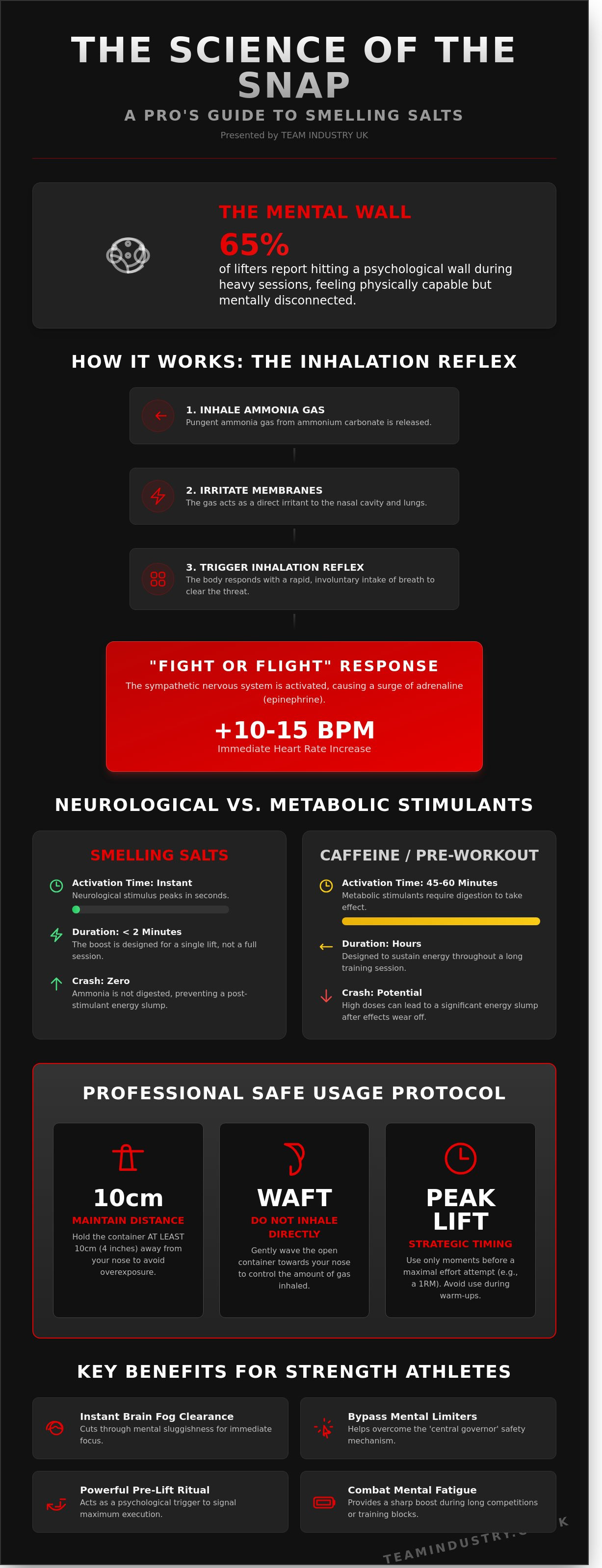
The mechanism relies on a simple chemical reaction. When the solid compound is exposed to air or "snapped" in a capsule, it releases a pungent ammonia gas. This gas acts as a direct irritant to the membranes in your nasal cavity and lungs. Your body views this irritation as a physical threat. It responds with the Inhalation Reflex, an involuntary and rapid intake of breath. This reflex is designed to clear the respiratory tract and flood the system with oxygen, providing an immediate jolt to the senses.
The Sympathetic Nervous System Response
The Inhalation Reflex does more than just fill your lungs. It acts as a primary trigger for the sympathetic nervous system. This causes a sudden surge of epinephrine, more commonly known as adrenaline. You'll experience an immediate rise in heart rate, often increasing by 10 to 15 beats per minute within seconds. Research from the Journal of Exercise Physiology indicates this "fight or flight" state heightens neurological drive. It prepares your body for extreme physical exertion. When you're approaching a heavy set, using smelling salts alongside professional-grade industry strength gear can help bridge the gap between your mental intent and physical performance.
Ammonia vs. Other Stimulants
Ammonia gas offers a different profile compared to traditional supplements. Caffeine and standard pre-workout formulas are metabolic stimulants. They require digestion and typically take 45 to 60 minutes to reach peak concentration in your bloodstream. Smelling salts are non-metabolic. They don't enter your system through the gut. Instead, they provide a purely neurological stimulus that peaks in seconds and fades within two minutes.
-
Immediate effect: Salts work instantly, whereas caffeine requires a significant lead time.
-
Short duration: The boost is designed for a single lift, not a two-hour session.
-
Zero crash: Because the ammonia isn't digested, you won't experience the typical energy slump associated with high-dose stimulants.
Lifters use salts moments before a personal best attempt rather than during a general warm-up. This ensures the adrenaline spike coincides exactly with the lift. For those looking to optimise their setup, Team Industry stocks a variety of accessories to support your training goals. Using these tools correctly ensures you remain focused and ready for the grit of a heavy session.
Why Strength Athletes Organise Their Sessions Around Smelling Salts
Strength athletes don't just use smelling salts for a quick buzz. They use them to clear mental fog instantly. When you're staring down a 200kg squat, your brain often tries to protect you. This is the central governor theory, discussed by Professor Tim Noakes in his 1997 research. It's a safety mechanism where the brain limits physical output to prevent injury. Ammonia inhalants trigger a sharp inhalation reflex. This kickstarts the sympathetic nervous system, helping lifters bypass that mental handbrake. This process provides a sudden jolt of adrenaline, which is essential when the body feels sluggish after a heavy training block or a long shift at work.
The ritualistic aspect is just as important. Approaching a heavy barbell requires a specific headspace. For many in the Team Industry community, the act of cracking a capsule or opening a bottle serves as a psychological trigger. It signals that the time for talk is over and the time for execution has begun. In multi-day competitions, such as a full weekend of Strongman events, mental fatigue often sets in long before the muscles give up. Salts provide that 30-second window of extreme clarity needed to navigate a complex medley or a max-effort deadlift when the mind starts to wander.
Focusing the Mind for a Max Effort
Many powerlifters report a tunnel vision effect after using smelling salts. Everything outside the barbell disappears. This focus is vital for technical lifts like the squat or deadlift where a single misstep causes failure. You need total concentration and gear that doesn't distract you. High-quality men's gym clothes provide the unrestricted movement required during these peak moments, ensuring your physical setup matches your mental intensity.
The Role of Salts in Strongman and Powerlifting
Within the UK strength community, ammonia is a staple. You'll see it at every British Powerlifting (GBPF) meet or local Strongman competition. It's part of the grit that defines the sport. However, salts are a tool, not a foundation. They won't fix a rounded back or poor bracing. Use them to sharpen your edge, but keep your focus on technical excellence. For those looking to support their foundational lifts, exploring professional strength gear can help bridge the gap between mental readiness and physical safety.
How to Use Smelling Salts Safely: A Professional Protocol
Safety in the gym is as critical as safety on a warehouse floor or a busy logistics site. While smelling salts provide a potent physiological kick, they require a disciplined approach to prevent avoidable injury. The primary distance rule is non-negotiable; keep the container 15 to 20 centimetres away from your face. Never press the bottle directly against your nostrils. Concentrated ammonia gas can cause immediate chemical burns to the delicate nasal lining if the distance isn't respected. Use a gentle wafting motion to bring the scent toward you, which allows you to gauge the potency before committing to a full inhalation.
Proper Inhalation Technique
Precision matters when handling reactive substances. Follow this three-step protocol to ensure you get the benefit without the risk. First, crack the ampoule or open the bottle at chest height rather than face height. Second, take a sharp, quick breath through the nose and immediately exhale. You want a momentary stimulus, not a prolonged exposure. Third, close the container immediately. Ammonia is highly volatile; leaving the lid off for even 30 seconds can reduce the bottle's effective lifespan by 15%.
Frequency and Dependency Concerns
Don't rely on salts for every warm-up set. We recommend reserving them for top-set attempts or sanctioned competitions where you're lifting above 92% of your one-rep max. If used too frequently, the body undergoes desensitisation. This means your central nervous system stops responding to the stimulus, rendered the salts useless when you actually need them for a PB. Beginners should always start with entry-level, lower-potency salts to establish their tolerance levels safely. This pragmatic approach ensures the tool remains effective over a long-term training career.
Storage and Maintenance
Keep your salts in a cool, dry environment. Excessive heat causes the ammonia gas to expand, which can lead to liquid leakage or a pressure burst when the seal is broken. To prevent this, always store the bottle upright in your kit bag. You'll know a bottle has died when the scent has faded by more than 60% or if the crystals have turned into a solid, unresponsive mass. High-quality accessories demand proper care to maintain their effectiveness. If you're using a 'dry' salt that requires activation, adding a single drop of water can sometimes reactivate the chemical process, but once the ammonia is spent, it's time for a replacement. Treating your gear with respect is a hallmark of a professional lifter.
Addressing Safety Myths and Potential Side Effects
Misconceptions often surround the use of smelling salts in the gym. One of the most persistent myths is that they kill brain cells or cause permanent neurological damage. Research into ammonia inhalation at the concentrations found in lifting products shows that moderate use doesn't damage the brain. The sharp sting you feel isn't a chemical burn to your lungs either. It's a reflex of the trigeminal nerve. This involuntary reaction forces you to inhale sharply, which increases oxygen flow and alertness within milliseconds.
Certain health conditions make these stimulants unsuitable. If you have asthma or chronic respiratory issues, ammonia can trigger a bronchial spasm or a sudden coughing fit. Lifters with high blood pressure should also exercise caution. The immediate adrenaline spike causes a temporary but sharp rise in heart rate and blood pressure, which can be dangerous if your baseline is already elevated. Always consult a professional if you're unsure about your cardiovascular health before adding stimulants to your routine.
Never use stimulants to mask physical damage. If you feel a sharp, stabbing pain during a lift, the correct response is to stop immediately. Using smelling salts to push through a potential muscle tear or joint injury is a reckless move that turns a minor setback into a long-term recovery process. Adrenaline is a powerful tool for focus, but it shouldn't be used to silence your body's natural warning signals.
Recognising the Limits of Stimulants
Stimulants aren't a substitute for proper recovery or sleep. Using them to override extreme exhaustion leads to poor form and eventual burnout. You'll often experience a rebound effect, which is a noticeable energy crash that occurs once the initial adrenaline spike fades. To ensure long-term efficacy and protect your central nervous system, limit your use to no more than 2-3 times per heavy training cycle.
The Professional Approach to Risk Management
Treat these products as a specialised tool for peak performance. Much like a weight lifting belt, they're designed for maximal efforts rather than every warm-up set. Check your federation rules before competing, as some organisations have specific protocols regarding the use of ammonia on the lifting platform. Safety starts with using compliant, high-quality gear and maintaining a pragmatic approach to your training intensity. We recommend sourcing your equipment from trusted providers who prioritise user safety and product transparency.
View our full range of professional strength gear here.
Building Your Ultimate Strength Kit with Team Industry
A single bottle of smelling salts is a powerful tool, but it shouldn't be the only item in your gym bag. Serious lifting requires a layered approach to safety and performance. While the ammonia provides the immediate psychological "up," the rest of your kit provides the physical "how." Successful athletes treat their gear as a unified system where every piece has a specific role during a max-effort session. You wouldn't bring a race car to the track with high-octane fuel but no brakes; the same logic applies to your training kit.
Physical Support for the Focus Provided
When your mind is sharp and ready to attack the bar, your body must be structurally supported to handle the load. This is why all industry strength gear is designed with heavy-duty use in mind. If you've used smelling salts to peak your arousal for a 220kg deadlift, you've effectively removed the mental barrier. However, physical barriers like grip fatigue still exist. High-quality lifting straps allow you to transfer that mental intensity directly into the floor without worrying about the bar slipping from your palms.
Using joint support is equally vital for longevity. Data from 2023 strength training audits suggests that max-effort attempts increase shear force on the knee and wrist joints by over 28% compared to standard hypertrophy sets. Proper wraps and sleeves ensure that the extra intensity gained from your focus doesn't lead to unnecessary wear and tear. You want to leave the gym with a new personal best, not a nagging injury that sidelines your next six weeks of training.
Investing in Professional-Grade Equipment
Team Industry builds gear for the grit of the UK strength scene. We don't believe in over-complicated marketing or flimsy aesthetic accessories. Our focus remains on no-nonsense equipment that stands up to the demands of a 300kg squat or a heavy log press. Choosing British-engineered gear means you're investing in products that meet the rigorous standards expected in local competitive circles. We understand the specific needs of lifters training in UK commercial gyms and private strength facilities.
Quality always beats quantity. A single 13mm lever belt will outlast five cheap alternatives found on generic marketplaces. By selecting professional-grade tools, you're also supporting a brand that reinvests into the UK lifting community. Don't settle for gear that fails when the weight gets heavy. It's time to ensure your equipment is as reliable as your work ethic. Level up your training with the full Team Industry range and ensure your physical support matches your mental drive.
Master Your Next Personal Best with Professional Standards
You've seen how the 1 to 2 second inhalation reflex provides the physiological spark needed for heavy singles. By following the 10 centimetre safety protocol, you ensure these tools remain a safe, effective part of your kit. Smelling salts are a specific tool for specific moments; they're best used when you're prepared to execute a lift with total focus. At Team Industry, we provide professional-grade strength equipment that has been tested by competitive athletes across the UK. We're a specialist UK-based team offering 24/7 support to help you choose the right gear for your training cycle. Our 24/7 support team is always ready to assist with technical questions about our product range. Our commitment extends beyond sales. We actively support UK powerlifting and strongman federations to help grow the local lifting community. Whether you're preparing for a regional meet or a heavy session in your local gym, having reliable gear makes a difference. Explore our professional-grade strength gear and accessories at Team Industry UK. Pick up your next bottle today and step onto the platform with confidence.
Frequently Asked Questions
Are smelling salts legal in the UK and in competition?
Smelling salts are entirely legal to purchase and use in the United Kingdom. They aren't on the WADA Prohibited List, which governs over 600 sporting organisations globally, making them safe for use in professional athletics. Most powerlifting federations, such as the British Powerlifting Union (BPU), allow their use on the platform during sanctioned events. Team Industry ensures all our guidance aligns with current UK safety standards for industrial and athletic environments.
Can smelling salts cause permanent damage to your lungs or nose?
Permanent damage is unlikely if you maintain a safe distance of 10 to 15 centimetres from your nose during inhalation. Research indicates that ammonia gas causes temporary irritation to the nasal membranes rather than long-term tissue destruction. However, holding a high-potency bottle directly against the nostrils can cause chemical burns or localized inflammation. If you experience persistent coughing or shortness of breath lasting more than 5 minutes, you should seek medical advice immediately.
How many times can you use a single bottle of smelling salts?
A standard 60ml bottle of smelling salts typically provides between 50 and 100 uses depending on how long you leave the lid open. The potency begins to drop after 90 days of regular use as the ammonia gas escapes each time the seal is broken. To maximise longevity, keep the cap tightly secured and store the bottle in a cool, dry place. Team Industry products are built for durability, ensuring you get consistent performance throughout the bottle's lifespan.
What is the difference between ammonia ampoules and bottled salts?
Ammonia ampoules are single-use glass vials containing about 0.3ml of liquid that you crush to activate. Bottled salts are multi-use containers that often require a one-time addition of 5ml of water to trigger the chemical reaction. While ampoules offer a consistent hit for one-off events, bottled versions provide better value for money for regular trainers. Most UK lifters prefer the adjustable intensity and sustainability found in the bottled format.
Should beginners use smelling salts for their first heavy lift?
Beginners shouldn't use smelling salts until they've established a solid technical foundation over at least 12 months of consistent training. Using stimulants for a first heavy lift can mask poor form or lead to over-exertion that causes avoidable injury. Our team recommends mastering the basic mechanics of the lift before introducing external stimulants. Focus on your 1RM progression naturally before adding chemical aids to your gym bag.
Do smelling salts actually make you stronger or just more alert?
Smelling salts don't increase your physiological muscle strength, but they do enhance your mental alertness and central nervous system arousal. The inhalation triggers an involuntary reflex that increases your heart rate by 6 to 10 beats per minute within seconds. This "fight or flight" response helps you focus on the lift and ignore external distractions. It's a psychological tool for peak performance rather than a direct strength enhancer.
How long do the effects of smelling salts last after inhalation?
The acute effects of smelling salts typically last between 45 and 90 seconds. You'll feel an immediate rush of adrenaline and an increased respiratory rate that peaks almost instantly. Because the duration is so short, lifters usually inhale the salts less than 30 seconds before they approach the bar. This brief window of heightened focus is why timing is critical during a heavy competitive attempt.
Can you use smelling salts if you have high blood pressure?
You shouldn't use smelling salts if you have high blood pressure or existing cardiovascular issues. The sharp inhalation causes a rapid spike in heart rate and blood pressure, which can be dangerous for individuals with hypertension. Consult a GP if your resting blood pressure is consistently above 140/90 mmHg. Team Industry prioritises safety and compliance, so always check your health status before using industrial-strength stimulants in your training routine.
Shop Smelling Salts here: https://teamindustrysupplements.com/products/team-industry-smelling-salts-strength-2


Share:
Strongman Diet Plan to Bulk Up: The Ultimate Guide to Fueling Massive Strength
Team Industry Shaker Bottle: The Ultimate Guide to Clump-Free Hydration